
Robohub.org
A GPS for inside your body
By Adam Conner-Simons | Rachel Gordon
Investigating inside the human body often requires cutting open a patient or swalloing long tubes with built-in cameras. But what if physicians could get a better glimpse in a less expensive, invasive, and time-consuming manner?
A team from MIT’s Computer Science and Artificial Intelligence Laboratory (CSAIL) led by Professor Dina Katabi is working on doing exactly that with an “in-body GPS” system dubbed ReMix. The new method can pinpoint the location of ingestible implants inside the body using low-power wireless signals. These implants could be used as tiny tracking devices on shifting tumors to help monitor their slight movements.
In animal tests, the team demonstrated that they can track the implants with centimeter-level accuracy. The team says that, one day, similar implants could be used to deliver drugs to specific regions in the body.
ReMix was developed in collaboration with researchers from Massachusetts General Hospital (MGH). The team describes the system in a paper that’s being presented at this week’s Association for Computing Machinery’s Special Interest Group on Data Communications (SIGCOMM) conference in Budapest, Hungary.
Tracking inside the body
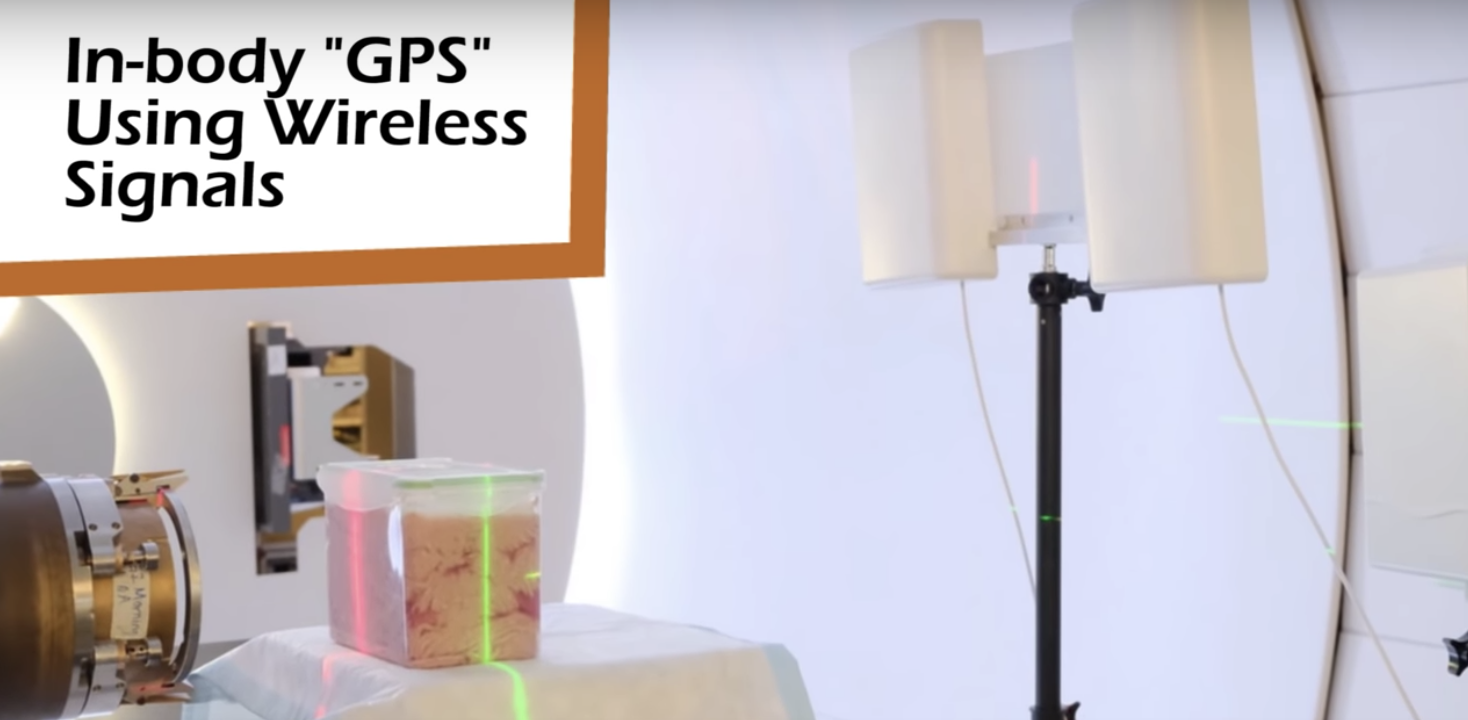
To test ReMix, Katabi’s group first implanted a small marker in animal tissues. To track its movement, the researchers used a wireless device that reflects radio signals off the patient. This was based on a wireless technology that the researchers previously demonstrated to detect heart rate, breathing, and movement. A special algorithm then uses that signal to pinpoint the exact location of the marker.
Interestingly, the marker inside the body does not need to transmit any wireless signal. It simply reflects the signal transmitted by the wireless device outside the body. Therefore, it doesn’t need a battery or any other external source of energy.
A key challenge in using wireless signals in this way is the many competing reflections that bounce off a person’s body. In fact, the signals that reflect off a person’s skin are actually 100 million times more powerful than the signals of the metal marker itself.
To overcome this, the team designed an approach that essentially separates the interfering skin signals from the ones they’re trying to measure. They did this using a small semiconductor device, called a “diode,” that mixes signals together so the team can then filter out the skin-related signals. For example, if the skin reflects at frequencies of F1 and F2, the diode creates new combinations of those frequencies, such as F1-F2 and F1+F2. When all of the signals reflect back to the system, the system only picks up the combined frequencies, filtering out the original frequencies that came from the patient’s skin.
One potential application for ReMix is in proton therapy, a type of cancer treatment that involves bombarding tumors with beams of magnet-controlled protons. The approach allows doctors to prescribe higher doses of radiation, but requires a very high degree of precision, which means that it’s usually limited to only certain cancers.
Its success hinges on something that’s actually quite unreliable: a tumor staying exactly where it is during the radiation process. If a tumor moves, then healthy areas could be exposed to the radiation. But with a small marker like ReMix’s, doctors could better determine the location of a tumor in real-time and either pause the treatment or steer the beam into the right position. (To be clear, ReMix is not yet accurate enough to be used in clinical settings. Katabi says a margin of error closer to a couple of millimeters would be necessary for actual implementation.)
“The ability to continuously sense inside the human body has largely been a distant dream,” says Romit Roy Choudhury, a professor of electrical engineering and computer science at the University of Illinois, who was not involved in the research. “One of the roadblocks has been wireless communication to a device and its continuous localization. ReMix makes a leap in this direction by showing that the wireless component of implantable devices may no longer be the bottleneck.”
Looking ahead
There are still many ongoing challenges for improving ReMix. The team next hopes to combine the wireless data with medical data, such as that from magnetic resonance imaging (MRI) scans, to further improve the system’s accuracy. In addition, the team will continue to reassess the algorithm and the various tradeoffs needed to account for the complexity of different bodies.
“We want a model that’s technically feasible, while still complex enough to accurately represent the human body,” says MIT PhD student Deepak Vasisht, lead author on the new paper. “If we want to use this technology on actual cancer patients one day, it will have to come from better modeling a person’s physical structure.”
The researchers say that such systems could help enable more widespread adoption of proton therapy centers. Today, there are only about 100 centers globally.
“One reason that [proton therapy] is so expensive is because of the cost of installing the hardware,” Vasisht says. “If these systems can encourage more applications of the technology, there will be more demand, which will mean more therapy centers, and lower prices for patients.”
Katabi and Vasisht co-wrote the paper with MIT PhD student Guo Zhang, University of Waterloo professor Omid Abari, MGH physicist Hsaio-Ming Lu, and MGH technical director Jacob Flanz.

AUAI is supported by:









