Robohub.org
ep.

309

podcast
 

Learning to Grasp with Jeannette Bohg


by
11 May 2020


share this:


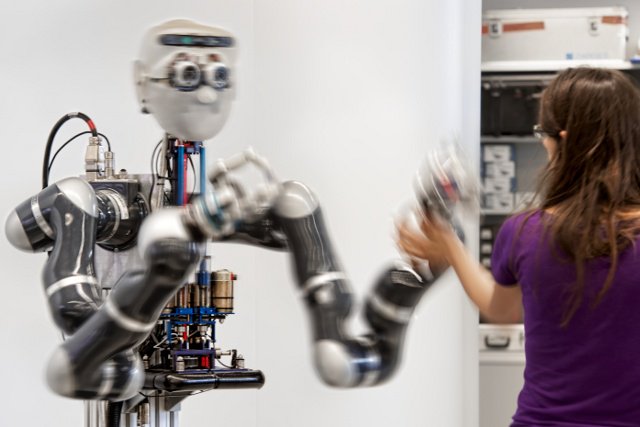
In this episode, Lilly Clark interviews Jeannette Bohg, Assistant Professor at Stanford, about her work in interactive perception and robot learning for grasping and manipulation tasks. Bohg discusses how robots and humans are different, the challenge of high dimensional data, and unsolved problems including continuous learning and decentralized manipulation.

Jeannette Bohg is an Assistant Professor of Computer Science at Stanford University. She was a group leader at MPI until September 2017 and remains affiliated as a guest researcher. Her research focuses on perception for autonomous robotic manipulation and grasping. She is specifically interested in developing methods that are goal-directed, real-time and multi-modal such that they can provide meaningful feedback for execution and learning.

Before joining the Autonomous Motion lab in January 2012, Jeannette Bohg was a PhD student at the Computer Vision and Active Perception lab (CVAP) at KTH in Stockholm. Her thesis on Multi-modal scene understanding for Robotic Grasping was performed under the supervision of Prof. Danica Kragic. She studied at Chalmers in Gothenburg and at the Technical University in Dresden where she received her Masters in Art and Technology and her Diploma in Computer Science, respectively.

Links


tags: , ,


Lilly Clark

            AUAI is supported by:


Subscribe to Robohub newsletter on substack


Related posts :

A ‘5-in-1’ seed-sized surgical robot

Mini robot can move, cut tissue, release drugs, grip and store samples, and generate heat wirelessly

AI agents create virtual playgrounds to help robots get crucial training data

  07 Aug 2026
“SceneSmith” system uses collaborative AI agents to create realistic 3D environments of places like kitchens, hotels, and living rooms, where robots can simulate everyday chores.

Robots in society, business and culture: July 2026

A round up of robotics stories in a new monthly series from IEEE RAS.

Simulated zebrafish and a vision-equipped robotic fish reveal how the body shapes brain circuits

Researchers look to the fish brain to create a robotic zebrafish that can autonomously swim upstream.

Researchers develop modular nanorobot

  31 Jul 2026
A team at the University of Basel has developed a versatile nanorobot with propulsion and payload modules.

Surviving the paper deluge: a one-year study in learning from demonstration

With the explosion of robotics research, staying current in fields like Learning from Demonstration is a monumental challenge.

Soft robotic heart offers new way to study disease and test life-saving devices

Researchers have developed a soft robotic model of the human heart that can mimic disease and provide a realistic environment for testing the next generation of cardiac devices.

A mini robot to simplify dental treatment

  24 Jul 2026
Researchers have developed a miniature dental robot that could one day automatically prepare teeth for crowns.


AUAI is supported by:


Subscribe to Robohub newsletter on substack


©2026.05 - Association for the Understanding of Artificial Intelligence