Robohub.org
054
Modeling biology with Barbara Webb and Steffen Wischmann
In today’s episode we speak about modeling biology using robots and how lessons learned through this process can feedback into robotics. Our first guest, Barbara Webb, is a world renowned expert in the field with several seminal papers on the subject such as “Using robots to understand animal behavior.” This interview follows up on her previous interview with Talking Robots. Our second guest, Steffen Wischmann, from the EPFL and University of Lausanne gives us his in-depth overview of the cross-fertilization between biology and robotics and tells us about his interest in artificial evolution.
Barbara Webb
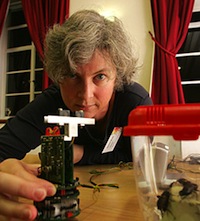 Barbara Webb is director of the Insect Robotics Group at the Institute of Perception, Action and Behaviour at the University of Edinburgh.
Her group researches and models the sensorimotor capabilities of insects ranging from simple reflexive behaviours such as the phonotaxis of crickets, to more complex capabilities such as multimodal integration, navigation and learning.
While her group carries out behavioural experiments on insects, they principally work on computational models of the underlying neural mechanisms, which are often embedded on robot hardware. We’ll be talking to her about insect inspired robotics as a control system design approach.
Steffen Wischmann
 Steffen Wischmann is a Postdoctoral researcher based at the Laboratory of Intelligent Systems at the EPFL and at the Department of Ecology and Evolution at the University of Lausanne. His current research investigates the evolution and the neural mechanisms of cooperation and communication in biological systems using robotic models. After years of reading about the close interaction between robotics and biology, he gives us his opinion on when robotic models are interesting for biology, to what depth the models should replicate biology and the use of artificial evolution.
Links:
- Download mp3 (16 MB)
- Subscribe to Robots using iTunes
- Subscribe to Robots using RSS
- Barbara Webb’s Website
- Steffen Wischmann’s Homepage
Latest News:
For more information and a video on the Ballbot as well as this year’s robot novelties at the Automatica trade fair, visit the Robots Forum!
tags: bio-inspired, podcast