
Robohub.org
New Master of Advanced Studies (MAS) in architecture and digital fabrication at ETHZ
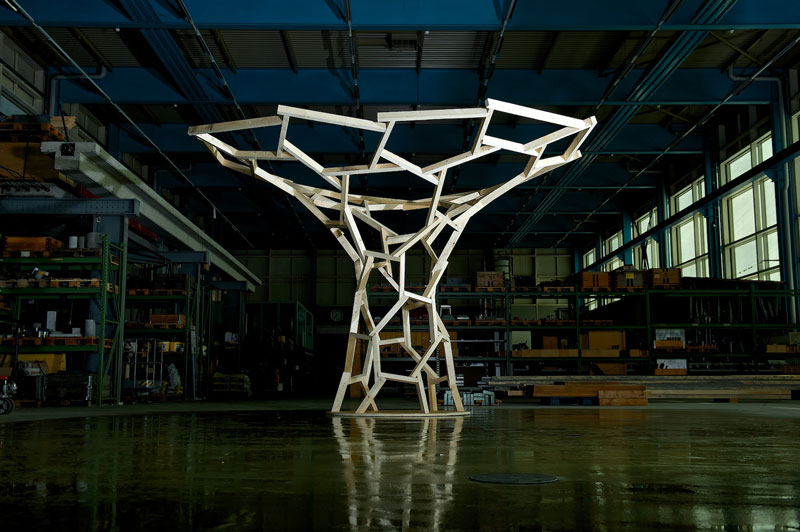
Photo credit: Gramazio Kohler Research, ETH Zurich.
In September a new Master of Advanced Studies (MAS) ETH in Architecture and Digital Fabrication will be offered by the Gramazio Kohler Research chair at ETH Zurich. This one-year, full-time program focuses on digital design and full-scale fabrication using state-of-the-art robotic fabrication facilities at ETH. The MAS is embedded within the National Centre of Competence in Research (NCCR) Digital Fabrication, itself an ambitious research initiative at the intersection of architecture, engineering, robotics, material and computer sciences. Interested candidates are invited to apply until April 30, 2015.
The term “digital fabrication” refers to the seamless combination of digital planning with the physical fabrication process. The project data is sent to a machine, and directly implemented in reality. However, this exchange of information could also work in the other direction: the physical conditions could immediately influence the computer-aided designs.
For architecture, this opens up possibilities that were previously undreamt of, and which go far beyond purely design-related aspects. New construction systems, material systems, resource-saving production, efficient-yet-flexible engineering and construction processes, and a transition from mass production to customised industrial production all promise a decisive developmental step towards a sustainable building culture for the future.
Unlike objects produced by conventional computer-controlled production, architectural objects are typically larger than the actual production facility, they are always unique, and they are usually produced on site. As a result, research on this topic is confronted with completely new questions: How can the automated industrial robot in the factory hall become a reactive robot for the building site? What intelligent material systems and construction systems are suited to a robot-based additive (and thus waste-free) building technique? And what do the new planning and building processes mean for the future interaction between humans and machines?
The practicability (and thus the success) of digital construction will depend not only on research, but also, to a great extent, on experts who can ensure the transfer of knowledge into practice. This is why the NCCR Digital Fabrication, in conjunction with ETH Zurich, is launching the new Master of Advanced Studies (MAS) in Architecture and Digital Fabrication next autumn. As the education platform of the NCCR, this programme is embedded in the context of the latest research findings. In the NCCR’s unique robotic fabrication facilities, the students will also have the opportunity to research digital design and construction processes, and to implement these directly in large-scale prototypes.
More info: http://www.dfab.ch/education/mas/
If you liked this article, you may also be interested in:
- Swiss to invest almost CHF30 million in digital fabrication research over next 4 years
- Robots Podcast: Future cities
- Three new quadrotor videos demonstrate agile control and the power of machine learning
See all the latest robotics news on Robohub, or sign up for our weekly newsletter.
tags: digital fabrication, ETH Zurich, Gramazio & Kohler, industrial, NCCR, research, Switzerland

AUAI is supported by:









