Robohub.org
ep.

178

podcast
 

Speech-Based Emotion Recognition with Christina Brester


by
20 March 2015


share this:


emotion_robots2

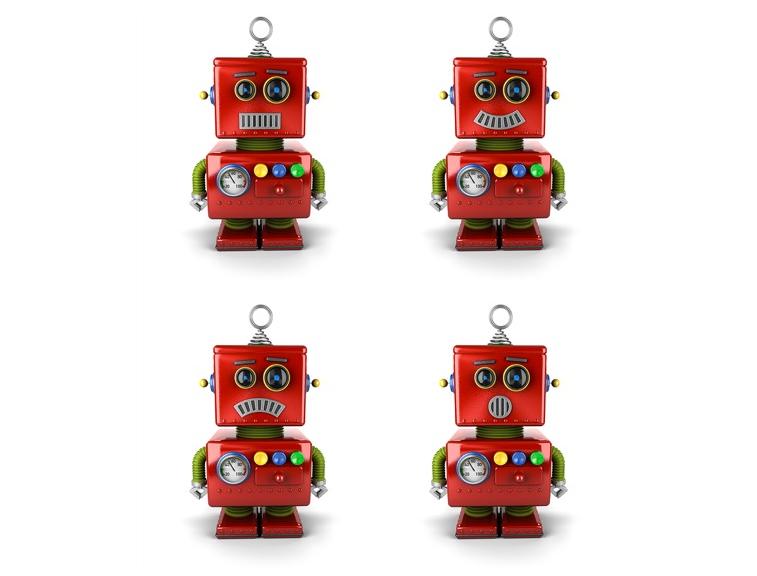
In this episode, Audrow Nash interviews Christina Brester, from the Siberian State Aerospace University, about her research on a method to identify emotional state from speech. This method performs speech analysis with a self-adaptive, multi-objective, genetic algorithm for feature selection and uses a neural network to classify those features. In this interview, we’ll discuss exactly what that means, as well as the implications and future of this research.


Christina Brester

SONY DSC

Christina Brester completed her bachelor’s (2012) and master’s degree (2014) at the Siberian State Aerospace University (SibSAU) in Krasnoyarsk, Russia. Her master’s thesis was on Speech-based Emotion Recognition.

Currently, Brester is a PhD student in Computer Science and Engineering at SibSAU. Her research interests include evolutionary computation, neuro-evolutionary algorithms, machine learning, and speech analysis.


Links:


tags: , , , , , , , ,


Audrow Nash is a Software Engineer at Open Robotics and the host of the Sense Think Act Podcast

            AUAI is supported by:


Subscribe to Robohub newsletter on substack


Related posts :

What does it take for a robot to hold a conversation with a room, not just a person?

and   14 Aug 2026
Find out about a summer school held at Imperial College London.

Robotics roadmaps from around the world

We embark on a tour into some of the recent and prominent robotics roadmaps from around the world.

A ‘5-in-1’ seed-sized surgical robot

Mini robot can move, cut tissue, release drugs, grip and store samples, and generate heat wirelessly

AI agents create virtual playgrounds to help robots get crucial training data

  07 Aug 2026
“SceneSmith” system uses collaborative AI agents to create realistic 3D environments of places like kitchens, hotels, and living rooms, where robots can simulate everyday chores.

Robots in society, business and culture: July 2026

A round up of robotics stories in a new monthly series from IEEE RAS.

Simulated zebrafish and a vision-equipped robotic fish reveal how the body shapes brain circuits

Researchers look to the fish brain to create a robotic zebrafish that can autonomously swim upstream.

Researchers develop modular nanorobot

  31 Jul 2026
A team at the University of Basel has developed a versatile nanorobot with propulsion and payload modules.

Surviving the paper deluge: a one-year study in learning from demonstration

With the explosion of robotics research, staying current in fields like Learning from Demonstration is a monumental challenge.


AUAI is supported by:


Subscribe to Robohub newsletter on substack


©2026.05 - Association for the Understanding of Artificial Intelligence