Robohub.org
 

The Year of CoCoRo Video #40/52: Adaptive layers water column

by
06 October 2015


share this:
Cocoro40

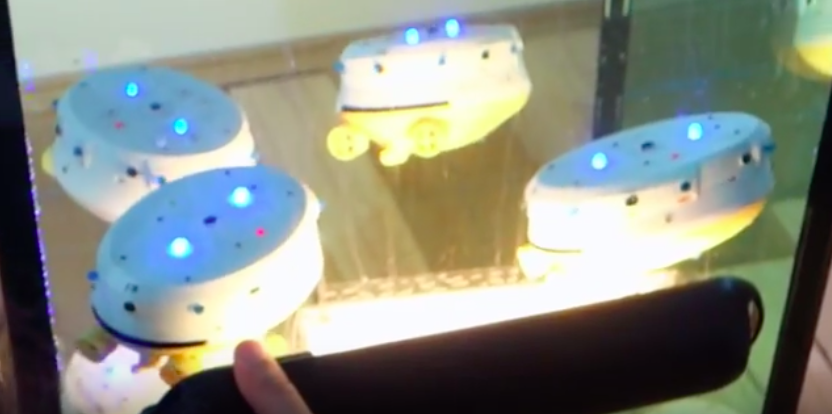
The EU-funded Collective Cognitive Robotics (CoCoRo) project has built a swarm of 41 autonomous underwater vehicles (AVs) that show collective cognition. Throughout 2015 – The Year of CooRo – we’ll be uploading a new weekly video detailing the latest stage in its development. This week’s video shows the mechanisms used in the “social inhibition algorithm” in more detail and our experiments with swarms of robots in a vertical aquarium. 

Last week we introduced the “social inhibition algorithm” we developed for our CoCoRo robot swarm. This is an algorithm for regulating division of labour, inspired by the self-organized regulation of physiological age in honeybee colonies.

The week the robots regulate an internal variable, X, by interacting with other robots, and split the swarm into three cohorts, allocating themselves to different depths in the aquarium. We added and removed robots. Their regulation of the internal variable leads to an automatic rearrangement of the swarm, so that there are always an equal number of robots at each depth.

We also added sources of interest: special robots or external lights, at different depth layers, and the swarm rearranges in a way that more robots are attracted to particularly interesting depths.

The algorithm shown here is promising due to its ability to automatically rearrange the robots to meet different demands, based only on local interactions. This makes it attractive for large scale applications where several sub-groups of the swarm need to act at different depth levels performing different tasks.


tags: , , , , ,


Thomas Schmickl is an Associate Professor at Karl-Franzens University, Graz, Austria, and a lecturer at the University for Applied Sciences in St. Pölten, Austria.


Subscribe to Robohub newsletter on substack


Related posts :

Translating music into light and motion with robots

  25 Feb 2026
Robots the size of a soccer ball create new visual art by trailing light that represents the “emotional essence” of music

Robot Talk Episode 145 – Robotics and automation in manufacturing, with Agata Suwala

  20 Feb 2026
In the latest episode of the Robot Talk podcast, Claire chatted to Agata Suwala from the Manufacturing Technology Centre about leveraging robotics to make manufacturing systems more sustainable.

Reversible, detachable robotic hand redefines dexterity

  19 Feb 2026
A robotic hand developed at EPFL has dual-thumbed, reversible-palm design that can detach from its robotic ‘arm’ to reach and grasp multiple objects.

“Robot, make me a chair”

  17 Feb 2026
An AI-driven system lets users design and build simple, multicomponent objects by describing them with words.

Robot Talk Episode 144 – Robot trust in humans, with Samuele Vinanzi

  13 Feb 2026
In the latest episode of the Robot Talk podcast, Claire chatted to Samuele Vinanzi from Sheffield Hallam University about how robots can tell whether to trust or distrust people.

How can robots acquire skills through interactions with the physical world? An interview with Jiaheng Hu

and   12 Feb 2026
Find out more about work published at the Conference on Robot Learning (CoRL).

Sven Koenig wins the 2026 ACM/SIGAI Autonomous Agents Research Award

  10 Feb 2026
Sven honoured for his work on AI planning and search.

Robot Talk Episode 143 – Robots for children, with Elmira Yadollahi

  06 Feb 2026
In the latest episode of the Robot Talk podcast, Claire chatted to Elmira Yadollahi from Lancaster University about how children interact with and relate to robots.


Robohub is supported by:


Subscribe to Robohub newsletter on substack


©2026.02 - Association for the Understanding of Artificial Intelligence