
Robohub.org
American nuclear materials storage site guarded by robots
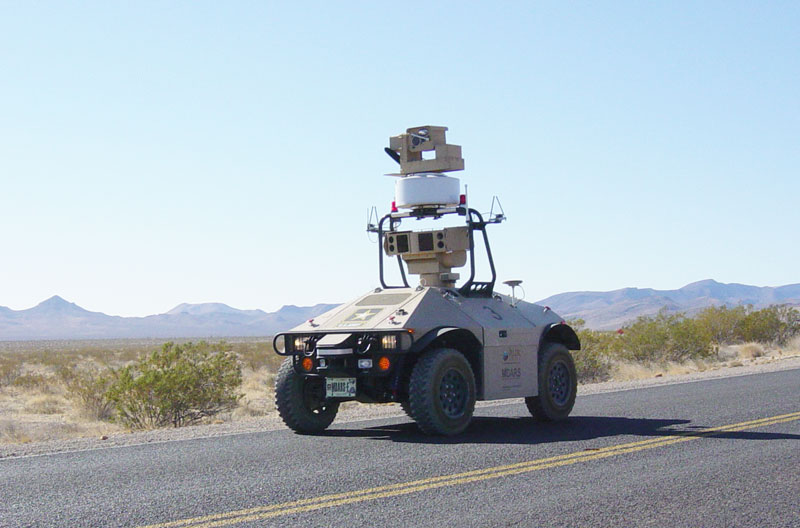
Since 2011, a Nevada nuclear materials storage site has been guarded by robots (Mobile Detection, Assessment and Response System). Last week the US Marines announced that their airbase in Twentynine Palms will also be guarded by the same type of robots.
Security robots are becoming more prevalent for both governmental and corporate clients not only to lower costs but to improve surveillance and security options. General Dynamics MDARS, the robots used in Nevada and by the Marines, have been around since 2005. These devices autonomously surveil and check for intruders, investigate alarm sources, monitor high-value inventory and assess barriers, such as the doors of storage bunkers. MDARS are diesel-powered, 4-wheel hydrostatic-drive vehicles, with a payload capacity of 500 lbs. Each vehicle is equipped with a real-time obstacle avoidance system and 360-degree sensors. It can operate for 16 hours without refueling and at speeds up to 20 miles per hour.

Israeli G-nius has a whole line of remotely piloted border-patrolling devices as does Samsun Techwin in South Korea and both are being used in their respective countries.
Less lethal, newer sleeker devices are coming to the commercial marketplace. Gamma 2 Robotics and their Vigilant Robots has been winning awards for their museum, parking garage and warehouse guards – all of which are still being beta tested.

Silicon Valley Knightscope has partnerships with insurers, police and large campus organizations, and others for their stylish patrolling robots.
Turnover for private security firms is often more than 400% which is worse than the fast food industry – and there are about 1.3 million security guards in the US and 20 million globally, hence the need for this type of robot. Many of these patrol positions are ideal for mobile robotic devices such as those offered by Vigilant and Knightscope. Schools, shopping malls, data centers, museums, parking lots, warehouses, parks and stadiums are all ideal locations for these types of robots. Defense contractors, as they feel the bite of reduced military budgets will soon be redesigning their MDARS-like military devices for the commercial marketplace and offer competition, as will mobile robot makers Adept, iRobot and KUKA – but right now Knightscope and Vigilant are the closest to market. [Adept Technologies had a security mobile robot but dropped it from their line to focus on their primary business.]
In the consumer sector, there have been many tries and all have either failed or moved on to more lucrative fields. Romotive is a case in point. It was first offered as a home security device but found few takers. Most of the interest for their very successful Romo bot was (and is) as a kids toy.
WowWee’s Rovio was a big hit when it was launched but hasn’t done anything since and is no longer promoted by WowWee.

One unique start-up from St. Petersburg, Russia, xTurion, may have found the right niche for home, second home and service space monitoring using a mobile security bot and some very capable software. The device can be equipped with smoke, heat and leak sensors, gas analyzers, and be remotely controlled to check out an alarm. xTurion is supported by iDealMachine, an accellerator associated with University ITMO in St. Petersburg, and also by the Skolkovo where xTurion is a participant in their Skolkovo IT Cluster. At present they are working to get the price down to under $1,000, build 100 beta test devices, and enter the marketplace late this year.
tags: military

AUAI is supported by:









