Robohub.org
 

Video: Autonomous robot surgery on deformable tissue phantoms

by , and
13 November 2014


share this:
Goldberg_debridement-high-res

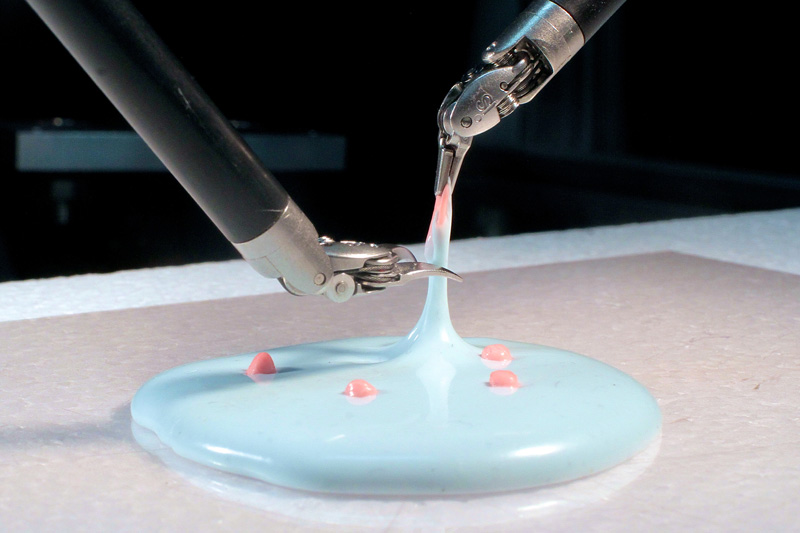
Automating repetitive surgical subtasks such as cutting and debridement can facilitate supervised tele-surgery, and reduce surgeon fatigue and procedure times. Programming these tasks can be difficult, however, in part because human tissue is deformable. Using the da Vinci Research Kit (DVRK) robotic surgical assistant, we explore a “Learning By Observation” (LBO) approach where we identify, segment, and parameterize sub-trajectories (“surgemes”) and sensor conditions to build a finite state machine (FSM) for each subtask. The robot then executes the FSM repeatedly in order to tune parameters and update the FSM structure.

A video from UC Berkeley’s new Center for Automation and Learning for Medical Robotics (Cal-MR) demonstrates how the approach can be used to automate two surgical subtasks: debridement of 3D Viscoelastic Tissue Phantoms (3d-DVTP), in which small target fragments are removed from a 3D viscoelastic tissue phantom, and Pattern Cutting of 2D Orthotropic Tissue Phantoms (2d-PCOTP), a step in the standard Fundamentals of Laparoscopic Surgery training suite in which a specified circular area must be cut from a sheet of orthotropic tissue phantom.

Initial physical experiments yielded a success rate of 96% for 50 trials of the 3d-DVTP subtask and 70% for 20 trials of the 2d-PCOTP subtask.

Paper under review:

Learning by Observation for Surgical Subtasks: Multilateral Cutting of 3D Viscoelastic and 2D Orthotropic Tissue Phantoms. Adithyavairavan Murali, Siddarth Sen, Ben Kehoe, Animesh Garg, Seth McFarland, Sachin Patil, W. Douglas Boyd, Susan Lim, Pieter Abbeel, Ken Goldberg, UC Berkeley. IEEE International Conference on Robotics and Automation. May, 2015.


tags: , , ,


Sachin Patil is postdoctoral researcher in the research groups of Prof. Pieter Abbeel and Prof. Ken Goldberg at the University of California, Berkeley.

Pieter Abbeel is currently on the faculty at UC Berkeley in the Department of Electrical Engineering and Computer Sciences.

Ken Goldberg is a roboticist and artist.

            AUAI is supported by:


Subscribe to Robohub newsletter on substack


Related posts :

Developing active and flexible microrobots

  13 May 2026
This class of robots opens up possibilities for biomedical applications.

How to teach the same skill to different robots

  11 May 2026
A new framework to teach a skill to robots with different mechanical designs, allowing them to carry out the same task without rewriting code for each.

Robot Talk Episode 155 – Making aerial robots smarter, with Melissa Greeff

  08 May 2026
In the latest episode of the Robot Talk podcast, Claire chatted to Melissa Greeff from Queen's University about autonomous navigation and learning for drones.

New understanding of insect flight points way to stable flapping-wing robots

  07 May 2026
The way bugs and birds flap their wings may look effortless, but the dynamics that keep them aloft are dizzyingly complex and difficult to quantify.

Robotically assembled building blocks could make construction more efficient and sustainable

  05 May 2026
Research suggests constructing a simple building from interlocking subunits should be mechanically feasible and have a much smaller carbon footprint.

Robot Talk Episode 154 – Visual navigation in insects and robots, with Andrew Philippides

  01 May 2026
In the latest episode of the Robot Talk podcast, Claire chatted to Andrew Philippides from the University of Sussex about what we can learn from ants and bees to improve robot navigation.

Ultralightweight sonar plus AI lets tiny drones navigate like bats

  29 Apr 2026
Researchers develop ultrasound-based perception system inspired by bat echolocation.

Gradient-based planning for world models at longer horizons

  28 Apr 2026
What were the problems that motivated this project and what was the approach to address them?


AUAI is supported by:


Subscribe to Robohub newsletter on substack


©2026.02 - Association for the Understanding of Artificial Intelligence