Robohub.org
 

Bioinspired robotics #1: Swarm collectives, with Radhika Nagpal

by
28 October 2015


share this:
Source: Wyss Institute at Harvard University

Source: Wyss Institute at Harvard University

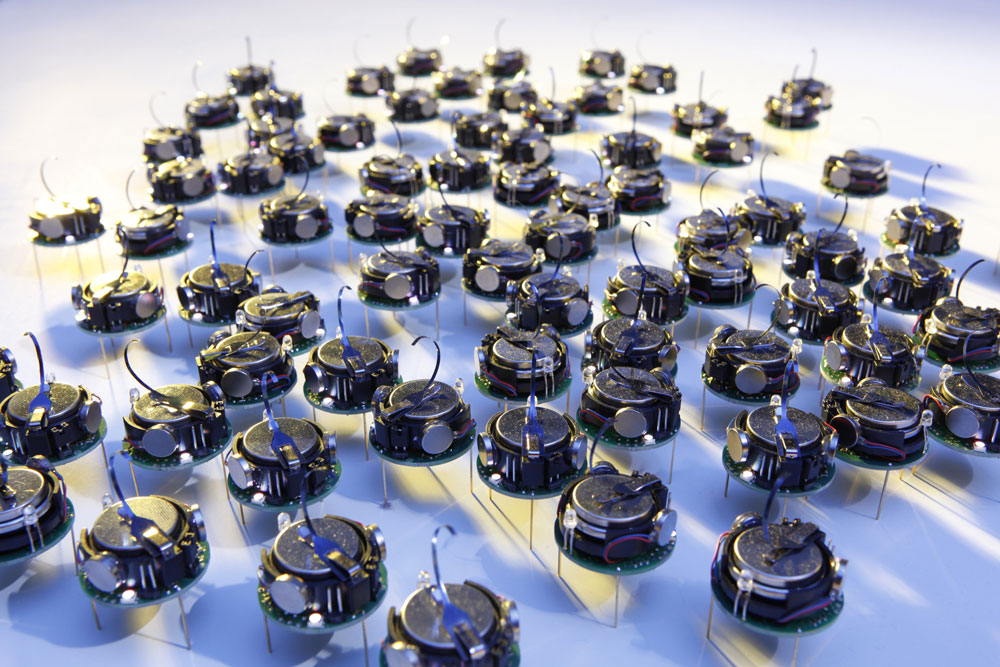
In the Disruptive Podcast series, Terrence McNally speaks directly with Wyss Institute researchers, exploring what motivates them and how they envision our future as might be impacted by their disruptive technologies. In part 1 of the Disruptive: Bioinspired Robotics podcast episode, Wyss Founding Core Faculty Member Radhika Nagpal discusses swarm collectives, as well as the challenges faced by women in the engineering and computer science fields.

Nagpal is developing programming paradigms that enable new types of robotic systems to mimic the collective behaviors of living creatures. Inspired by bee swarms and termite colonies, she is applying nature’s approach to decentralized cooperation to engineer new collective systems that meet real-world challenges. Biological systems, from embryos to social insects, depend upon the coordinated behavior of large numbers of individual agents to achieve highly complex outcomes — termites build skyscrapers and embryonic cells develop into healthy babies. Nagpal is building new types of distributed systems — from multi-modular robots and robot swarms, to vast sensor networks — that have similar capabilities.


If you liked this article, you may also be interested in:

See all the latest robotics news on Robohub, or sign up for our weekly newsletter.


tags: , , , , , ,


Wyss Institute uses Nature's design principles to develop bioinspired materials and devices that will transform medicine and create a more sustainable world.


Related posts :


MIT engineers design an aerial microrobot that can fly as fast as a bumblebee

  31 Dec 2025
With insect-like speed and agility, the tiny robot could someday aid in search-and-rescue missions.

Robohub highlights 2025

  29 Dec 2025
We take a look back at some of the interesting blog posts, interviews and podcasts that we've published over the course of the year.

The science of human touch – and why it’s so hard to replicate in robots

  24 Dec 2025
Trying to give robots a sense of touch forces us to confront just how astonishingly sophisticated human touch really is.

Bio-hybrid robots turn food waste into functional machines

  22 Dec 2025
EPFL scientists have integrated discarded crustacean shells into robotic devices, leveraging the strength and flexibility of natural materials for robotic applications.

Robot Talk Episode 138 – Robots in the environment, with Stefano Mintchev

  19 Dec 2025
In the latest episode of the Robot Talk podcast, Claire chatted to Stefano Mintchev from ETH Zürich about robots to explore and monitor the natural environment.

Artificial tendons give muscle-powered robots a boost

  18 Dec 2025
The new design from MIT engineers could pump up many biohybrid builds.

Robot Talk Episode 137 – Getting two-legged robots moving, with Oluwami Dosunmu-Ogunbi

  12 Dec 2025
In the latest episode of the Robot Talk podcast, Claire chatted to Oluwami Dosunmu-Ogunbi from Ohio Northern University about bipedal robots that can walk and even climb stairs.


Robohub is supported by:


Would you like to learn how to tell impactful stories about your robot or AI system?


scicomm
training the next generation of science communicators in robotics & AI


©2025.05 - Association for the Understanding of Artificial Intelligence