
Robohub.org
CBS News outlines jobs and robotics debate; IFR fills in gaps
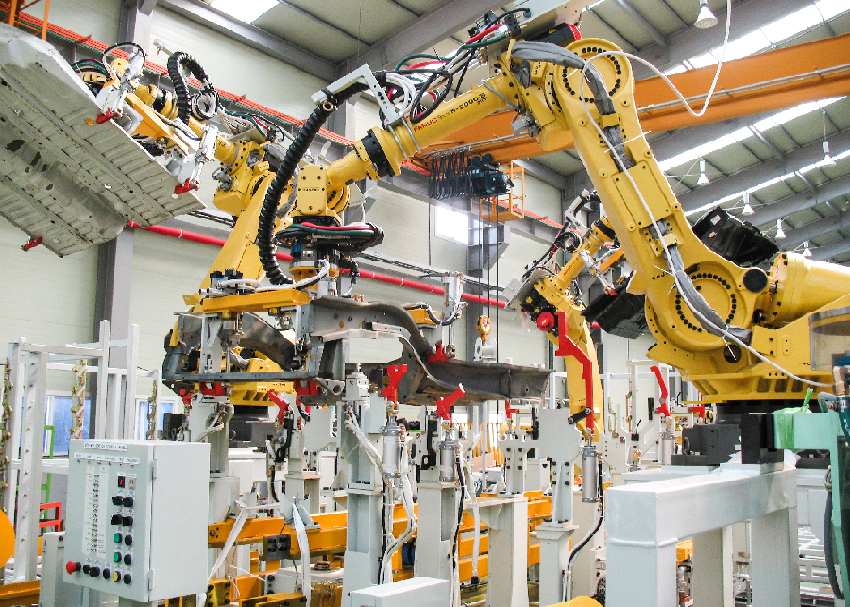
FANUC_R2000iB at work. Source: Wikipedia Commons
CBS News, and reporter David Pogue, displayed some new technologies threatening jobs, while the International Federation of Robotics suggested that deploying robots actually increases jobs. Are either true? Or both?
In this Sunday Morning CBS News piece, David Pogue cites the numbers of drivers that will be displaced as self-driving cars and trucks hit the roads (180k taxi drivers, 600k Uber drivers and 3.5 million truck drivers). He then explores other areas where bots and robots will soon disrupt employment: 230k workers in fintech along with 47% of many other occupations could be lost to automation in the next 20 years. He concludes with an MIT economics professor who suggests that, historically, new occupations have risen and overall employment has also risen even as major disruptions have happened over the last 100 years.
IFR’s Press Conference
Last week’s Chicago Automate and ProMat trade shows began with a press conference by the International Federation of Robotics (IFR) which included a CEO Roundtable discussing automation, the future of US manufacturing, and the jobs issue. Executives from Amazon, GM, ARM, ABB and AMT participated.
The IFR reported 2016 data which indicated that 31,500 industrial robots were installed in the US in 2016 (up 15% from 2015). 43% of those robots went to the auto industry, reaching an all-time high for that industry which has been growing at a CAGR of 9% since 2010.
Worldwide, around 290,000 industrial robots were installed, 14% more than 2015. 90,000 of those robots were installed in China, 31% more than 2015. The IFR also predicted that global annual growth is expected to average 12% for the remainder of the decade.
Employment and jobs
 Employment in the U.S. auto industry during the 2010 to 2016 period rose from 679,000 to 940,000 at a steady 6% CAGR, thus 261,000 new jobs were created in the automotive sector in the U.S. from 2010 through 2016 — the same period that robot deployment grew by 9%.
“The main driving force of this growth is the ongoing trend to automate production in order to strengthen the competitiveness of American industry globally, to keep manufacturing at home, and in some cases bring back manufacturing that had previously been outsourced to other countries,” said Joe Gemma, President of the IFR.
Recent articles in The Guardian, Financial Times and the NY Times debate whether increased manufacturing efficiencies using automation and robotics cause fewer jobs or change job growth from DDD (dull, dirty, dangerous) jobs to higher-skilled ones, or neither. The NY Times article presented evidence from two economists who quantified the negative effects of the deployment of robots in a new paper which concluded that for every robot deployed, up to six workers lost their jobs and wages fell for the remaining workers by as much as three-fourths of a percent. NOTE: All three articles are worth reading.
The panelists and the IFR agreed on the IFR analysis of economic data and forecasts that show automation and the use of robots create new jobs by increasing productivity. They also agreed, that education and training systems must be adapted to enable current and future workers to reap the benefits of robotics.
Reporters asked about the Bill Gates robot tax idea and the IFR responded with a reasoned fact-backed argument which included this paragraph:
According to the McKinsey Global Institute, more than 90 percent of jobs will not be fully automatable in the future. Instead, robots and humans will work together. The positive impact that the increased productivity of robots has on employment can already be seen in the most advanced industrial nations. The US automotive industry, for instance, installed more than 60,000 industrial robots between 2010 and 2015. During this same period, the number of employees in the US automotive sector increased by 230,000. [See chart above.] The same trends can be seen in the most advanced economies in Europe and Asia. Moreover, recent research by the OECD on the future of productivity shows: companies that employ technological innovation effectively are up to 10 times more productive than those that do not.
The IFR foresees the future job scene to be robots and humans working together and, agrees with the McKinsey report that less than 10% of jobs will be fully automatable.
Thus the debate continues.
Ahem…
Although more people are reading The Robot Report, very few are paying for it. Advertising revenues don’t really cover costs and unlike many others, I haven’t put up a paywall. The Robot Report’s independent reporting and compilations, directories and global maps of companies and institutions involved in making robots, takes a lot of time, money and hard work which I do because I believe the focus I’ve set – tracking the business of robotics – matters. I hope it matters to you too and that you will make a contribution by clicking the donate button.
Support The Robot Report
tags: Automation, business, Frank Tobe, ifr, The Robot Report

AUAI is supported by:









