
Robohub.org
 

Countering singularity sensationalism: Ken Goldberg reviews three books at the nexus of people and robots | Nature

by
16 October 2015


share this:

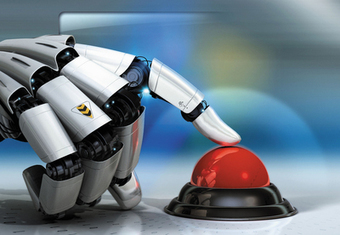
In the late nineteenth century, the United States was awash with the racist term ‘yellow peril’. Fears spread that Chinese immigrants working in the country’s mines and building its railways would seize more jobs from the citizenry. Today, there is a similar collective fear, this time about a ‘singularity’ in which artificial intelligence (AI) and robots surpass human abilities. In May 2014, for instance, physicists Stephen Hawking, Frank Wilczek and Max Tegmark, with computer scientist Stuart Russell, warned in the newspaper The Independent: “Success in creating AI would be the biggest event in human history. Unfortunately, it might also be the last”.

Surprising advances are being achieved, for example in ‘deep learning’ — a method for approximating complex functions using thousands of numerical parameters. And robots are evolving, with advances in 3D sensing and mapping. But progress is not nearly as steady as some claim. Three books explore the topic from different perspectives. All suggest that robot superiority faces a formidable obstacle: human psychology.

Hallie Siegel’s insight:
I recently interviewed John Markoff about his new book – watch for that on Robohub soon.


Hallie Siegel robotics editor-at-large

            AUAI is supported by:


Subscribe to Robohub newsletter on substack


Related posts :

Robotics roadmaps from around the world spotlight of the month: United States of America

US robotics researchers and industry are looking for a cohesive national robotics strategy.

Could robots help tackle loneliness? BBC’s Ann Droid raises questions about the future of care

  07 Sep 2026
While the series exaggerates what robots can currently do, some of the technology it depicts is already being tested.

Exploring the Moon will require rovers that can think for themselves – an upcoming NASA mission will test whether they can

  04 Sep 2026
NASA is planning to send three small rovers to the Moon to autonomously compute how to best explore a patch of ground.

Surviving the paper deluge: Notes from an ICRA panel on publishing, LLMs, and the future of peer review

Experts discuss peer-review challenges and possibilities for reshaping the process.

When expressive humanoid robots are awkward, people become wary – new brain study

  31 Aug 2026
People become more suspicious of a humanoid robot that makes errors, especially when the robot is an expressive conversation partner.

First 11 vs 11 humanoid soccer game played at RoboCup 2026

  28 Aug 2026
Watch highlights from this historic match.

How green is your robot? And other awkward questions

Robots clean rivers and sort waste, monitor ecosystems, and inspect renewable-energy infrastructure. But even the greenest robot has an environmental footprint.

These tiny drones are powered by sound

  24 Aug 2026
EPFL engineers have designed acoustic cavities that convert sound waves into thrust, propelling small robots and ultralight aerial vehicles without on-board actuators or electronics.


AUAI is supported by:


Subscribe to Robohub newsletter on substack


©2026.05 - Association for the Understanding of Artificial Intelligence









