
Robohub.org
Empowering startups’ global reach
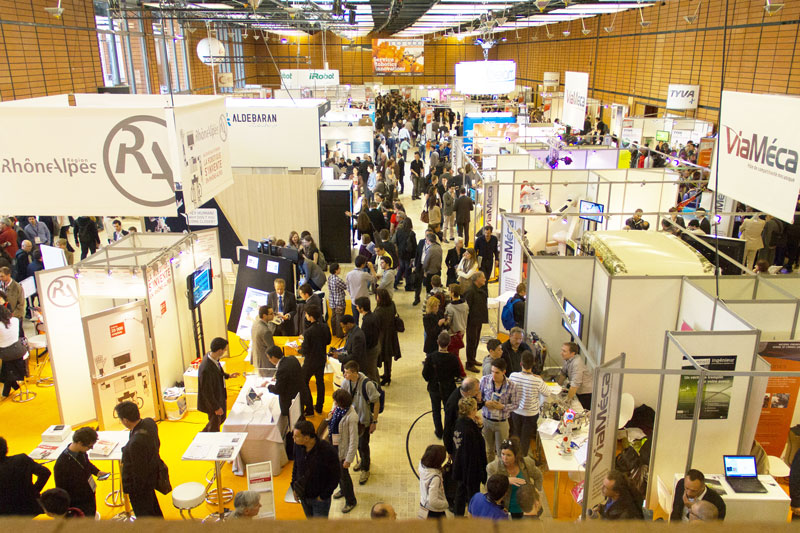
Innorobo 2014.
Innorobo’s call for start-ups has just closed and 25 semi-finalists from around the world will now be reviewed by a jury of experts to select the five winners. The winners will pitch to investors at a plenary conference and exhibit free of charge at Innorobo, the international robotics summit. Why does Innoecho – the consulting company specialized in driving disruptive technologies to market, and organizer of Innorobo – hold such a call?
The Call for Start-ups initiative came up three years ago in order to meet robotics entrepreneurs’ need to connect with a broader ecosystem. Professional and personal service robotics is an emerging, thriving field thanks to an ever-growing wealth of entrepreneurial projects. Entrepreneurs in this arena need connections with an extensive international network to develop and reach their market as swiftly as possible.
A few years back, most investors set their sights on Internet entrepreneurial initiatives and hardware projects (with high investment needs, a long, complex prototyping / beta test process and lower gross margin forecasts), and had a tough time finding any kind of seed or development funding. Today, Innorobo brings together an audience of 10,000 decision-makers in robotics and related technologies, as well as from industry, service companies, research laboratories, the academic sphere, public institutions, the investment/finance world and the media. In this way, Innorobo’s “Call for Start-ups” connects entrepreneurial ventures with a broad, meaningful ecosystem.
Since the tech boom, many organizations have been set up to support entrepreneurship, and robotics has become a hot topic in mature economies. In addition to love money, start-ups can now benefit from crowdfunding platforms, business angels, industrial partners and investors specializing in hardware ventures. This is illustrated in Europe, which has a healthy early-stage startup scene.
The number of European accelerators and incubators has increased dramatically since the start of the financial crisis. Between 2007 and 2013, the number rose by nearly 400%. In 2013, a study by Telefonica identified 260 organizations in 10 European countries. This dizzying growth in funding providers does nevertheless make it harder for start-ups to pinpoint the one that best meets their needs. One size doesn’t fit all, and entrepreneurs sometimes get lost in the maze of huge groups or multiple supporting institutions (clusters, incubators, investors network, etc.) in various “vertical” technological fields (mechanical engineering, electronics, software, mechatronics, etc.). Innorobo can put entrepreneurs in contact with the right key stakeholders for their project.
In addition, these structures are mainly regional – only 15% of the incubators/accelerators in Europe are “international” – and the Telefonica survey recommends European leaders take decisive steps to make country borders meaningless for entrepreneurs. Finally, while some countries have laid out roadmaps, built institutions and seen private organizations sprouting up to support robotics entrepreneurs, others are lacking a structured business ecosystem. Hence, Innorobo provides both a dynamic international marketplace and a structure that nurtures the amazing entrepreneurial spirit of robotics. Though we “physically” bring people together around projects, we also provide services that go beyond the confines of a physical location. Start-ups need international exposure from the very start in order to move from the prototype phase to the production stage and find their first customers. We work hard to promote innovation, competitiveness, technology transfer and other key public policy aims of and across all participating countries.
More importantly, over the years, Innorobo’s team has built lasting connections with many people and projects in the diverse fields of robotics. It is not just about a database of more than 3,000 robotics companies, it is about real interactions with passionate people who are truly working to make the world a better place. There are some entrepreneurs who know how to communicate and capitalize on their network as part of their strategy, and others who don’t. We believe all energy and efforts would be better focused on principles that help push innovation forward, on substance versus style. The Call for Start-ups jury is handpicked to reflect these values.
Innoecho believes in open innovation, in international partnerships and in a globalized world with social responsibility. To help meet the challenges our world is facing today, we believe we must go beyond the typical national or continental business visions and create a global network that will generate a host of opportunities for every entrepreneurial venture to find its fair share of business and truly impact society for the better.
Come visit our hall dedicated to start-ups and discover the innovations that are going to make the world a better place.
tags: c-Events, Competition-Challenge, cx-Business-Finance, InnoRobo, startups

AUAI is supported by:









