Robohub.org
 

First results of the ROSIN project: Robotics Open-Source Software for Industry


by
18 September 2018


share this:

Open-Source Software for robots is a de-facto standard in academia, and its advantages can benefit industrial applications as well. The worldwide ROS-Industrial initiative has been using ROS, the Robot Operating System, to this end.

In order to consolidate Europe’s expertise in advanced manufacturing, the H2020 project ROSIN supports EU’s strong role within ROS-Industrial. It will achieve this goal through three main actions on ROS: ensuring industrial-grade software quality; promoting new business-relevant applications through so-called Focused Technical Projects (FTPs); supporting educational activities for students and industry professionals on the one side conducting ROS-I trainings as well as and MOOCs and on the other hand by supporting education at third parties via Education Projects (EPs).

Now it is easier to get an overview of first results from ROSIN at http://rosin-project.eu/results.
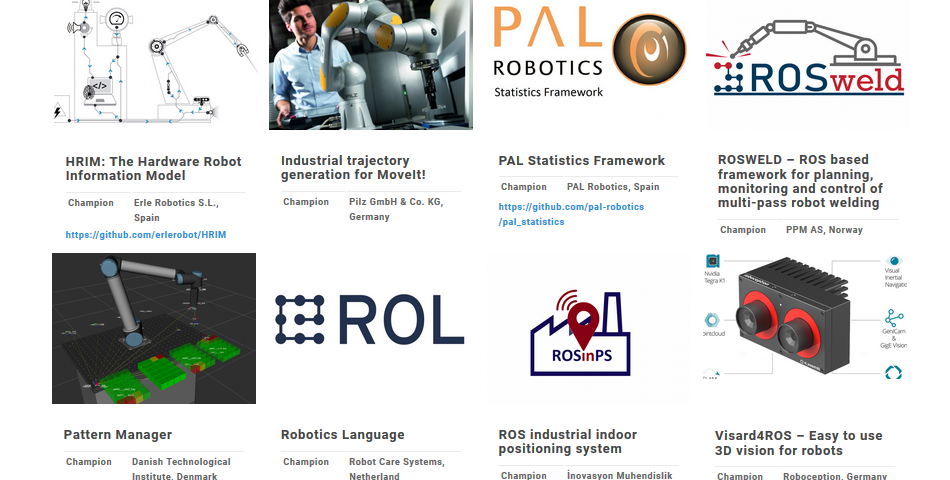
Collage of Focused Techincal Projects (FTPs) supported by ROSIN

Focused Techincal Projects (FTPs) supported by ROSIN

Browse through vendor-developed ROS drivers for industrial hardware, generic ROS frameworks for industrial applications and model based tooling. Thanks to ROSIN support, all of these new ROS components are open-sourced for the benefit of the ROS-Industrial community. Each entry leads to a minipage that is maintained by the FTP champion, so check back often for updates on the progress of the projects.

The project is continuously accepting FTP project proposals to advance open-source robot software. New incoming proposals are evaluated every 3 months (approximately). The next cut-off dates will be 14. September and 16. November 2018. Further calls can be expected throughout the project runtime (January 2017 – December 2020).


tags: ,


Thilo Zimmermann

            AUAI is supported by:


Subscribe to Robohub newsletter on substack


Related posts :

Developing active and flexible microrobots

  13 May 2026
This class of robots opens up possibilities for biomedical applications.

How to teach the same skill to different robots

  11 May 2026
A new framework to teach a skill to robots with different mechanical designs, allowing them to carry out the same task without rewriting code for each.

Robot Talk Episode 155 – Making aerial robots smarter, with Melissa Greeff

  08 May 2026
In the latest episode of the Robot Talk podcast, Claire chatted to Melissa Greeff from Queen's University about autonomous navigation and learning for drones.

New understanding of insect flight points way to stable flapping-wing robots

  07 May 2026
The way bugs and birds flap their wings may look effortless, but the dynamics that keep them aloft are dizzyingly complex and difficult to quantify.

Robotically assembled building blocks could make construction more efficient and sustainable

  05 May 2026
Research suggests constructing a simple building from interlocking subunits should be mechanically feasible and have a much smaller carbon footprint.

Robot Talk Episode 154 – Visual navigation in insects and robots, with Andrew Philippides

  01 May 2026
In the latest episode of the Robot Talk podcast, Claire chatted to Andrew Philippides from the University of Sussex about what we can learn from ants and bees to improve robot navigation.

Ultralightweight sonar plus AI lets tiny drones navigate like bats

  29 Apr 2026
Researchers develop ultrasound-based perception system inspired by bat echolocation.

Gradient-based planning for world models at longer horizons

  28 Apr 2026
What were the problems that motivated this project and what was the approach to address them?


AUAI is supported by:


Subscribe to Robohub newsletter on substack


©2026.02 - Association for the Understanding of Artificial Intelligence