
Robohub.org
 

Flying Donkey Challenge on hold as Kenyan authorities cope with Westgate Mall fallout


by
18 July 2014


share this:

Today organizers announced that the first edition of the Flying Donkey Challenge in Kenya, which had preliminary sub-challenges slated to begin this November, is on hold indefinitely due to delays in obtaining final approvals from Kenyan authorities.

According to their press release:

Beginning with the horrific Westgate attack last September in Nairobi and following the tragic terrorist attacks near Lamu this month, it has become clear that organising a high visibility drone event in Kenya is incompatible with immediate security concerns. To be clear, it is not that cargo drone testing presents any threat whatsoever to Kenya, or that international participants would be at risk from travelling to Kenya, but only that, for the coming months, the overseers of civil and military aviation in Kenya have made it clear they are unlikely to be able to sign off on legal precedents for autonomous flight.

Since April, we have been pursuing air space approvals and locations in other African locations. While these talks have been productive, our unfortunate conclusion is that we will not be able to confirm a new date and location in 2015. Without a clear time-scale, closing on the budget is not possible. Taking into account the speed with which research and commercial drone ventures are proceeding, we feel it unfair to leave the teams that have applied for the Challenge in limbo and prefer to put the Flying Donkey Challenge in its current format on hold.

Organizers remain steadfast in their goal to spur a new transport industry using cargo drones in order to solve the problem of supply delivery in places where infrastructure is poor or non-existent.
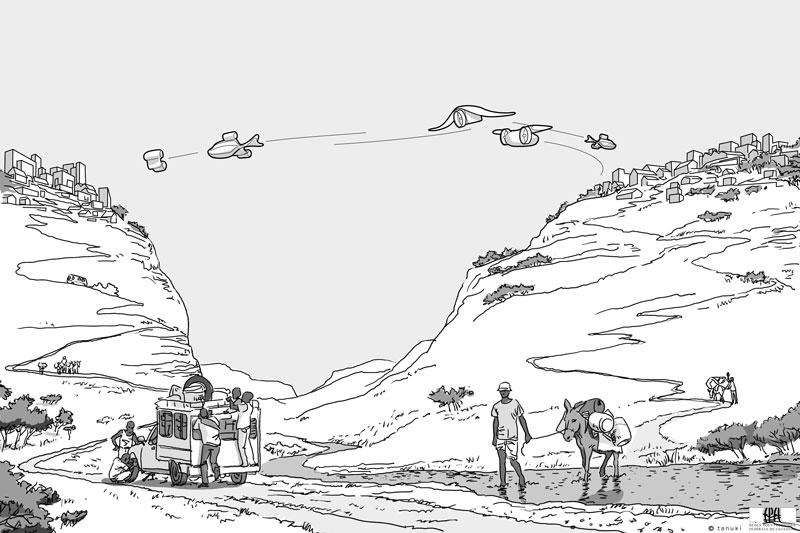
Flying_Donkey_Challenge

tags: , , ,


Hallie Siegel robotics editor-at-large


Subscribe to Robohub newsletter on substack


Related posts :

What I’ve learned from 25 years of automated science, and what the future holds: an interview with Ross King

and   14 Apr 2026
Ross King created the first robot scientist back in 2009. He spoke to us about the nature of scientific discovery, the role AI has to play, and his recent work in DNA computing.

Robot Talk Episode 151 – Robots to study the ocean, with Simona Aracri

  10 Apr 2026
In the latest episode of the Robot Talk podcast, Claire chatted to Simona Aracri from National Research Council of Italy about innovative robot designs for oceanography and environmental monitoring.

Generative AI improves a wireless vision system that sees through obstructions

  08 Apr 2026
With this new technique, a robot could more accurately detect hidden objects or understand an indoor scene using reflected Wi-Fi signals.

Resource-constrained image generation and visual understanding: an interview with Aniket Roy

  07 Apr 2026
Aniket tells us about his research exploring how modern generative models can be adapted to operate efficiently while maintaining strong performance.

Back to school: robots learn from factory workers

  02 Apr 2026
A Czech startup is making factory automation easier by letting workers teach robots new tasks through simple demonstrations instead of complex coding.

Resource-sharing boosts robotic resilience

  31 Mar 2026
When a modular robot shares power, sensing, and communication resources among its individual units, it is significantly more resistant to failure than traditional robotic systems.

Robot Talk Episode 150 – House building robots, with Vikas Enti

  27 Mar 2026
In the latest episode of the Robot Talk podcast, Claire chatted to Vikas Enti from Reframe Systems about using robotics and automation to build climate-resilient, high-performance homes.

A history of RoboCup with Manuela Veloso

and   24 Mar 2026
Find out how RoboCup got started and how the competition has evolved, from one of the co-founders.


Robohub is supported by:


Subscribe to Robohub newsletter on substack


©2026.02 - Association for the Understanding of Artificial Intelligence









