
Robohub.org
Interview with Amina Mević: Machine learning applied to semiconductor manufacturing
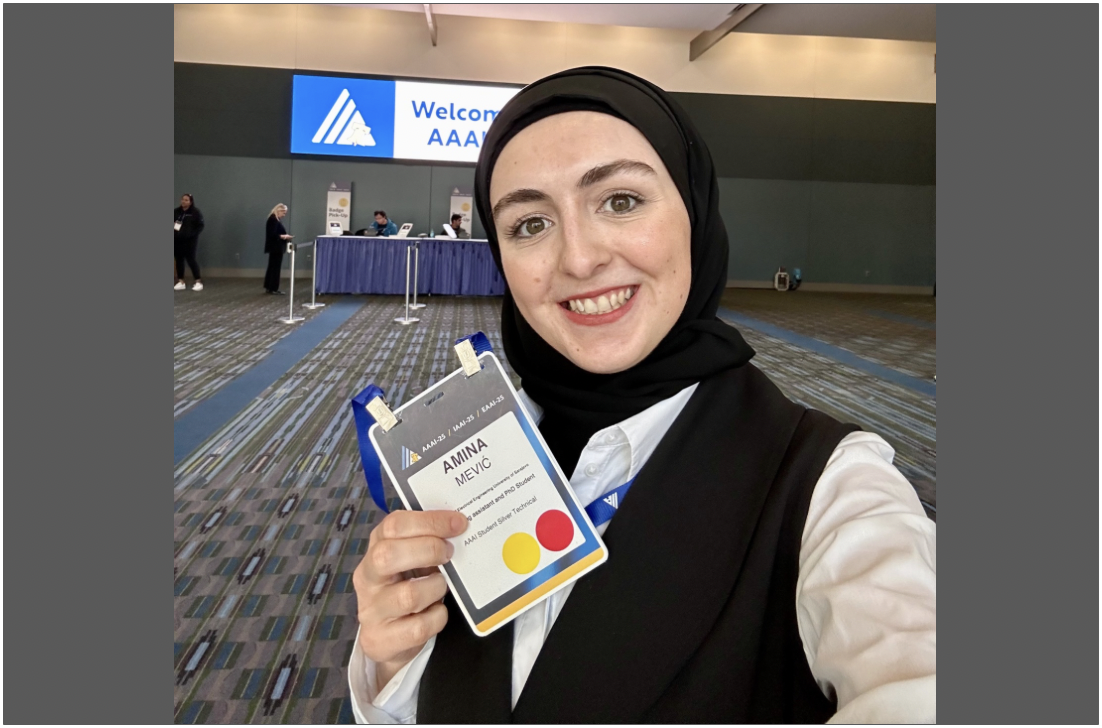
In a series of interviews, we’re meeting some of the AAAI/SIGAI Doctoral Consortium participants to find out more about their research. In this latest interview, we hear from Amina Mević who is applying machine learning to semiconductor manufacturing. Find out more about her PhD research so far, what makes this field so interesting, and how she found the AAAI Doctoral Consortium experience.
Tell us a bit about your PhD – where are you studying, and what is the topic of your research?
I am currently pursuing my PhD at the University of Sarajevo, Faculty of Electrical Engineering, Department of Computer Science and Informatics. My research is being carried out in collaboration with Infineon Technologies Austria as part of the Important Project of Common European Interest (IPCEI) in Microelectronics. The topic of my research focuses on developing an explainable multi-output virtual metrology system based on machine learning to predict the physical properties of metal layers in semiconductor manufacturing.
Could you give us an overview of the research you’ve carried out so far during your PhD?
In the first year of my PhD, I worked on preprocessing complex manufacturing data and preparing a robust multi-output prediction setup for virtual metrology. I collaborated with industry experts to understand the process intricacies and validate the prediction models. I applied a projection-based selection algorithm (ProjSe), which aligned well with both domain knowledge and process physics.
In the second year, I developed an explanatory method, designed to identify the most relevant input features for multi-output predictions.
Is there an aspect of your research that has been particularly interesting?
For me, the most interesting aspect is the synergy between physics, mathematics, cutting-edge technology, psychology, and ethics. I’m working with data collected during a physical process—physical vapor deposition—using concepts from geometry and algebra, particularly projection operators and their algebra, which have roots in quantum mechanics, to enhance both the performance and interpretability of machine learning models. Collaborating closely with engineers in the semiconductor industry has also been eye-opening, especially seeing how explanations can directly support human decision-making in high-stakes environments. I feel truly honored to deepen my knowledge across these fields and to conduct this multidisciplinary research.
What are your plans for building on your research so far during the PhD – what aspects will you be investigating next?
I plan to focus more on time series data and develop explanatory methods for multivariate time series models. Additionally, I intend to investigate aspects of responsible AI within the semiconductor industry and ensure that the solutions proposed during my PhD align with the principles outlined in the EU AI Act.
How was the AAAI Doctoral Consortium, and the AAAI conference experience in general?
Attending the AAAI Doctoral Consortium was an amazing experience! It gave me the opportunity to present my research and receive valuable feedback from leading AI researchers. The networking aspect was equally rewarding—I had inspiring conversations with fellow PhD students and mentors from around the world. The main conference itself was energizing and diverse, with cutting-edge research presented across so many AI subfields. It definitely strengthened my motivation and gave me new ideas for the final phase of my PhD.
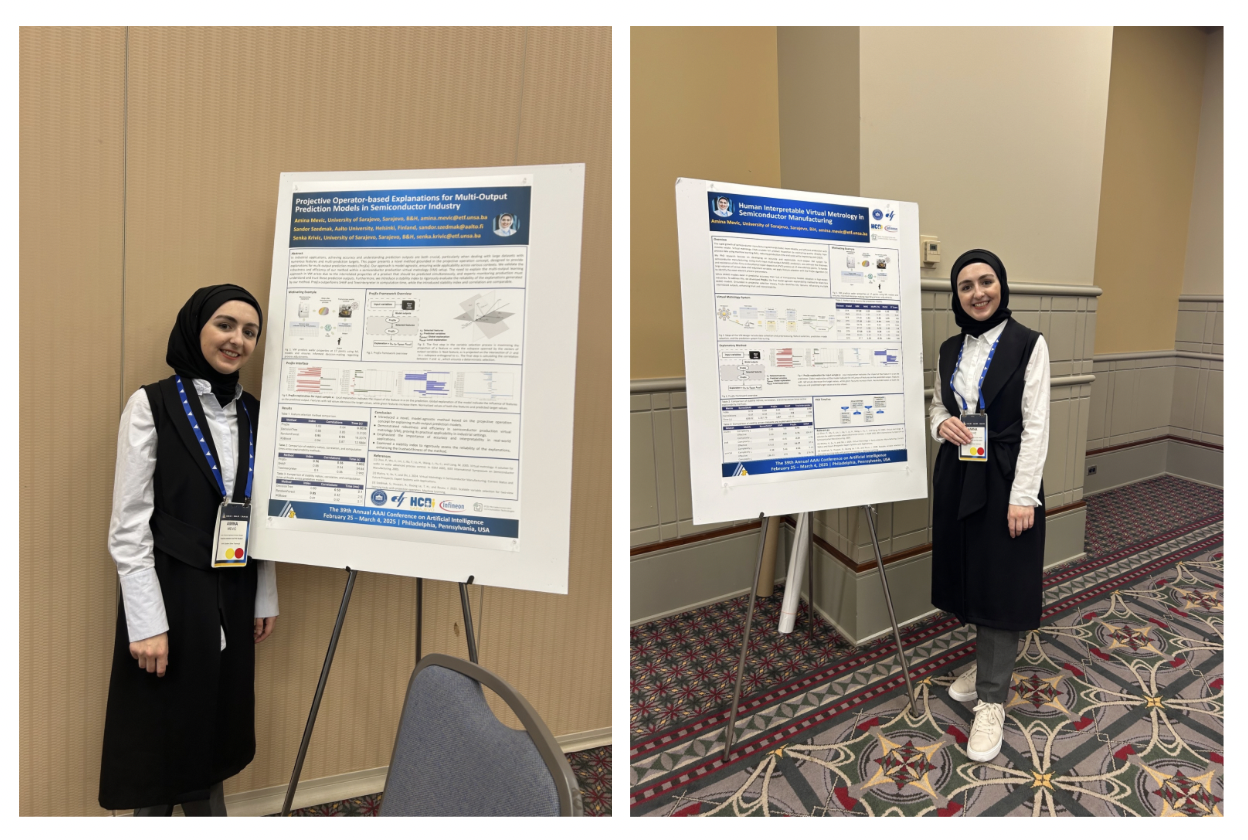 Amina presenting two posters at AAAI 2025.
What made you want to study AI?
After graduating in theoretical physics, I found that job opportunities—especially in physics research—were quite limited in my country. I began looking for roles where I could apply the mathematical knowledge and problem-solving skills I had developed during my studies. At the time, data science appeared to be an ideal and promising field. However, I soon realized that I missed the depth and purpose of fundamental research, which was often lacking in industry roles. That motivated me to pursue a PhD in AI, aiming to gain a deep, foundational understanding of the technology—one that can be applied meaningfully and used in service of humanity.
What advice would you give to someone thinking of doing a PhD in the field?
Stay curious and open to learning from different disciplines—especially mathematics, statistics, and domain knowledge. Make sure your research has a purpose that resonates with you personally, as that passion will help carry you through challenges. There will be moments when you’ll feel like giving up, but before making any decision, ask yourself: am I just tired? Sometimes, rest is the solution to many of our problems. Finally, find mentors and communities to share ideas with and stay inspired.
Could you tell us an interesting (non-AI related) fact about you?
I’m a huge science outreach enthusiast! I regularly volunteer with the Association for the Advancement of Science and Technology in Bosnia, where we run workshops and events to inspire kids and high school students to explore STEM—especially in underserved communities.
About Amina
|
Amina Mević is a PhD candidate and teaching assistant at the University of Sarajevo, Faculty of Electrical Engineering, Bosnia and Herzegovina. Her research is conducted in collaboration with Infineon Technologies Austria as part of the IPCEI in Microelectronics. She earned a master’s degree in theoretical physics and was awarded two Golden Badges of the University of Sarajevo for achieving a GPA higher than 9.5/10 during both her bachelor’s and master’s studies. Amina actively volunteers to promote STEM education among youth in Bosnia and Herzegovina and is dedicated to improving the research environment in her country. |

AUAI is supported by:









