
Robohub.org
Is drone delivery really a robot startup?
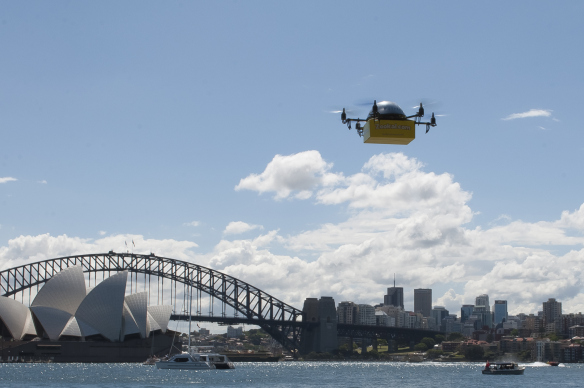
Australian startup Zookal is making news today with their claims to be the world’s first drone delivery company. It’s an exciting headline and I wish them well. But while you can quibble over who is really the first commercial drone delivery company, I think it’s more interesting that we’re hitting an inflection point where you have to ask, “is a company that uses robots a robot company”? Zookal is a textbook and student services startup. They use drones for delivery and marketing. They are not a drone or robot company. And that’s good!
Zookal is a textbook rental startup that also provides a digital note platform and internships for international students. Zookal are using drones developed by the University of Sydney engineering students and technically Flirtey is the actual drone startup. Or possibly Vimbra who are managing the logistics partnerships, ie between Zookal and Flirtey. However they all have cofounder Ahmed Haider in common.
Haider hopes to close the gap between the rapid developments in ecommerce and logistics which has remained largely unchanged. Textbooks are a great test bed for drone logistics as they are robust, reasonably expensive and in demand, unlike tacos, which may be in demand but are fragile and offer little margin for a startup.
“Textbooks are an excellent way to test the market as they allow for varying weights,” he says. “With the concentration of students in universities in Australia, we will have proof of concept that shows if you can deliver a textbook, then things such as urgent medical deliveries, clothes, shoes, fast food and other e-commerce will be much more viable.”
Drones are the first robots to become an off the shelf technology that is wide open for diverse uses, with drone delivery and aerial photography leading the way as consumer and small business verticals. What next? Drones are the gateway for consumer robotics where the robot is a tool that anyone can use. Increasingly, there will be more and more separation between companies that simply use robots and companies that make or deploy or augment robots. This inflexion point has occurred many times in various industries, most notably the automotive industry in the 70s and 80s.
While Australia is friendlier towards commercial UAV operation than the US, this is still a fledgeling industry with many standards and regulations still to be worked out. Flirtey are working in partnership with The Warren Centre for Advanced Engineering, a non-profit research institute, to develop a set of guidelines for the use of commercial drones.
“We hope to use this guide as a way to work through safety, privacy and community concerns locally which will hopefully set a benchmark for the rest of the world as to how to interact with this new technology,” says Haider. “I think this is going to be absolutely huge in terms of logistics,” he says.
So let’s keep Zookal with Flirtey on the list of robot startups for a while longer because they are creating interest and expanding awareness of potential business models which will increase the funding opportunities for more robot startups.
tags: startups

AUAI is supported by:









