Robohub.org
 

Midea’s masterplan to become China’s robot powerhouse

by
18 August 2016


share this:
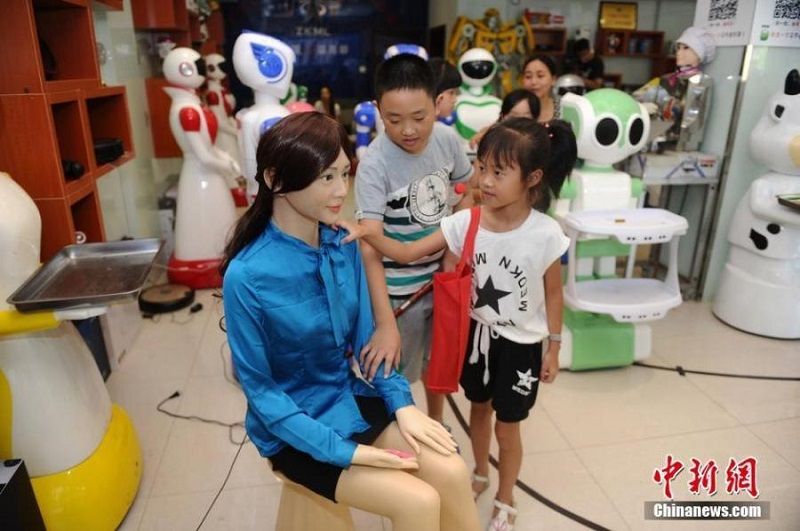
Hunan Changsha 5S robot store. Source: gog.cn

Hunan Changsha 5S robot store. Source: gog.cn

Chinese consumer manufacturer Midea, after having spent over $4 billion to acquire 94% of German robot maker Kuka, is planning to spend an additional $1.5 billion to turn itself into China’s preeminent robot powerhouse.

Midea plans to build a factory located in Foshan City to expand its capacity to manufacture and assemble robots and robot components. Much of the production will be to produce automatons for homes and individuals, robots similar to SoftBank’s Pepper. Midea expects to ramp up production at the new facility from an initial 7,000 robots annually to 17,000 or more, within 10 years.

Midea is China’s biggest manufacturer of air conditioners, refrigerators and home appliances, employing around 135,000 people. Their investments in robotics as a user and also by buying Kuka, establishing a robot factory, and creating an automaton for home use – underscores their ambition to lead China in automation and robotics.

Midea’s recent investments follow a series of government-led initiatives labeled China Manufacturing 2025, which is aimed at transforming China’s manufacturing industry from low-end mass production into a more profitable model harnessing new technologies such as robotics, artificial intelligence and the Internet of Things.

“Midea’s strategy is to be the Chinese leader in robotics and automation,” said Wang Cairong, secretary general of the China Artificial Intelligence Robot Industry Alliance, an industry association. “It may even be a global giant in this field. The Chinese government needs and encourages new “heavyweight” companies in this sector.”


tags: , , ,


Frank Tobe is the owner and publisher of The Robot Report, and is also a panel member for Robohub's Robotics by Invitation series.


Related posts :


Bio-hybrid robots turn food waste into functional machines

  22 Dec 2025
EPFL scientists have integrated discarded crustacean shells into robotic devices, leveraging the strength and flexibility of natural materials for robotic applications.

Robot Talk Episode 138 – Robots in the environment, with Stefano Mintchev

  19 Dec 2025
In the latest episode of the Robot Talk podcast, Claire chatted to Stefano Mintchev from ETH Zürich about robots to explore and monitor the natural environment.

Artificial tendons give muscle-powered robots a boost

  18 Dec 2025
The new design from MIT engineers could pump up many biohybrid builds.

Robot Talk Episode 137 – Getting two-legged robots moving, with Oluwami Dosunmu-Ogunbi

  12 Dec 2025
In the latest episode of the Robot Talk podcast, Claire chatted to Oluwami Dosunmu-Ogunbi from Ohio Northern University about bipedal robots that can walk and even climb stairs.

Radboud chemists are working with companies and robots on the transition from oil-based to bio-based materials

  10 Dec 2025
The search for new materials can be accelerated by using robots and AI models.

Robot Talk Episode 136 – Making driverless vehicles smarter, with Shimon Whiteson

  05 Dec 2025
In the latest episode of the Robot Talk podcast, Claire chatted to Shimon Whiteson from Waymo about machine learning for autonomous vehicles.


Robohub is supported by:


Would you like to learn how to tell impactful stories about your robot or AI system?


scicomm
training the next generation of science communicators in robotics & AI


©2025.05 - Association for the Understanding of Artificial Intelligence