Robohub.org
 

Mirobot: An open source WiFi robot for kids

by
14 May 2014


share this:
mirobot_med

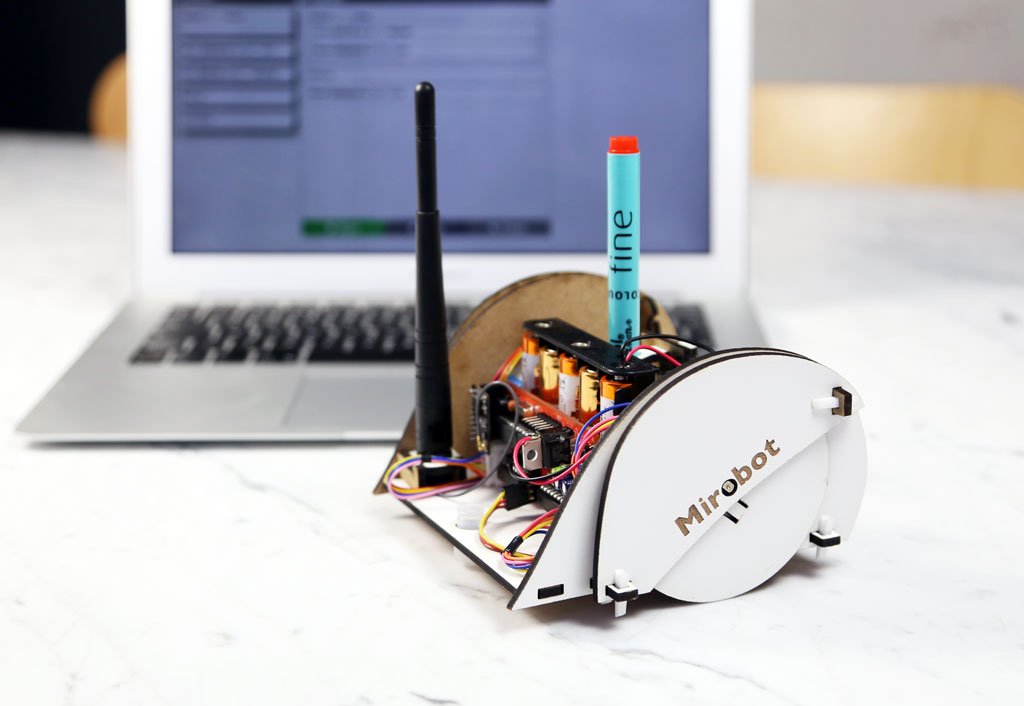
Mirobot is a robotics kit that’s designed to get kids more interested in technology, engineering and programming. Children solder and build it themselves, and then can use a drag-and-drop programming tool in their browser to get the robot to draw shapes and patterns.

All of the designs and software are open source, which means that once it has been used for its original purpose, it can be adapted to do new and unforeseen things. Although primarily a drawing robot, it can also use additional sensors in order to be able to experiment with making it autonomous. Arduino compatibility means that extending and modifying it is well documented and straightforward. Using WiFi with JSON over WebSockets to communicate which means that it can be easily controlled from a web browser as well as easily integrated into any other programming language or tool.

Mirobot was inspired by a visit to the London Science Museum when I came across one of the original Turtle robots used in schools in the UK in the late 70s and 80s. I used to use these robots as a child and thought it would be interesting to make a modern version that was based around open hardware platforms like the Arduino. The idea that what was once a very expensive piece of equipment could now be made inexpensively really appealed to me. Moving from one-per-school to one-per-child is a great advance and enables much greater learning.

It’s currently on Kickstarter and has made great progress – it’s 320% funded now with a little over a week left to go.


tags: , , , ,


Ben Pirt

            AUAI is supported by:


Subscribe to Robohub newsletter on substack


Related posts :

Robotics roadmaps from around the world

We embark on a tour into some of the recent and prominent robotics roadmaps from around the world.

A ‘5-in-1’ seed-sized surgical robot

Mini robot can move, cut tissue, release drugs, grip and store samples, and generate heat wirelessly

AI agents create virtual playgrounds to help robots get crucial training data

  07 Aug 2026
“SceneSmith” system uses collaborative AI agents to create realistic 3D environments of places like kitchens, hotels, and living rooms, where robots can simulate everyday chores.

Robots in society, business and culture: July 2026

A round up of robotics stories in a new monthly series from IEEE RAS.

Simulated zebrafish and a vision-equipped robotic fish reveal how the body shapes brain circuits

Researchers look to the fish brain to create a robotic zebrafish that can autonomously swim upstream.

Researchers develop modular nanorobot

  31 Jul 2026
A team at the University of Basel has developed a versatile nanorobot with propulsion and payload modules.

Surviving the paper deluge: a one-year study in learning from demonstration

With the explosion of robotics research, staying current in fields like Learning from Demonstration is a monumental challenge.

Soft robotic heart offers new way to study disease and test life-saving devices

Researchers have developed a soft robotic model of the human heart that can mimic disease and provide a realistic environment for testing the next generation of cardiac devices.


AUAI is supported by:


Subscribe to Robohub newsletter on substack


©2026.05 - Association for the Understanding of Artificial Intelligence