Robohub.org
 

New partnership looks to strengthen European robot industry

by
22 June 2016


share this:
Source: ROBOTT-NET

Source: ROBOTT-NET

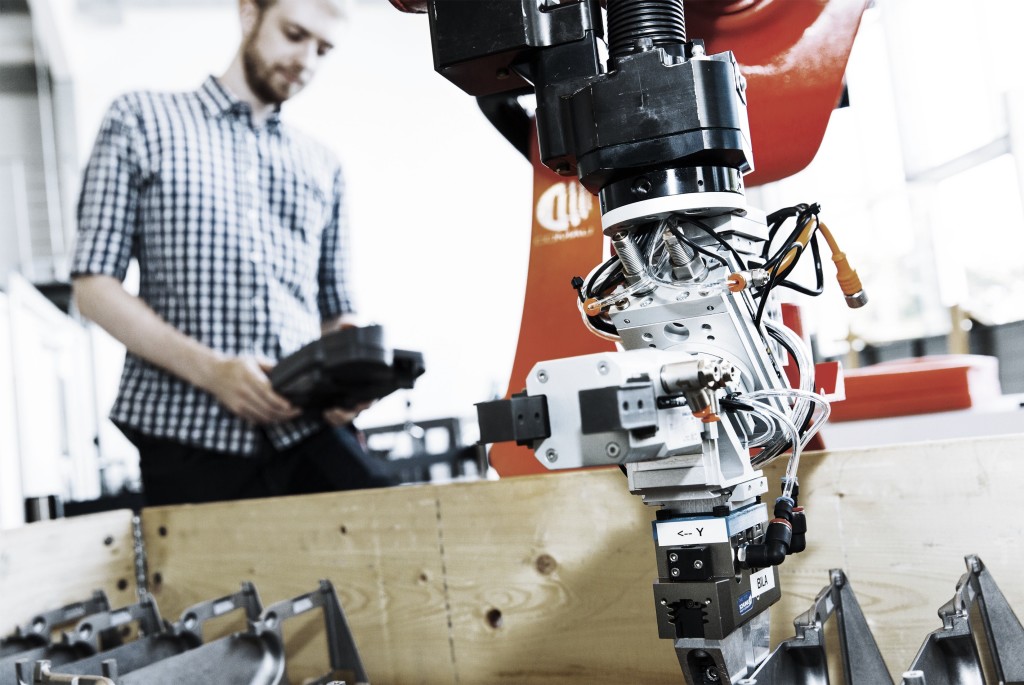
A new EU-funded, robot technology transfer partnership is looking to help manufacturing and robotics companies with robot consultancy, networking, and funding.

Four knowledge institutes across Europe — the Danish Technological Institute (DK), Fraunhofer IPA (DE), Tecnalia (ES), and the Manufacturing Technology Centre (UK) — have teamed up to offer highly qualified consulting services at no cost to companies that either want to use robot technology in their production or want to develop new robot technology to sell. This initiative is ROBOTT-NET.

The initiative will combine European competencies in state-of-the-art applied robotics, and enable companies to benefit from Danish, German, Spanish and British expertise.

ROBOTT-NET is not only about technological advances, but also about developing solid business cases, arranging contacts with relevant investors, and so on. The complete package is needed if we are to improve production, bring new ideas to market, and increase competitiveness.

European companies wishing to use or produce robots are invited to apply for a voucher, that can be exchanged for approximately 400 hours of consultancy at four partner locations. Of the 64 winning companies, eight will later be selected to receive follow-on development aid worth more than €150,000, plus, 3,500 consulting hours from the four partners.

Anyone with a concrete idea, challenge or development related to industrial robotics or service robots can apply for support in ROBOTT-NET. Large manufacturing companies, garage start-ups, and everything in between qualify.

ROBOTT-NET has already set sail with four Open Lab events across Europe with four more to follow in autumn. Stay tuned at www.robott-net.eu. At these events, you can hear more about how your company can become part of ROBOTT-NET and also see some of today’s most cutting-edge industrial robot technologies that are being developed in the European robotics labs.

You can also apply for a voucher through our website.


tags: , ,


Samuel Brøgger is the Communication Consultant at DTI Robotics.

            AUAI is supported by:


Subscribe to Robohub newsletter on substack


Related posts :

Robotics Café brings together autonomous robot practitioners

  20 May 2026
Recently launched series for researchers, students and industry practitioners aims to provide a platform for students to present their work.

Table tennis robot defeats some of world’s best players – why this has major implications for robotics

  18 May 2026
Ace, from Sony AI, is the first robot to beat elite human players in competitive physical sport.

Robot Talk Episode 156 – Rugged robots for dangerous missions, with Gavin Kenneally

  15 May 2026
In the latest episode of the Robot Talk podcast, Claire chatted to Gavin Kenneally from Ghost Robotics about robot dogs for defence, security, and public safety.

Developing active and flexible microrobots

  13 May 2026
This class of robots opens up possibilities for biomedical applications.

How to teach the same skill to different robots

  11 May 2026
A new framework to teach a skill to robots with different mechanical designs, allowing them to carry out the same task without rewriting code for each.

Robot Talk Episode 155 – Making aerial robots smarter, with Melissa Greeff

  08 May 2026
In the latest episode of the Robot Talk podcast, Claire chatted to Melissa Greeff from Queen's University about autonomous navigation and learning for drones.

New understanding of insect flight points way to stable flapping-wing robots

  07 May 2026
The way bugs and birds flap their wings may look effortless, but the dynamics that keep them aloft are dizzyingly complex and difficult to quantify.

Robotically assembled building blocks could make construction more efficient and sustainable

  05 May 2026
Research suggests constructing a simple building from interlocking subunits should be mechanically feasible and have a much smaller carbon footprint.


AUAI is supported by:


Subscribe to Robohub newsletter on substack


©2026.02 - Association for the Understanding of Artificial Intelligence