
Robohub.org
One robot on Mars is robotics, ten robots are automation
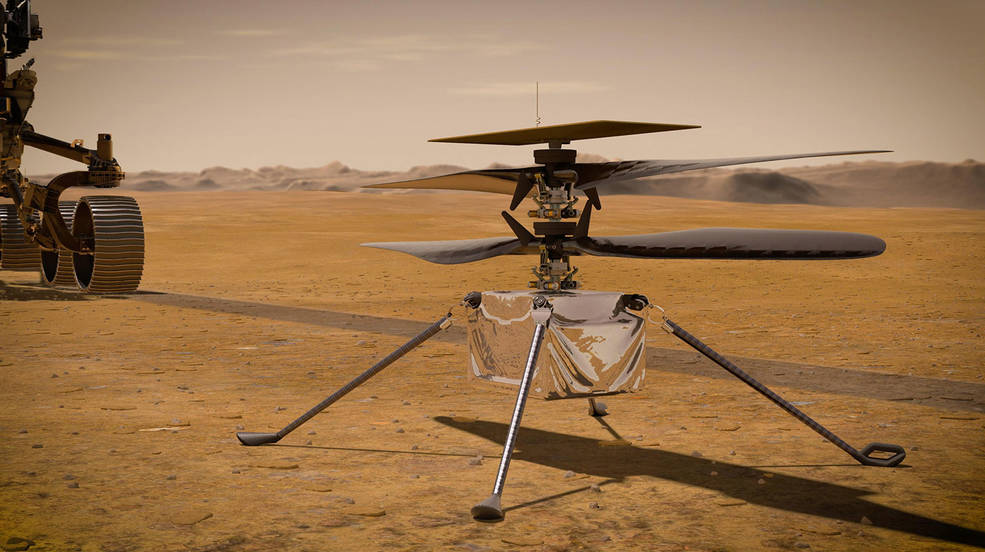
In this illustration, NASA’s Ingenuity Mars Helicopter stands on the Red Planet’s surface as NASA’s Perseverance rover (partially visible on the left) rolls away. Credits: NASA/JPL-Caltech
The difference between robotics and automation is almost nonexistent and yet has a huge difference in everything from trade shows, marketing, publications to academic conferences and journals. This week, the difference was expressed as an opportunity in the Dear Colleague Letter below from Professor Ken Goldberg, CITRIS CPAR and UC Berkeley, who suggested that students whose papers were rejected from ICRA, revise them for CASE, the Conference on Automation Science and Engineering. This opportunity was expressed beautifully in the title quote from Professor Raja Chatila, ex President of IEEE Robotics and Automation Society and current President of IEEE Global Society on Ethics of Autonomous and Intelligent Systems. “One robot on Mars is robotics, ten robots on Mars is automation.”
Dear Colleagues,
Over 2000 papers were declined by ICRA today, including many that can be
effectively revised for another conference such as IEEE CASE (deadline 15
March).
IEEE CASE, the annual Conference on Automation Science and Engineering, is
a major IEEE conference that is one of three fully-supported IEEE
conferences in our field (with ICRA and IROS).
In 2021 CASE will be held 23-27 August. It will be hybrid, with a live
component in Lyon France and an online component:
https://case2021.sciencesconf.
IEEE CASE was founded in 2006 so is smaller but growing quickly. The
acceptance rate for the last CASE was about 56%, higher than ICRA 2021
(48%), IROS, or RSS. I consider this a feature not a bug: it is an
excellent venue for exploratory and novel projects.
IEEE CASE continues the classic conference model of featuring a 10-15 min
oral presentation of each paper in contrast to poster sessions. This is
particularly exciting for students, who get the valuable experience of
lecturing and fielding questions in front of an audience of peers.
IEEE CASE also has a tradition of spotlighting papers nominated for awards
such as Best Paper, Best Student Paper, etc. Each nominated paper is
presented in special single session track on Day 1, where everyone at the
conference attends and there is a lively Q&A led by judges.
IEEE CASE emphasizes Automation. Automation is very closely related to
Robotics. There is substantial overlap, but Automation emphasizes
efficiency, robustness, durability, safety, cost effectiveness. Automation
also includes topics such as optimization and applications such as
transportation and mfg. I like how RAS President Raj Chatila summed up the
relationship 10 years ago: “One robot on Mars is robotics, ten robots on
Mars is automation.”
In China there are over 100 university departments
focused on Automation. The impact factor for the IEEE Transactions on
Automation Science and Engineering (T-ASE) this year is on par with T-RO
and higher than IJRR. Automation is important to put robotics into
practice.
Professor, Industrial Engineering and Operations Research
William S. Floyd Jr. Distinguished Chair in Engineering, UC Berkeley
Director, CITRIS People and Robots Lab
tags: ICRA, Ken Goldberg

AUAI is supported by:









