
Robohub.org
Parrot grows both consumer and commercial drone business
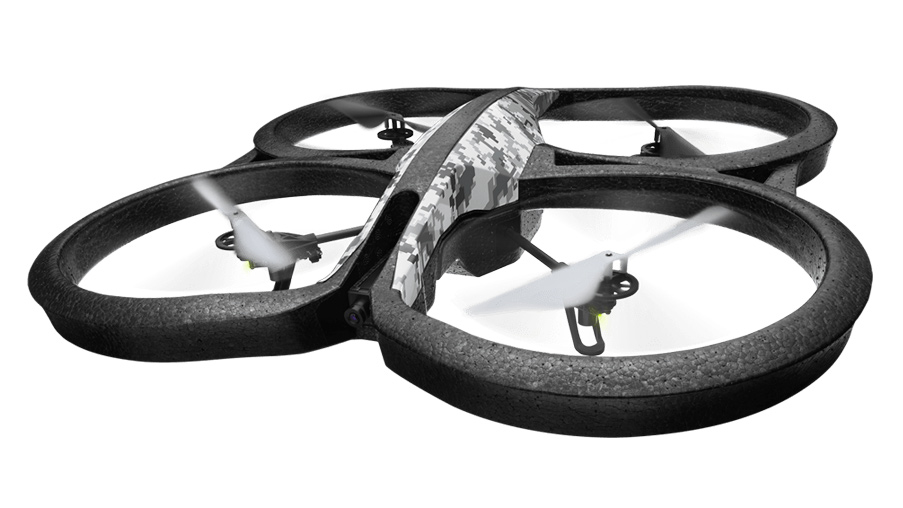
Previously known for consumer products for smartphones, tablets and cars, Paris-based Parrot recently branched into both the consumer and commercial drone businesses.
Previously known for consumer products for smartphones, tablets and cars, Paris-based Parrot recently branched into both the consumer and commercial drone businesses.
Parrot created the AR.Drone quadcopter and revealed it at CES 2010 in Las Vegas. Since then they have sold over a million of them – 700M in 2014 alone! In 2014, drones generated 34% of Parrot’s total revenue. At CES 2014 they launched two new mini drones for the retail consumer market. All appear to have done quite well during the Christmas season.
But what is particularly interesting is Parrots growth In the commercial drone sector. Parrot is acquiring companies and developing products to provide drones, software and data solutions for the agriculture, mapping and surveillance industries. To jumpstart their movement toward commercial drones, two spinoffs from the Swiss Federal Institute of Technology (EPF), senseFly and Pix4D, were invested in in 2012.
- senseFly
 designs and develops a line of winged drones and is soon to release a quadcopter as well. All their drones are for commercial use. senseFly’s $25K eBee drone was rated one of the Top 7 Drones for Agriculture in 2014 by DroneLife.
 - Pix4D provides image processing software for mapping and modeling geo-referenced 2D images into 3D models and for a wide range of GIS and CAD applications.
Two more acquisitions in B2B (business-to-business) drones happened in 2014: Parrot invested in MicaSense and Airinov.
- MicaSense is a Seattle-based software and systems company providing advanced data gathering and processing, coupled with professional analysis tools, to provide accurate and repeatable information on the status of a crop. Raw data from the MicaSense camera, a lightweight, multispectral camera, is transformed into vegetation index maps. Powerful analytics provide time-based trends and change maps. Analysis tools such as plant population counts enable optimized farm management. Parrot invested $2M in a Series A round of funding in November, 2014.
- Airinov is a French provider of UAV farming applications and sensors for use on senseFly and other UAS. Their software can process flight and sensor data and produce fertilization recommendations which are compatible with most brands of dispenser equipment. Parrot invested $2.2M for a 20.9% equity interest in Airinov.
Henri Seydoux, Parrot’s founder, chairman and CEO, said:
We are moving forward with our external growth policy initiated in 2011 and focusing on new products with high-potential, outstanding and complementary technological expertise, applications for commercial and retail customer segments, strong operational and financial synergies. Parrot intends to meet the needs of professionals moving into the civil drone age and firmly believes in the commercial potential of this market, (on which the Parrot AR.Drone has already enabled us to gain global recognition) and I am very pleased that we can also serve the commercial drone market as well.
Agriculture is one of the fastest-growing market segments for unmanned aircraft commercial applications. The sensors required to capture accurate data are a critical part of the solution, and [our recent acquisition of MicaSense and Airinov] brings this technology to the table.
As much fun as Parrot’s drones are, there is a growing market for professional service drones for mapping, surveying, protection, real estate photography and agricultural uses. Shenzen-based Dajiang Innovation Technology (DJI) has sold over 400M of their line of consumer and B2B drones; San Francisco startup Skycatch has partnered with one of the largest heavy machinery makers, Komatsu, to automate construction and mining job sites world wide using drones, mapping software and various sensors.
- There is also a steadily growing defense and first-responder market led by Lockheed Martin, Boeing, AeroVironment, Elbit and Northrup Grumman. The Global UAV Market 2015-2025 projects the global defense UAV market to grow at a 5.66% CAGR from 2014 to 2025 with North America and Europe the largest markets and the military drone segment (UCAV – unmanned combat aerial vehicle) to dominate the UAV market.
- But the real good news is Wintergreen Research’s report entitled “Commercial Drones: Highways in the Sky, UAS, Market Shares, Strategies and Forecasts, Worldwide, 2015 to 2021” (whew!) which projects commercial drone growth at 34.3% CAGR over the period from 2014 to 2021. That’s game-changing growth!
tags: AR Drone, business, mapping & surveillance, Parrot, Pix4D, SenseFly, UAVs & drones

AUAI is supported by:









