Robohub.org
RoboThespian gets its own YouTube channel
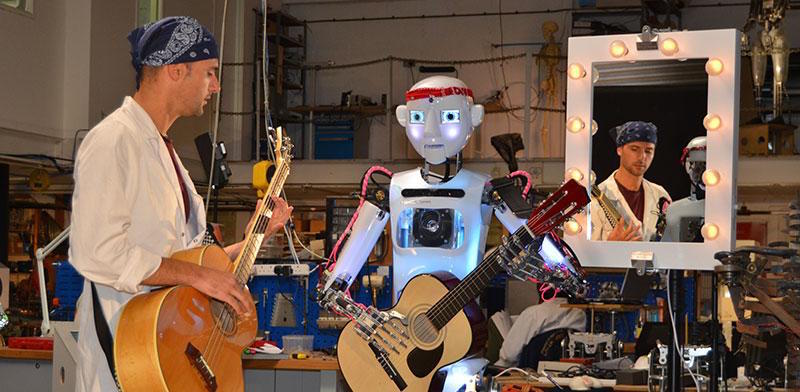
National Geographic’s new movie, Robots 3D, proves that robots don’t need to be sci-fi to be compelling.
The team behind RoboThespian, a life-sized humanoid robot designed for human interaction in a public environment, have launched a new YouTube channel: Robot’s World. The robot is very much real and enjoys a bit of profanity in its first episode about the confusion between AI and robots.
Watch here:
Engineered Arts was founded in October 2004 by Will Jackson, to produce mixed media installations for UK science centres and museums, many of which involved simple mechanical figures, animated by standard industrial controllers.
In early in 2005, the Company began work on the Mechanical Theatre for the Eden Project. This involved three figures, with storylines focused on genetic modification. Rather than designing another set of figures for this new commission, Engineered Arts decided to develop a generic programmable figure that would be used for the Mechanical Theatre, and the succession of similar commissions that would hopefully follow. The result was RoboThespian Mark 1 (RT1).
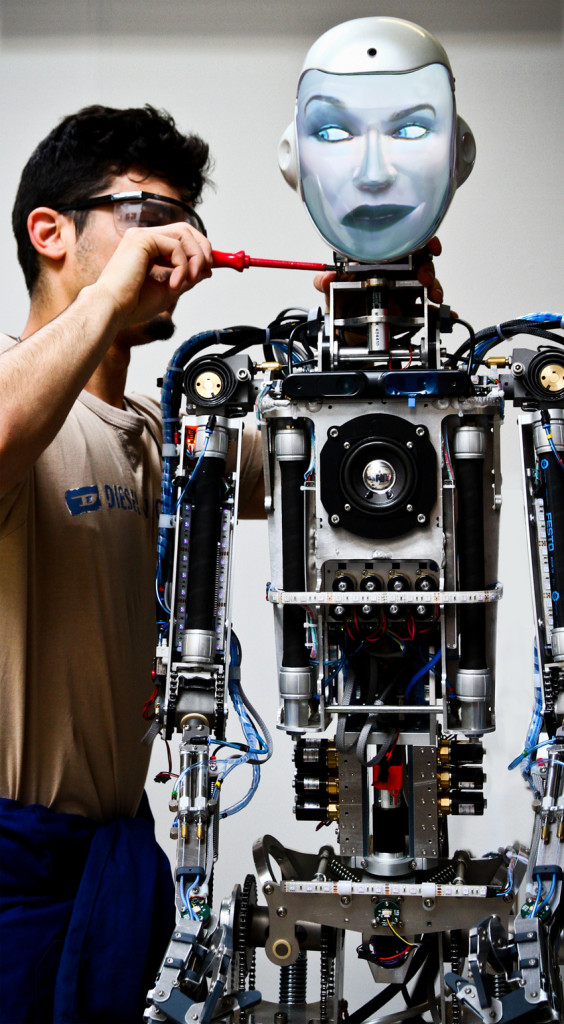
RoboThespian being assembled in the Engineered Arts’ workshop. Source: Engineered Arts
“After 10 years designing and building full sized humanoids, similar questions kept coming up again and again. So, in part, this is a way to address those,” said Will. “The first episode is to try and dispel some myths about AI, for example, a talking robot tells the audience it is stupid — talking does not automatically equivolate intelligence. Also, just because a machine looks like a person does not mean it has any human qualities.”
Each episode takes about 2-3 weeks to create. The team programmes the movement in their virtual simulation software, and films in their workshop.
“I wanted to focus a little more on creative uses for our robots, rather than always leaving the fun part to someone else,” said Will. “We are now making episode 2, which looks at robots as domestic servants. Humanoids are not at all likely to be useful for utility tasks around the home in the foreseeable future.”
And the comical profanity?
“Well … Robot’s ranting personality is somewhat a proxy for myself,” said Will. “The second episode is a lot less profanity-laden — I think I just needed to get that rant out!”
“Most of all, we are not afraid to make fun of ourselves. We do some extremely difficult engineering. The 4th iteration of our dynamic biped, Byrun, will be completed soon — at the same time, we know primarily that using humanoid robots is for entertainment value and communication. We are looking to push the boundaries in that space.”
You can subscribe to Robot’s World on their YouTube channel.
If you liked this post, you may also like reading:
- Robots Podcast #173: RoboThespian, with Will Jackson
- Robots at #ERW2015: From imagination to market
- RoboThespian co-hosts new robot documentary from CBC – “Roboticize Me”
tags: arts & entertainment, robohub focus on arts and entertainment, RoboThespian

AUAI is supported by: