
Robohub.org
In today’s episode we speak with two authorities in robotics, George Bekey and Rodney Brooks about the last 50 years of robotics, the ongoing robot revolution and future prospects.
George Bekey
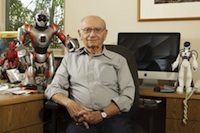 George Bekey is one of the father of robotics. In the 1960s, he designed and built the first four-legged robot in North America. He later founded the Biomedical Engineering Department and the Robotics Research Laboratory at the University of Southern California.
His laboratory designed and built several five-fingered robot hands and developed grasping theory. Their work included a knowledge-based approach to grasping and the use of robot hands as models for prosthetic hands. He also worked with his students to develop an autonomous helicopter, study gait control in legged robots and create a walking machine governed by genetic algorithms. His experience led him to write a book on Autonomous Robots published in 2005.
A member of the National Academy of Engineering, Bekey was chosen by the National Science Foundation (NSF) and National Aeronautics and Space Administration (NASA) to lead a 2005-2006 assessment of the state of robotics in the United States, Western Europe and the Pacific Rim. The team’s findings culminated in a report to its federal sponsors on American competitive advantages and weaknesses on the international stage.
He retired after 40 years as a full-time faculty member at USC and continues to be active in his community and in his profession. He currently serves on the advisory boards of several robotics and high-tech companies.
In this interview, we discuss the history of robotics and his vision of the future with emphasis on bio-inspiration, learning, human robot interactions and ethics.
Rodney Brooks
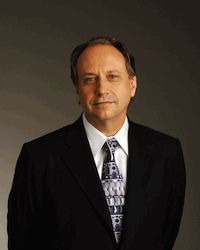 Rodney Brooks has been one of the main actors in the field of robotics over the past 30 years. He received degrees in pure mathematics from the Flinders University of South Australia and a Ph.D. in Computer Science from Stanford University in 1981. He held research positions at Carnegie Mellon University and MIT, and a faculty position at Stanford before joining the faculty of MIT in 1984 where his work focused on computer vision, artificial intelligence, robotics, and artificial life.
Brooks was the director of the MIT Computer Science & Artificial Intelligence Laboratory (C-SAIL) Laboratory until 2007 and one of the founders of iRobot. He is currently the founder, chairman and CTO of Heartland Robotics that aims to revolutionize manufacturing and increase productivity of industries using robots that are teachable, safe and affordable.
Per was able to briefly meet with Brooks at the RobotDalen conference in Sweden. A video of Brooks’ keynote can be found below.
Links:
- Download mp3 (28.6MB)
- Subscribe to Robots using iTunes
- Subscribe to Robots using RSS
- George Bekey’s Homepage
- Rodney Brook’s Homepage
tags: ethics, podcast

AUAI is supported by:









