Robohub.org
Teams and Tasks with Lynne Parker
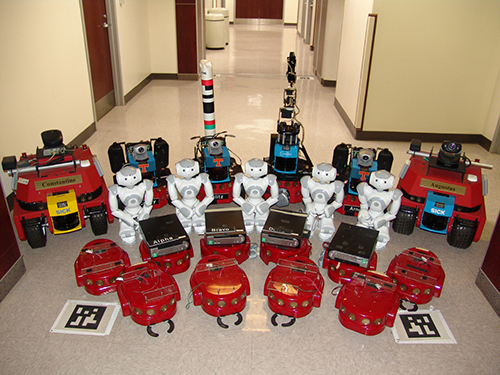
In today’s episode, Per Sjöborg speaks with Lynne Parker from the University of Tennessee about her work with robot teams. Her lab is developing techniques to get robots to team up to complete tasks that they individually could not. The robots share data from sensors to extend their perception or share capabilities to perform particular tasks. This approach is essential to increase the efficiency, potential and reliability of multi-robot systems.
Ideally, multi-robot systems should be able to cope with different types of robots joining or leaving the team, and tasks changing over time. While most approaches would require a roboticist to manually predefine how the robot team accomplishes its task, Parker automates this process using smart algorithms and software architectures. This makes the design of multi-robot systems more manageable in the long run since one framework can be used in different situations.
Dr. Parker also works on integrating humans in the robot teams. This allows implicit communication between the robot and the human coworker to reduce the workload on the human and make the interaction more efficient.
In the long term, she hopes her research in multi-robot systems will enable applications in security, surveillance, and reconnaissance; planetary exploration; search and rescue; cleanup of hazardous waste; mining; construction; automated manufacturing; industrial/household maintenance; and nuclear power plant decommissioning.
Lynne Parker
 Lynne E. Parker is Professor and Associate Head in the Department of Electrical Engineering and Computer Science at The University of Tennessee-Knoxville (UTK). At UTK, she is the founder and director of the Distributed Intelligence Laboratory, which performs research in multi-robot systems, sensor networks, machine learning, and human-robot interaction.
Parker is a leading international researcher in the field of distributed multi-robot systems. She has published over 135 articles in the areas of mobile robot cooperation, human-robot cooperation, sensor networks, robotic learning, intelligent agent architectures, and robot navigation. These publications include five edited books on the topic of distributed robotics.
She is the Editor-in-Chief of the IEEE Robotics Automation Society’s Conference Editorial Board, Senior Editor of IEEE Transactions on Robotics, Associate Editor of IEEE Intelligent Systems Magazine and an Associate Editor of the Swarm Intelligence journal. She serves on numerous international conference program committees. She is also an elected member of the Administrative Committee of the IEEE Robotics and Automation Society.
Links:
- Download mp3 (21.2MB)
- Subscribe to Robots using iTunes
- Subscribe to Robots using RSS
- Lynne Parker’s Website
- The Distributed Intelligence Laboratory’s Website
tags: podcast, swarm

AUAI is supported by: