Robohub.org
 

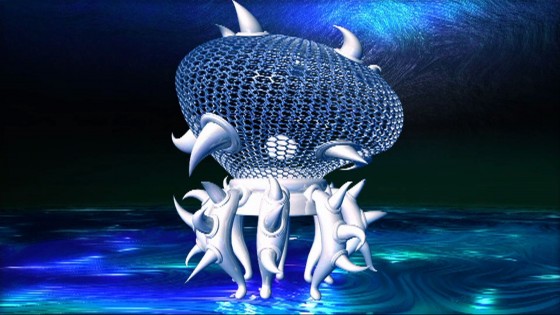
“Space Jellyfish” created with traditional handicraft and high tech

by
20 January 2013


share this:
12-0198-n

Professor Yoichiro Kawaguchi of the University of Tokyo Interfaculty Initiative in Information Studies is building a robot of a swimming jellyfish based on the theme of “space jellyfish.” To artistically express the ambience of a wriggling jellyfish, he selected the theme of a jellyfish swimming in space.

“I don’t believe there have been many soft-bodied creatures of this type that have been made into a robot. It requires creating numerous delicate movements. We put together simple configurations and focused on creating the elegant movements of the jellyfish. While skillfully integrating repeated wavering motions, for the future I would like to make it so that it can elicit various emotions. For this exhibit I would be satisfied to have people see both the design and movements.”

“This model is made of a ceramic pottery known as Satsuma porcelain. I once asked the most famous local Satsuma porcelain artisan named Chin Jukan to make a CG model for me. I thought this could be further improved, which has led to the current model made.”

Kawaguchi ultimately wants to make not just traditional handicraft but rather something capable of space travel.

“For the future I am thinking of incorporating traditional handicraft in the manufacturing process, so I am also considering lacquering. I am thinking of using previously unused combinations to draw out new possibilities.”

With an eye towards creating a new industry and exporting Japanese traditional handicrafts to the world, Kawaguchi is considering the incorporation of high tech in future product development.


tags:


DigInfo TV is a Tokyo-based online video news platform dedicated to producing original coverage of cutting edge technology, research and products from Japan.

            AUAI is supported by:


Subscribe to Robohub newsletter on substack


Related posts :

Developing active and flexible microrobots

  13 May 2026
This class of robots opens up possibilities for biomedical applications.

How to teach the same skill to different robots

  11 May 2026
A new framework to teach a skill to robots with different mechanical designs, allowing them to carry out the same task without rewriting code for each.

Robot Talk Episode 155 – Making aerial robots smarter, with Melissa Greeff

  08 May 2026
In the latest episode of the Robot Talk podcast, Claire chatted to Melissa Greeff from Queen's University about autonomous navigation and learning for drones.

New understanding of insect flight points way to stable flapping-wing robots

  07 May 2026
The way bugs and birds flap their wings may look effortless, but the dynamics that keep them aloft are dizzyingly complex and difficult to quantify.

Robotically assembled building blocks could make construction more efficient and sustainable

  05 May 2026
Research suggests constructing a simple building from interlocking subunits should be mechanically feasible and have a much smaller carbon footprint.

Robot Talk Episode 154 – Visual navigation in insects and robots, with Andrew Philippides

  01 May 2026
In the latest episode of the Robot Talk podcast, Claire chatted to Andrew Philippides from the University of Sussex about what we can learn from ants and bees to improve robot navigation.

Ultralightweight sonar plus AI lets tiny drones navigate like bats

  29 Apr 2026
Researchers develop ultrasound-based perception system inspired by bat echolocation.

Gradient-based planning for world models at longer horizons

  28 Apr 2026
What were the problems that motivated this project and what was the approach to address them?


AUAI is supported by:


Subscribe to Robohub newsletter on substack


©2026.02 - Association for the Understanding of Artificial Intelligence