
Robohub.org
Teaching ROS quickly to students
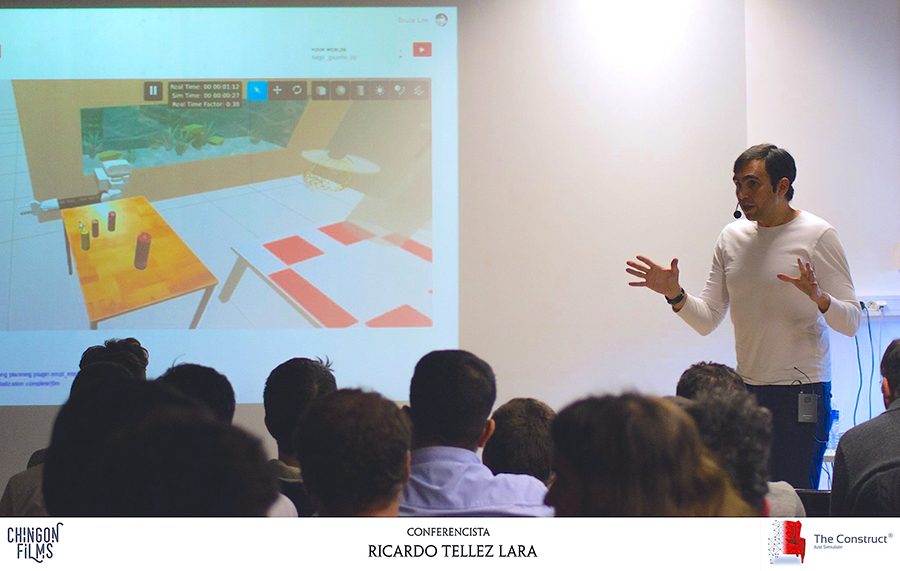
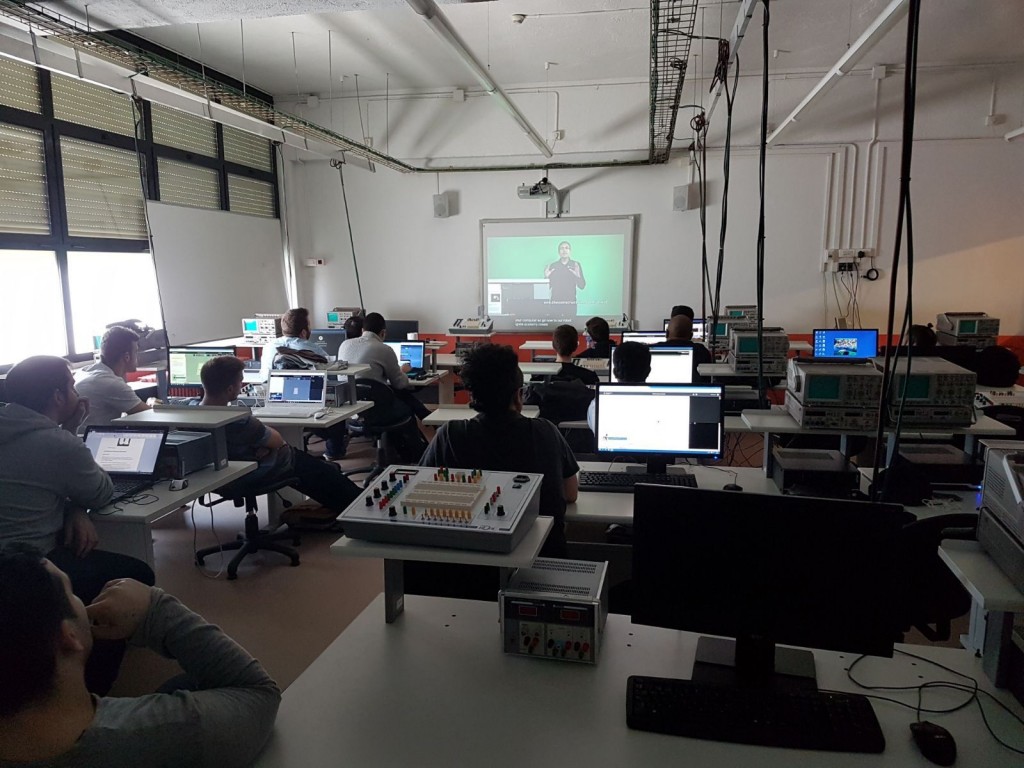
Lecturer Steffen Pfiffner of University of Weingarten in Germany is teaching ROS to 26 students at the same time at a very fast pace. His students, all of them within the Master on Computer Science of University of Weingarten, use only a web browser. They connect to a web page containing the lessons, a ROS development environment and several ROS based simulated robots. Using the browser, Pfiffner and his colleague Benjamin Stähle, are able to teach how to program with ROS quickly and to many students. This is what Robot Ignite Academy is made for.
“With Ignite Academy our students can jump right into ROS without all the hardware and software setup problems. And the best: they can do this from everywhere,” says Pfiffner.
Robot Ignite Academy provides a web service which contains the teaching material in text and video format, the simulations of several ROS based robots that the students must learn to program, and the development environment required to build ROS programs and test them on the simulated robot.
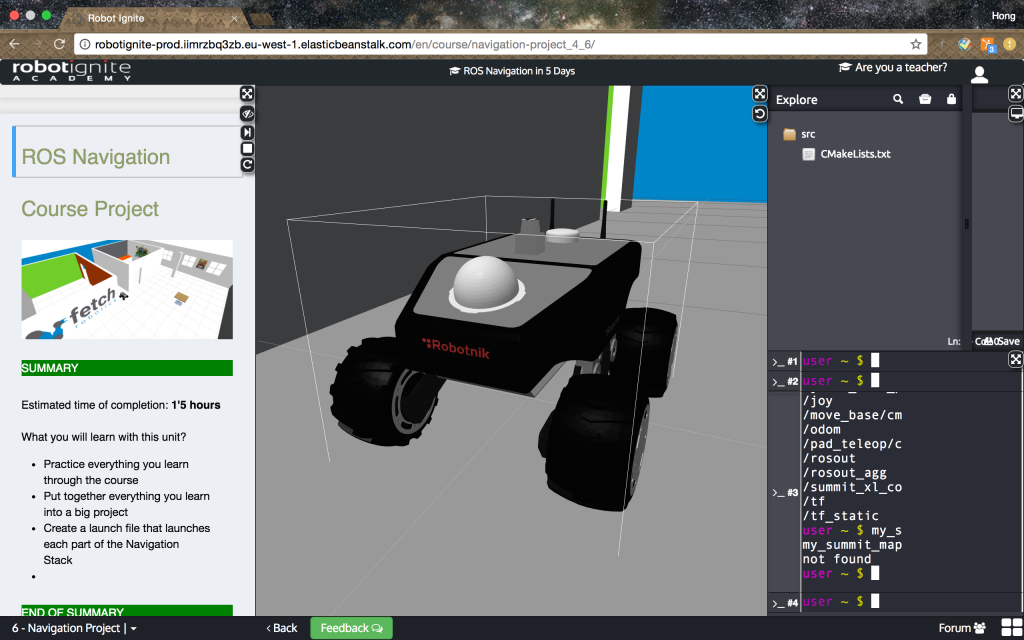
Student’s point of view
Students bring their own laptops to the class and connect to the online platform. From that moment, their laptop becomes a ROS development machine, ready to develop programs for many simulated real robots.
The Academy provides the text, the videos and the examples that the student has to follow. Then, the student creates her own ROS program and makes the robot perform a specific action. The student develops the ROS programs as if she is in a typical ROS development computer.
The main advantage is that students can use a Windows, Linux or Mac machine to learn ROS. They don’t even have to install ROS in their computers. The only prerequisite of the laptop is to have a browser. So students do not mess with all the installation problems that frustrate them (and the teachers!), especially when they are starting.
After class, students can continue with their learning at home, library or even the beach if there is a wifi available! All their code, learning material and simulations are stored online so they can access them from anywhere, anytime using any computer.
Teacher’s point of view
The advantage of using the platform is not only for the students but also for the teachers. Teachers do not have to create the material and maintain it. They do not have to prepare the simulations or work on multiple different computers. They don’t even have to prepare the exams!! (which are already provided by the platform).
So what are the teachers for?
By making use of the provided material, the teacher can concentrate on guiding the students by explaining the most confusing parts, answer questions, suggest modifications according to the level of each student, and adapt the pace to the different types of students.
This new method of teaching ROS is exploding among the Universities and High Schools that want to provide the latest and most practical teachings to their students. The method, developed by Robot Ignite Academy, combines a new way of teaching based on practice and an online learning platform. Those two points combined make the teaching of ROS a smooth experience and can potentially see the students’ knowledge base skyrocket.
As user Walace Rosa indicates in his video comment about Robot Ignite Academy:
It is a game changer [in] teaching ROS!
The method is becoming very popular in the robotics circuits too, and many teachers are using it for younger students. For example, High School Mundet in Barcelona is using it to teach ROS to 15 years old students.
Additionally, the academy provides a free online certification exam with different levels of knowledge certification. Many Universities are using this exam to certify that their students did learn the material since the exam is quite demanding.
Some examples of past events
- 1 week ROS course in Barcelona for SMART-E project team members. This is a private course given by Robot Ignite Academy at Barcelona for 15 members of the SMART-E project that need to be up to speed with ROS fast. From 8th to 12nd of May 2017
- 1 day ROS course for the Col·legi d’Enginyers de Barcelona. The 17th of May 2017.
- 3 months course for University of La Salle in Barcelona within the Master on Automatics, Domotics and Robotics. From 10th of May to 29th of June 2017.
- 1 weekend ROS course for teenagers in Bilbao, Spain. The 20th and 21st of May 2017.
- We can also organize a special event like these for you and your team.
Helpful ROS videos
tags: coding, control, programming, research, ROS, software

AUAI is supported by:









