
Robohub.org
The Drone Center’s Weekly Roundup: 2/2/15
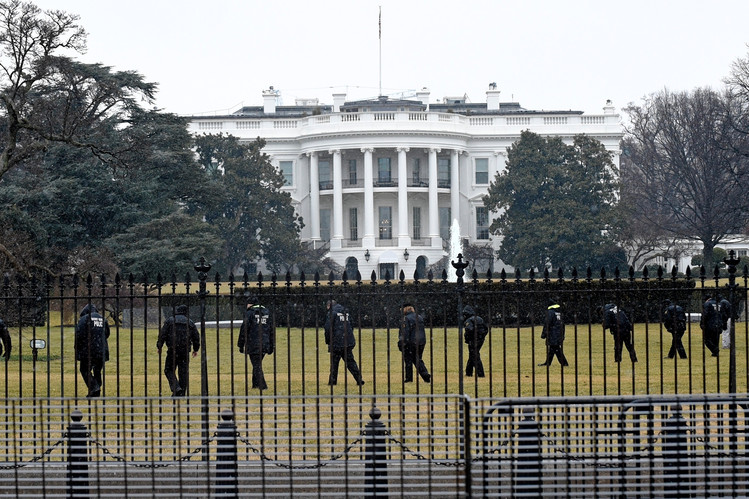
Secret Service officers search White House grounds after a hobbyist drone crashed on the lawn. Credit: Associated Press
At the Center for the Study of the Drone
This week, we introduced the Portals, comprehensive collections of the best multimedia resources on a variety of issues on drones. Portals are now available on Strategy, Terrorism and Targeted Killing, and the Laws of War.
News
A U.S. drone strike in Yemen reportedly killed three members of al-Qaeda in the Arab Peninsula. The strike targeted a vehicle in the central Marib province carrying two men and, potentially, a teenage boy. The strikes took place amid increasing turmoil in Yemen and uncertainty as to whether the U.S. counterterrorism operations there will continue. (New York Times)
A second drone strike in Yemen reportedly killed four people. The strike targeted a vehicle traveling in the Shabwa province. It was the second strike in Yemen this year. (Associated Press)
A U.S. drone strike in Pakistan reportedly killed six people. The strike targeted a suspected Taliban compound in the Shawal area of North Waziristan. An unnamed Pakistani security official told Agence-France Presse that the victims were believed to be from Central Asia. It is believed to be the fifth drone strike in Pakistan this year.
A DJI phantom quadcopter drone crashed on White House grounds last week. The owner of the drone was reportedly test-flying in downtown Washington D.C. when the machine malfunctioned. The owner, whose identity has not been released to the public, is believed to be employed by the National Geospatial-Intelligence Agency. (New York Times)
In response to the White House drone incident, drone manufacturer DJI said that it will introduce software changes that will keep drones out of restricted areas. The required software update will prevent users from taking off or flying within a 15.5-mile radius of Washington D.C.’s restricted airspace. (The Telegraph)
The U.S. Air Force Scientific Advisory Board (SAB) announced that it will spend the year studying the roles that three new technologies—including drones—will play in the future fighting force. At a meeting at the Secretary of the Air Force Technical and Analytical Support Conference Center last week, the USAF SAB determined that it will focus on the ability of drones to operate in contested environments. The board will release a report of its findings in December. (Military Times)
The Federal Aviation Administration announced that the Super Bowl was a “No Drone Zone.” The FAA suggested that everyone leave their drones at home and reminded attendees that there were penalties for flying drones over crowded stadiums. (Gizmodo)
A Chinese-made CH-3 drone reportedly crashed in Nigeria’s Borno province. Photos of the drone, which is thought to be owned by the Nigerian military, show the aircraft upside down with two anti-tank missiles strapped to the wings. (Popular Science)
Thailand’s Transport Ministry is reportedly working on new regulations that will prohibit members of the public from flying drones fitted with cameras. The regulations should go into effect next month. (Bangkok Post)
Commentary, Analysis and Art
At Forbes, Greg McNeal writes that the FAA’s forthcoming drone rules may also apply to toy remote-controlled aircraft.
Sales of drones on eBay have passed $16 million since last March, reports Frank Bi at Forbes.
At War on the Rocks, Paul Scharre points out that drones are a big ticket item to look for in the forthcoming Department of Defense budget.
At Warscapes, Jyoti Omi Chowdhury considers the strategic viability of continuing drone strikes in Pakistan and Yemen.
At Breaking Defense, Richard Whittle writes that the U.S. Army is increasingly teaming manned helicopters with drones.
At Popular Mechanics, Joshua A. Krisch considers how long it will be until ambulance drones work on the battlefield.
At the Yemen Times, Ahlam Mohsen and Amal al-Yarisi argue that American drone strikes against al-Qaeda in the Arab Peninsula are often counterproductive.
The Editorial Board of the New York Times criticizes both the Obama administration and Congress for failing to pass a new war authorization for the air campaign against the Islamic State.
Also at the New York Times, Michael S. Schmidt and Michael D. Shear write that recent security breaches by hobby drone pilots are fueling concerns that the small aircraft could be used in attacks.
At IEEE Spectrum, David Schneider argues that small drones are not a big threat to commercial aircraft.
In a “Snapchat Interview,” Senator Rand Paul (R-KY) said that he would shoot down with a shotgun any drone that flies over his property. (CNN)
The Washington Post picked out the best moments in the coverage of the White House drone incident on late-night comedy shows.
Also at the Post, Matt McFarland argues that Washington’s no-fly zone hurts drone innovation.
At Time, Dan Kedmey considers why, in spite of DJI’s software updates, “keeping drones out of no-fly zones is harder than you think.”
At Slate, Konstantin Kakaes questions why drone manufacturers are helping the U.S. government crack down on hobbyists.
Afghan weavers in Pakistan are including images of drones on traditional rugs. (The Atlantic)
Know Your Drone
The Marine Corps Times takes a closer look at Qinetiq’s Modular Advanced Armed Robotic System, a machine gun equipped ground robot.
Defense One’s Patrick Tucker considers what kind of anti-drone measures the Secret Service might have used against that drone the crashed on the White House lawn.
Security researcher Rahul Sasi has developed malware that can take control of a drone’s autonomous flight system. (Gizmodo)
Drones at Work
Arthur Holland Michel profiles a born-again Christian who uses drones to get closer with God. (Motherboard)
YouTube user Sky Frog posted a video imagining what it would be like for a drone delivery service to operate in Hong Kong. (Boing Boing)
U.S. Lieutenant General Ben Hodges, the commander of NATO forces in Europe, told reporters that pro-Russian forces are using drones to target Ukrainian troops. (Defence Talk)
ESPN released a video of drone footage from the X-Games.
A team from the University of Maryland’s Institute for Advanced Computer Studies has developed a system to use data from drones and satellites is being used to curb rhino poaching. (Mashable)
At the French theme park Puy du Fou, a nighttime show called Cinéscénie is reaching ambitious new heightswith the incorporation of 50 drones.
A farmer in Kansas used a drone to capture “cow art.” (YouTube)
The Weekly Drone Roundup is a newsletter from the Center for the Study of the Drone. It covers news, commentary, analysis and technology from the drone world. You can subscribe to the Roundup here.
tags: c-Aerial, drones, UAVs

AUAI is supported by:









