Robohub.org
 

The Year of CoCoRo Video #17/52: Lily confinement by bluelight

by
30 April 2015


share this:


CoCoRo-17

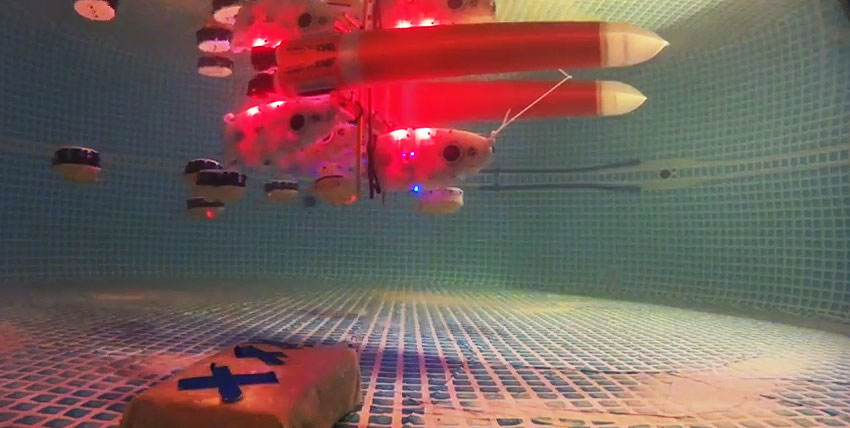
The EU-funded Collective Cognitive Robotics (CoCoRo) project has built a swarm of 41 autonomous underwater vehicles (AUVs) that show collective cognition. Throughout 2015 – The Year of CoCoRo – we will be uploading a new weekly video detailing the latest stage in its development. In this video we use blue-light blinks to keep the swarm together and to keep it in vicinity of the moving base station.

Due to this “confinement”, the radio-controlled base-station can pull a whole swarm of Lily robots like a tail behind itself. It is important to confine the robots into specific areas in larger water bodies because the swarm requires normally a minimum connectivity among agents to work efficiently, which is achieved only with a critical minimum swarm density. Without keeping the robots in a controlled area, robots could get lost and the robot density could fall below the critical density. Thus, confinement was identified to be a critical functionality.

To learn more about the project, see this introductory post, or check out all the videos from the Year of CoCoRo on Robohub.


tags: , , , , , , ,


Thomas Schmickl is an Associate Professor at Karl-Franzens University, Graz, Austria, and a lecturer at the University for Applied Sciences in St. Pölten, Austria.

            AUAI is supported by:


Subscribe to Robohub newsletter on substack


Related posts :

How green is your robot? And other awkward questions

Robots clean rivers and sort waste, monitor ecosystems, and inspect renewable-energy infrastructure. But even the greenest robot has an environmental footprint.

These tiny drones are powered by sound

  24 Aug 2026
EPFL engineers have designed acoustic cavities that convert sound waves into thrust, propelling small robots and ultralight aerial vehicles without on-board actuators or electronics.

#AAMAS2026 blue sky award winner: Foundation world models for agents in changing environments

and   21 Aug 2026
Hear from the AAMAS 2026 Best Blue Sky Paper Award winner.

Robotics roadmaps from around the world spotlight of the month: Japan

Robots have been a prolific theme in Japanese pop culture and media since the 1950s

Intermittent swimming promotes the energy efficiency of fish-like robot movements

How zebrafish-inspired robots save energy by swimming in bursts.

What does it take for a robot to hold a conversation with a room, not just a person?

and   14 Aug 2026
Find out about a summer school held at Imperial College London.

Robotics roadmaps from around the world

We embark on a tour into some of the recent and prominent robotics roadmaps from around the world.

A ‘5-in-1’ seed-sized surgical robot

Mini robot can move, cut tissue, release drugs, grip and store samples, and generate heat wirelessly


AUAI is supported by:


Subscribe to Robohub newsletter on substack


©2026.05 - Association for the Understanding of Artificial Intelligence