
Robohub.org
Travis Deyle on “Do robots need heads?”
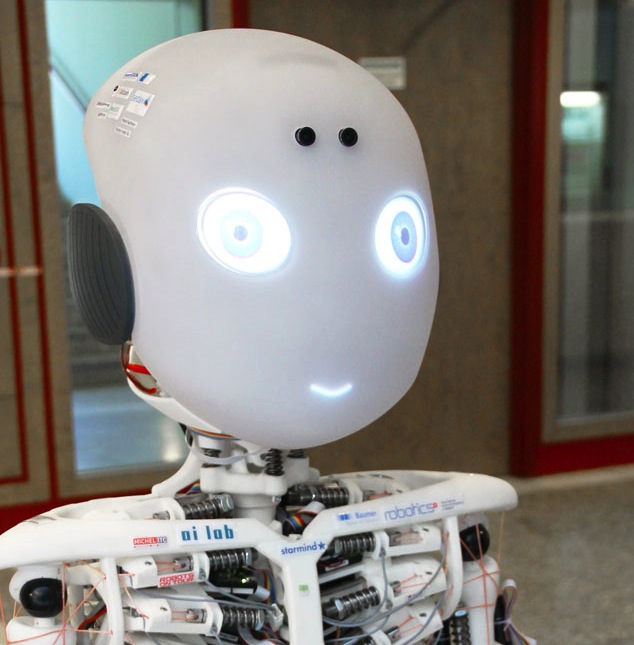 The obvious answer to this question is “No: there are lots of robots without heads.” It’s not even clear that social robots necessarily require a head, as even mundane robots like the Roomba are anthropomorphized (taking on human-like qualities) without a head. A follow-up question might be, “How are heads useful?” For humans, the reasons are apparent: food intake, a vessel for our brain, a locus for sensors (eyes and ears), and high-bandwidth communication via expression. What about for robots …?
- Food intake: Probably not.
- Computational storage: Again, probably not.
- Location for sensors: Indeed, the apex of a robot is a natural, obstacle-free vantage point for non-contact sensors. But a “head” form factor is not a strict requirement.
- Emotion and expression: Ah, the real meat of this question… “Do robots need to express emotion?”
This is a funny question to ask someone who once (in)famously advocated for either (A) extremely utilitarian designs: “I want my eventual home robot to be as unobtrusive as a trashcan or dishwasher”, or (B) designs unconstrained by the human form factor: “Why not give robots lots of arms (or only one)? Why impose human-like joint limits, arm configurations, and sensing? We can design our own mechanical lifeforms!”
My views have softened a bit over time. Early (expensive) general-purpose home robots will almost certainly have humanoid characteristics and have heads with the ability to express emotions (i.e. be social) — if nothing else, to appeal to the paying masses. And these robots will be useful: doing my laundry, cleaning my dishes, and cooking my meals. In the early attempts, I will still find their shallow attempts at emotion mundane and I will probably detest the sales pitches about “AI” and “robots that feel.” But as the emotional expressions become more natural and nuanced, and the robots become more capable, I will probably warm up to the idea myself.
TL;DR: No, many robots do not need heads. Even social robots may not need heads, but (whether I want them to or not) they probably will, because paying consumers will expect it.
tags: c-Research-Innovation, education, human-robot interaction, humanoid, RBI, Robotics by Invitation, Social aspect, Travis Deyle

AUAI is supported by:









