
Robohub.org
Urban vegetable garden system with LED lighting
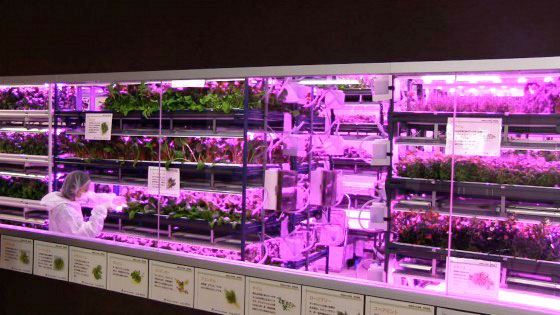
Keystone Technology’s LED vegetable garden system is a cultivation system for indoor plant factories that uses LED lighting instead of sunlight. The most defining feature of the system on display at the company’s showroom in Yokohama is its 3-dimensional use of space. “This is a 5-tiered cultivation system. For smaller heads of lettuce, you can harvest about 1,500 heads in one month. If this were to be fit into a container of about 20 feet (6m), it would be equivalent to 970 sq. meters. Thus with 16 sq. meters, you could produce an amount that is on par with 970 sq. meters.”
LED lighting has three different wavelengths of red, blue, and green. This system can control the illumination strength according to the stage of plant growth. So, cultivation that would require two and a half months with land cultivation can be reduced to less than one month of cultivation and harvesting.
“In most cases, lettuce grown indoors is crisper and does not have the coarse quality of lettuce grown in sunlight. Because it is softer, it is a vegetable that is easy to eat even for elderly people. Although this may be unexpected, as for the nutritional components or more accurately the functional ingredients, it is possible to obtain a larger content by percentage of vitamins and polyphenols than with vegetables grown in sunlight.”
With this system, there will be differences in production capacity depending on the shape of the plant. Because plants with leaves that spread sideways take up more space, the number of such stalks that can be cultivated is reduced. On the other hand, plants that grow upwards can be planted with smaller intervals so a greater number of stalks can be cultivated.
“This plant factory itself has been here for over 20 years, but there is very little history of plants grown with LED lighting. In particular for plants grown with red, blue, and green lighting, the produce displayed at a plant factory exhibition in July 2010 was our company’s first ever.”
Commercially available since 2010, this system has been installed in various factories, offices and eateries nationwide, such as by a leading eating establishment that has installed 48 units in its processing factory in Kanagawa Prefecture. As workers in Japan’s agricultural industry age, it is becoming more difficult to obtain safe and delicious vegetables through traditional farming techniques. Keystone Technology will continue to offer new lifestyle ideas that provide cities with production capacity and integrate consumption and production.
If you liked this article, you may also be interested in:
- Harvey: A working robot for container crops
- Transformational robotics and its application to agriculture
- Air, water, energy and food in a nutshell: Space exploration as driver for sustainable robotic agriculture
- Robots Podcast: From the greenhouse to the fields
- Robots Podcast: FutureDairy
See all the latest robotics news on Robohub, or sign up for our weekly newsletter.
tags: agricultural robotics, environment & agriculture, Japan

AUAI is supported by:









