
Robohub.org
When it comes to regulating robotics, multiple questions are at issue
 Earlier this month the Brookings Institute published a paper by Ryan Calo titled “The case for a federally regulated robotics commission“. As much as I appreciate the thoughtfulness and readability of this whitepaper – and the broad distribution that the Brookings connection affords – I noticed that the paper does not mention the National Robotics Initiative (NRI), the Congressional Caucus for Robotics, the Congressional Unmanned Systems Caucus, nor any of the OSTP coordination activities or the US Roadmap for Robotics.
All of these groups and their activities, plus DARPA’s initiatives, are making inroads (albeit slowly) into government planning and funding, and any attempt to go it alone is, to me, a wasted opportunity for the whole robotics community.
Many (perhaps most) of the media stories about robotics – except from a very few news and robotics portal sites – are blown out of proportion. They thereby stoke speculation and foster feelings of cynicism that the stories are hype and not news. Consequently for those of us involved with robotics “news”, it’s important to not contribute to that disinterest and hype with headlines and stories that inflate reality or expectations.
Calo’s whitepaper received a goodly amount of attention in the media, and while it did not in any way contribute to the hype itself, unfortunately some of the stories written about it in the news already have. Consider these recent headlines:
US needs a new robotics agency or the machine overloads will win … or something
… or …
Robot car: Hit the shopping cart or the stroller? Who (or what) will make this decision?
An interesting chart from Google Trends lends credence to the thesis that robotics is more media hype than of actual interest. What appears to be of interest is robots themselves – mostly in movies and videos, and the threat of rampant AI – which is often at the core of sci-fi thrillers. The robotics industry is low man on the totem pole. Naturally this is all my spin on the chart below:
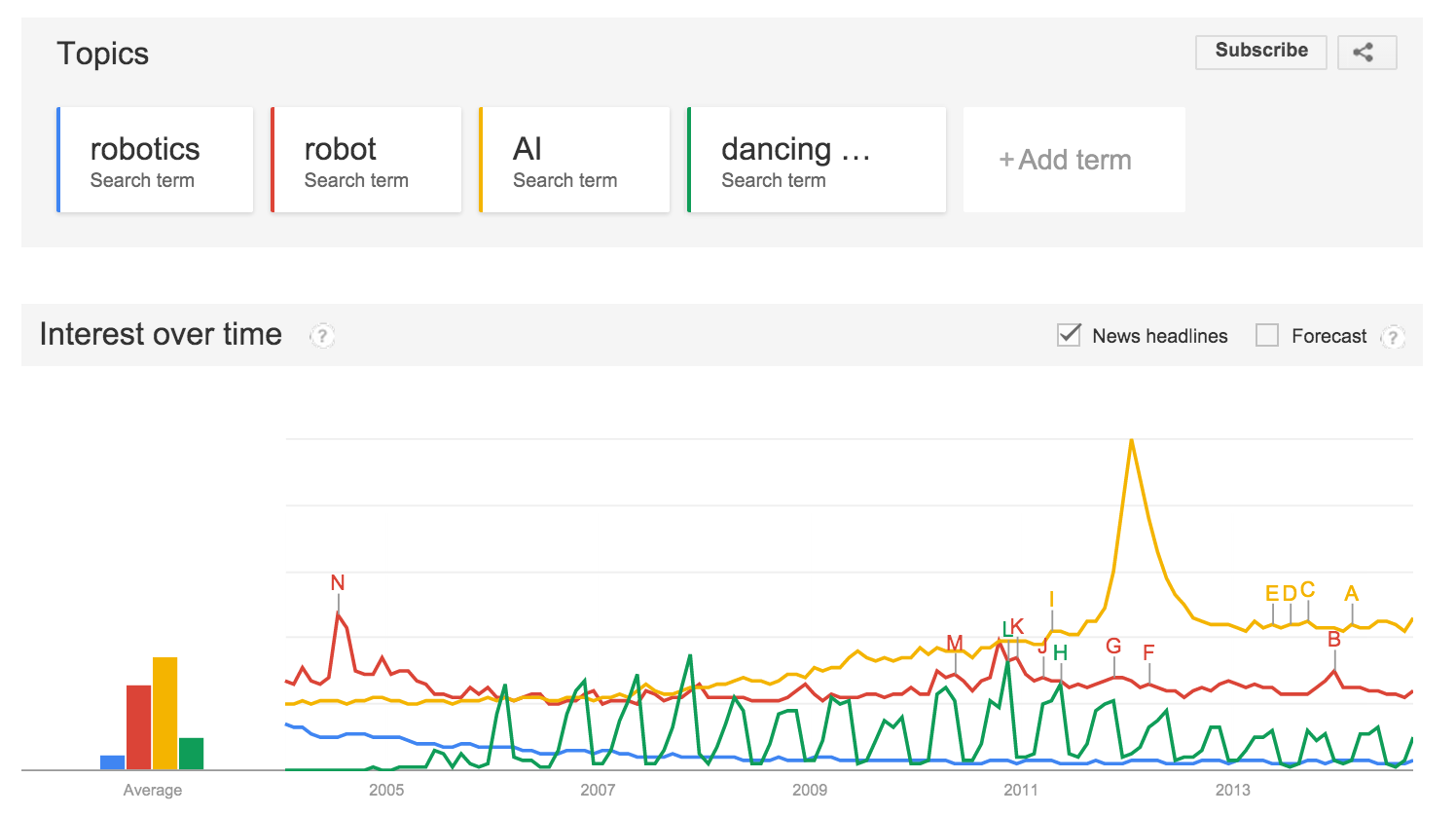
Robotics is just a dull blue flat line.
But returning to the question of whether robotics should be regulated, I think there are multiple questions at issue. For example:
- Does any country have a national policy regarding robotics?
- Korea, China, Japan and the EU do have such plans.
- Are they comprehensive?
- Do they regulate and/or stimulate?
- What’s their purpose?
- Korea, China, Japan and the EU do have such plans.
- If the US were to have a national policy regarding robotics, what would it cover, what would be the major premises, the strategic purpose, and how would it be administered?
- Laws, safety regulations, insurance, national defense, strategic goals, etc.
- Does America already have an implicit policy regarding robotics that could be aided by strategic governmental influence, or converting that implicit policy into a national policy?
- Is this what is happening already with the help of existing organizations such as the ones I mentioned above but that were left out of Calo’s article?
Further, one headline that seems especially appropriate to this discussion is this one: “Future of Robotics Debate Stumbles Over Question: What Is a Robot?“. The story, in eWeek, references the Brookings article, but points out that the analysts who were delivering the results of their studies on the Future of Civilian Robotics have yet to agree on what actually constitutes robotics.
The question of “What is a robot?” should be added to the list of questions above, as it is intrinsically linked to the issue of regulation: you cannot regulate something that you have not defined regardless whether it’s a moving target or not. As a community of robotics experts, we’ve been avoiding this particular subject, and I for one would like to see it tackled.
tags: politics, Robohub focus on regulating robotics, robot law, robot policy, robot regulation

AUAI is supported by: