Robohub.org
 

1.1M£ robotic “Porton Man” to test protective clothing for UK’s armed forces

by
07 April 2014


share this:

Porton-Man---cropped
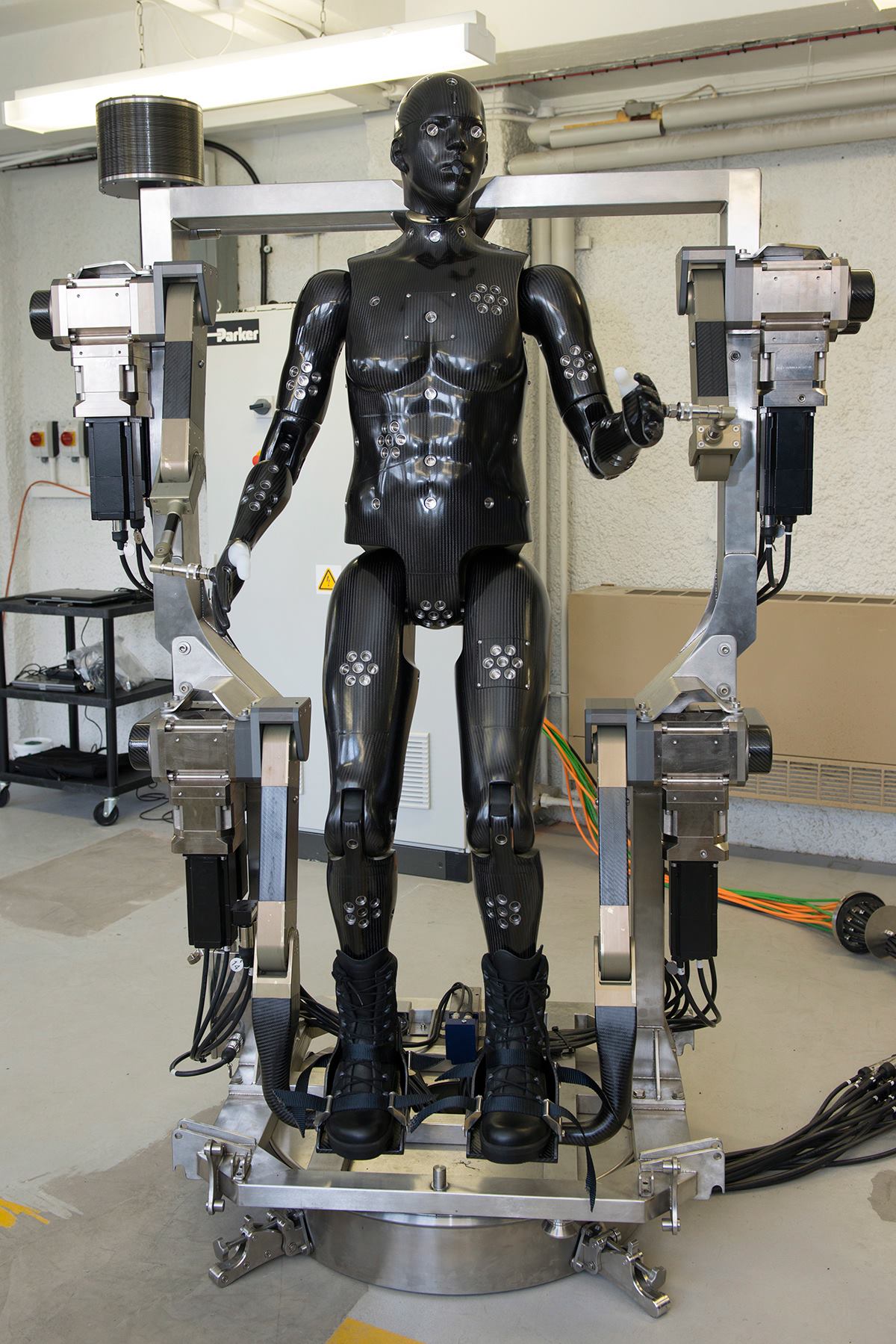
UK’s Ministry of Defense invested 1.1M GBP in a new robotic mannequin that will test protective suits and equipment for the UK’s armed forces. The project is named “Porton Man” and is able to emulate the movements of a soldier (march, sit, kneel and pose). It is equipped with more than a hundred sensors that monitor in real-time the performance of the tested article.

This animatronic mannequin is designed by i-bodi Technology for Defence Science and Technology Laboratory (DSTL), based in Porton Down in Wiltshire (hence the name). Its frame is made from CFRP parts, and in addition to the realistic movement emulation, it will be used to test equipment in extreme risk environments. The DSTL is the only laboratory in the world that can use chemical warfare agents to assess the effectiveness of complete clothing systems such as the chemical, biological and radiological suits used by UK Armed Forces.

Press release from UK MoD
Press release from Dstl
1956905_10152334085734885_5362528798753433553_o
1401528_10152360504029393_3039517513933889060_o

(via Royal Air Force / UK Armed Forces facebook page )


If you liked this article, you may also be interested in:

See all the latest robotics news on Robohub, or sign up for our weekly newsletter.


tags: , , ,


Ioannis K. Erripis joined the ROBOTS association in early 2011 as a news reporter and now leads all technical aspects of the Robohub project, including website design, implementation and branding.

            AUAI is supported by:


Subscribe to Robohub newsletter on substack


Related posts :

How to teach the same skill to different robots

  11 May 2026
A new framework to teach a skill to robots with different mechanical designs, allowing them to carry out the same task without rewriting code for each.

Robot Talk Episode 155 – Making aerial robots smarter, with Melissa Greeff

  08 May 2026
In the latest episode of the Robot Talk podcast, Claire chatted to Melissa Greeff from Queen's University about autonomous navigation and learning for drones.

New understanding of insect flight points way to stable flapping-wing robots

  07 May 2026
The way bugs and birds flap their wings may look effortless, but the dynamics that keep them aloft are dizzyingly complex and difficult to quantify.

Robotically assembled building blocks could make construction more efficient and sustainable

  05 May 2026
Research suggests constructing a simple building from interlocking subunits should be mechanically feasible and have a much smaller carbon footprint.

Robot Talk Episode 154 – Visual navigation in insects and robots, with Andrew Philippides

  01 May 2026
In the latest episode of the Robot Talk podcast, Claire chatted to Andrew Philippides from the University of Sussex about what we can learn from ants and bees to improve robot navigation.

Ultralightweight sonar plus AI lets tiny drones navigate like bats

  29 Apr 2026
Researchers develop ultrasound-based perception system inspired by bat echolocation.

Gradient-based planning for world models at longer horizons

  28 Apr 2026
What were the problems that motivated this project and what was the approach to address them?

Robot Talk Episode 153 – Origami-inspired robots, with Chenying Liu

  24 Apr 2026
In the latest episode of the Robot Talk podcast, Claire chatted to Chenying Liu from University of Oxford about how a robot's physical form can actively contribute to sensing, processing, decision-making, and movement.


AUAI is supported by:


Subscribe to Robohub newsletter on substack


©2026.02 - Association for the Understanding of Artificial Intelligence