
Robohub.org
Don’t throw out the baby with the bath water
There have been many headlines about “killer robots” and invasion of privacy. They protest that robots will soon choose targets and then bomb or shoot those targets under their own direction and will also invade people’s privacy through the use of drones. The issue, without the hyperbole, is whether there should be controls, what those controls should be, and who should administer them so that when advanced autonomous versions of today’s drones happen, as is sure to be the case 10-30 years from now, they won’t have the capability to kill people without human and governmental supervision and observe without legal authority.
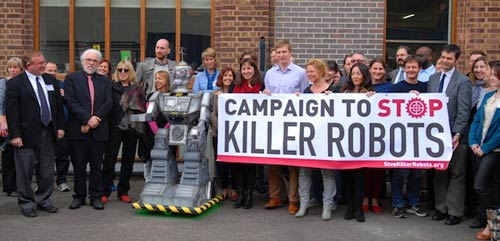
University of Sheffield (UK) AI and Robotics Professor Noel Sharkey (red tie) leading a group to protest killer robots.
Drones aren’t the only killer robots being discussed. There are also armed border robots in Israel and Korea, automatic missile defense systems on land and ships in many countries, and police surveillance drones. Except in the case of incoming missile defense, we don’t presently have the artificial intelligence capabilities to autonomously pick targets and implement armed attacks. In fact, we are many years away from that reality. Yet the headlines are written as if it is already happening.
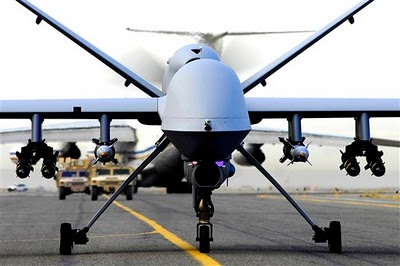
Armed with Hellfire missiles, General Atomics Predator drone prepares for take-off.
“Killer robots” is a “sell-papers” type of issue. It uses enflamed rhetoric because of America’s prolonged and very public use of armed drones to kill terrorists (albeit with a committee of human pilots and operators that actually pull the trigger even though they are thousands of miles away from the action) and the anger and moral, ethical and legal backlash to that.
Nevertheless, these scary headlines, which call for banning drones of all types, are obscuring the worth of forthcoming commercial applications for unmanned and autonomous flying robots. Unmanned aerial vehicles and systems (UAV and UAS) in agriculture, for mapping and surveying, for search and rescue, disaster relief, science, border patrol and a myriad other applications will begin to appear in America in 2016 (earlier in the EU and Australia where they aren’t as limited by the FAA as are the Americans).
There is no denying the commercial value of these new UASs. One story involving drones occurred recently in Haiti — it has all the elements of smart business, enterprising activists, the fun of flying, and the pleasure of helping. But this story didn’t receive any headlines.
Adam Klaptocz is an engineer and project manager with senseFly, a Swiss spin-off from the EPFL (and recently acquired by the Parrot Group). senseFly makes drones for mapping. Their eBee drone can take pictures down to 2″ precision. Adam and another senseFly employee, Emanuele Lubrano, independently founded a non-profit organization, Drone Adventures, to focus on humanitarian, conservation and cultural uses of drones beyond just mapping. Their first project – funded entirely by donations and grants from the IOM – was a two-week trip to Haiti. You can read about their adventure in a recent Robohub article.
Haiti has endured several recent natural disasters including a terrible earthquake at the beginning of 2010, a violent cholera epidemic at the end of 2010 and Hurricane Sandy at the end of 2012. Disasters not only result in casualties but they also change the landscape of the country; buildings and roads are destroyed and refugees create ever-moving encampments. There is a continuous need for up-to-date imagery for aid distribution, reconstruction and disaster relief.
The Drone Adventures video below shows the fun, the involvement, the flexibility and the need. Bravo to these two adventurers and their new organization.
Although Parrot and senseFly didn’t fund Drone Adventures, they think the project is creative and might want to take part in future missions.
I’m worried that all the negative headlines – and fear reactions to those headlines – may lead to legislation which could hamper the natural emergence of this new and very capable technology. Hence the headline of this article: Don’t throw out the baby with the bath water.
tags: competitions, events, reviews, SenseFly, SparkFun

AUAI is supported by:









