Robohub.org
 

Grasping unknown objects


by
06 May 2014


share this:

This post is part of our ongoing efforts to make the latest papers in robotics accessible to a general audience.

To manipulate objects, robots are often required to estimate their position and orientation in space. The robot will behave differently if it’s grasping a glass that is standing up, or one that has been tipped over. On the other hand, it shouldn’t make a difference if the robot is gripping two different glasses with similar poses. The challenge is to have robots learn how to grasp new objects, based on previous experience.
Bucket

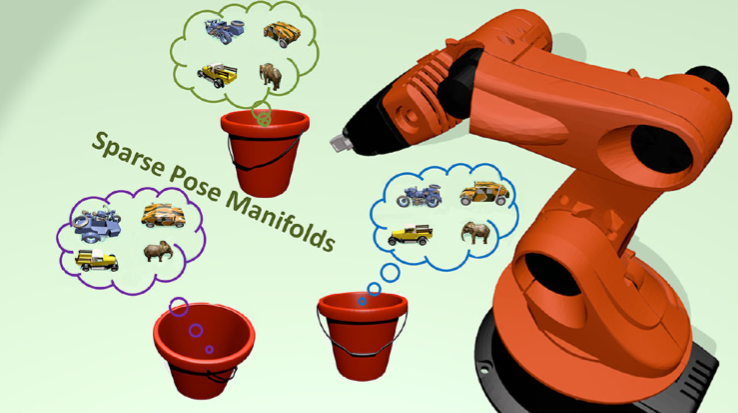
To this end, the latest paper in Autonomous Robots proposes a Sparse Pose Manifolds (SPM) method. As shown in the figure above, different objects viewed from the same perspective should share identical poses. All the objects facing right are in the same “pose-bucket”, which is different from the bucket for objects facing left, or forward. For each pose, the robot knows how to behave to guide the gripper to grasp the object. To grip an unknown object, the robot estimates what “bucket” the object falls into.

The videos below shows how this method can efficiently guide a robotic gripper to grasp an unknown object and illustrates the performance of the pose estimation module.


tags: , ,


Autonomous Robots Blog Latest publications in the journal Autonomous Robots (Springer).

            AUAI is supported by:


Subscribe to Robohub newsletter on substack


Related posts :

How to teach the same skill to different robots

  11 May 2026
A new framework to teach a skill to robots with different mechanical designs, allowing them to carry out the same task without rewriting code for each.

Robot Talk Episode 155 – Making aerial robots smarter, with Melissa Greeff

  08 May 2026
In the latest episode of the Robot Talk podcast, Claire chatted to Melissa Greeff from Queen's University about autonomous navigation and learning for drones.

New understanding of insect flight points way to stable flapping-wing robots

  07 May 2026
The way bugs and birds flap their wings may look effortless, but the dynamics that keep them aloft are dizzyingly complex and difficult to quantify.

Robotically assembled building blocks could make construction more efficient and sustainable

  05 May 2026
Research suggests constructing a simple building from interlocking subunits should be mechanically feasible and have a much smaller carbon footprint.

Robot Talk Episode 154 – Visual navigation in insects and robots, with Andrew Philippides

  01 May 2026
In the latest episode of the Robot Talk podcast, Claire chatted to Andrew Philippides from the University of Sussex about what we can learn from ants and bees to improve robot navigation.

Ultralightweight sonar plus AI lets tiny drones navigate like bats

  29 Apr 2026
Researchers develop ultrasound-based perception system inspired by bat echolocation.

Gradient-based planning for world models at longer horizons

  28 Apr 2026
What were the problems that motivated this project and what was the approach to address them?

Robot Talk Episode 153 – Origami-inspired robots, with Chenying Liu

  24 Apr 2026
In the latest episode of the Robot Talk podcast, Claire chatted to Chenying Liu from University of Oxford about how a robot's physical form can actively contribute to sensing, processing, decision-making, and movement.


AUAI is supported by:


Subscribe to Robohub newsletter on substack


©2026.02 - Association for the Understanding of Artificial Intelligence