Robohub.org
ep.

173

podcast
 

RoboThespian with Will Jackson


by
10 January 2015


share this:


robothespian-bg-1024x0

Transcript below

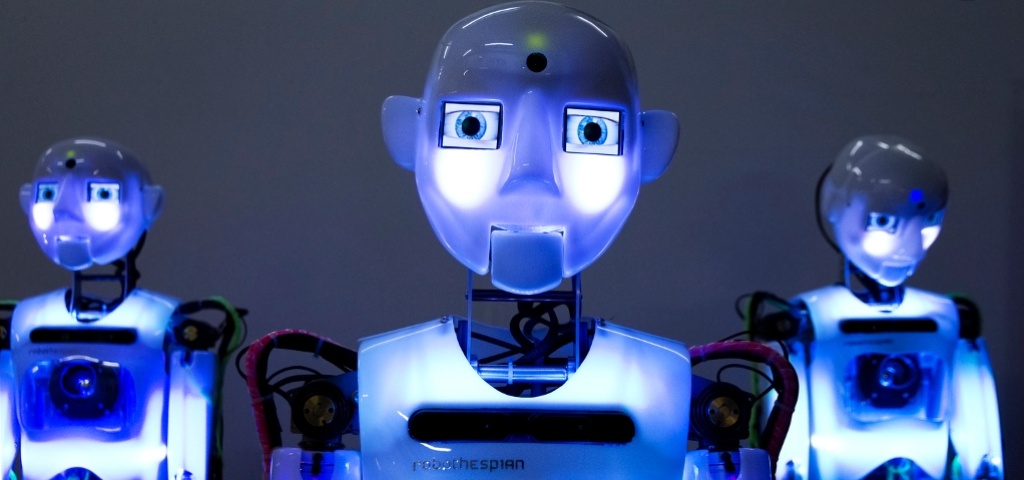
In today’s podcast, Ron Vanderkley speaks with Will Jackson from Engineered Arts Limited about his team’s work making robot actors.

Engineered Arts was founded in October 2004 by Will Jackson, to produce mixed media installations for UK science centres and museums, many of which involved simple mechanical figures, animated by standard industrial controllers.

In early in 2005, the Company began work on the Mechanical Theatre for the Eden Project. This involved three figures, with storylines focused on genetic modification. Rather than designing another set of figures for this new commission, Engineered Arts decided to develop a generic programmable figure that would be used for the Mechanical Theatre, and the succession of similar commissions that would hopefully follow. The result was RoboThespian Mark 1 (RT1).

From thereon, Engineered Arts took a change of direction and now concentrates entirely on development and sales of an ever expanding range of humanoid and semi-humanoid robots featuring natural human-like movement and advanced social behaviours.

RoboThespian, now in its third version, is a life sized humanoid robot designed for human interaction in a public environment. It is fully interactive, multilingual, and user-friendly. Clients range from NASA’s Kennedy Space Centre through to Questacon, The National Science and Technology Centre in Australia. You can watch it in action in the video below.

Will Jackson
Will Jackson and his RoboThespianWill Jackson has a BA in 3D design from University of Brighton, UK and is the Founder of Engineered Arts Ltd.

Links:


tags: ,


Ron Vanderkley


Subscribe to Robohub newsletter on substack


Related posts :

What I’ve learned from 25 years of automated science, and what the future holds: an interview with Ross King

and   14 Apr 2026
Ross King created the first robot scientist back in 2009. He spoke to us about the nature of scientific discovery, the role AI has to play, and his recent work in DNA computing.

Robot Talk Episode 151 – Robots to study the ocean, with Simona Aracri

  10 Apr 2026
In the latest episode of the Robot Talk podcast, Claire chatted to Simona Aracri from National Research Council of Italy about innovative robot designs for oceanography and environmental monitoring.

Generative AI improves a wireless vision system that sees through obstructions

  08 Apr 2026
With this new technique, a robot could more accurately detect hidden objects or understand an indoor scene using reflected Wi-Fi signals.

Resource-constrained image generation and visual understanding: an interview with Aniket Roy

  07 Apr 2026
Aniket tells us about his research exploring how modern generative models can be adapted to operate efficiently while maintaining strong performance.

Back to school: robots learn from factory workers

  02 Apr 2026
A Czech startup is making factory automation easier by letting workers teach robots new tasks through simple demonstrations instead of complex coding.

Resource-sharing boosts robotic resilience

  31 Mar 2026
When a modular robot shares power, sensing, and communication resources among its individual units, it is significantly more resistant to failure than traditional robotic systems.

Robot Talk Episode 150 – House building robots, with Vikas Enti

  27 Mar 2026
In the latest episode of the Robot Talk podcast, Claire chatted to Vikas Enti from Reframe Systems about using robotics and automation to build climate-resilient, high-performance homes.

A history of RoboCup with Manuela Veloso

and   24 Mar 2026
Find out how RoboCup got started and how the competition has evolved, from one of the co-founders.


Robohub is supported by:


Subscribe to Robohub newsletter on substack


©2026.02 - Association for the Understanding of Artificial Intelligence