Robohub.org
Toyota Research gets Kuffner, and Google gets Brondmo
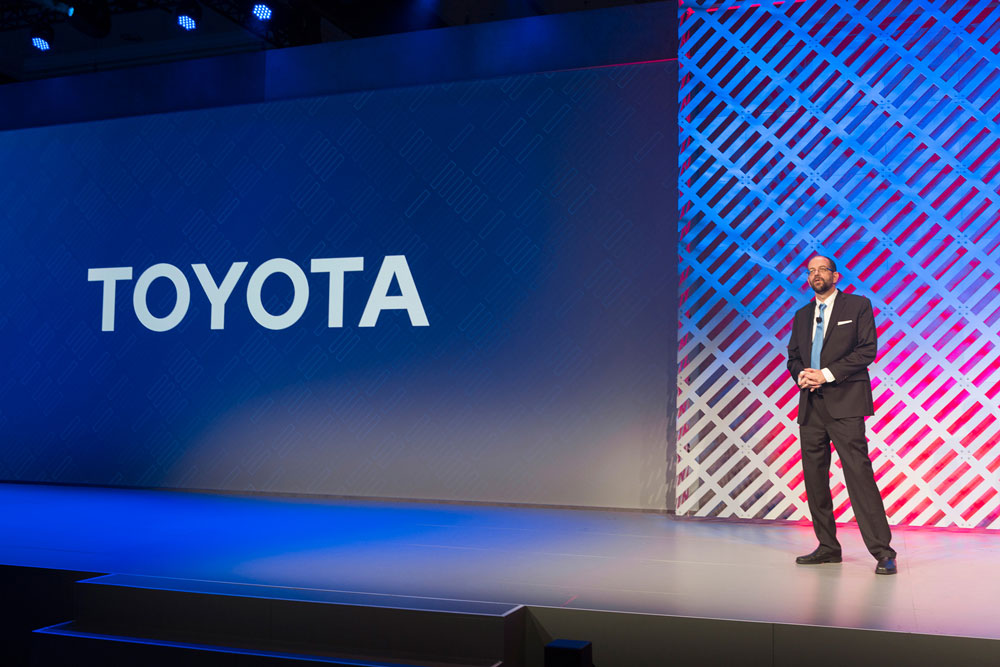
Toyota Executive Technical Advisor and Chief Executive Officer of Toyota Research Institute (TRI) Dr. Gill Pratt speaks during a press conference at the Consumer Electronics Show (CES) 2016 in Las Vegas, Jan. 5, 2016. Photo: Kathryn Rapier
At a press conference last week at CES, Toyota, led by Gill Pratt of DARPA fame and now CEO of Toyota Research Institute (TRI), informed the world what Toyota intended to do with it’s billion dollar investment in their new AI research facilities in Silicon Valley and Cambridge.
“Up to now, our industry has measured on-road reliability of autonomous vehicles in the millions of miles, which is impressive. But to achieve full autonomy, we actually need reliability that is a million times better. We need trillion-mile reliability. Toyota has traditionally been a hardware company because in the past the most important technology for enhancing human mobility was hardware. Times have changed, and software and data are now essential components of Toyota’s future mobility strategy.”
“It is entirely possible that robots will become for today’s Toyota what the car industry was when Toyota made looms. Home robots may be even more personally prized in our future than cars have been in our past. Toyota’s goal is to move people across the room, across town, and across the country.”
“Our initial technical team directing research will include James Kuffner, CMU professor and former head of Google Robotics, who will be our area lead in cloud computing… [and also six others].”
The portion of Pratt’s announcement that James Kuffner had left Google, and was joining Toyota and Pratt, was newsworthy in the robotics world. It showcased the changes in leadership stemming from the abrupt earlier departure from Google of Andy Rubin, the original leader who left after a buying spree that brought 8 robotic startups into Google. James Kuffner became the acting CEO of the Replicant robotics group, which recently located within the Google X Lab. Conor Dougherty, in a NY Times article, wrote:
Google’s robotics division has been plagued by low morale and a lack of leadership since the unit’s founder left abruptly in 2014. Now Alphabet is cleaning it up. Over the last two months, Alphabet, the new holding company that separated Google from its collection of speculative projects, has reframed the robots effort, moving it from a stand-alone division inside Google to a piece of the X research division. The company has also hired Hans Peter Brondmo, a technology industry veteran who last worked at Nokia, to help with management.
X, which is run by Astro Teller, is using some element of robotics in numerous projects like: self-driving cars; Project Wing, an effort to deliver packages with drone aircraft; and Makani, an effort to capture wind energy with high-flying kites.
Brondmo joins Jonathan Rosenberg, who is a troubleshooter for Larry Page (the Google co-founder who is Alphabet’s chief executive) and Aaron Edsinger (previously the CEO of both Meka and Redwood Robotics) in the day-to-day management of the robotics group.
The Rubin Google acquisitions include: Schaft, a Japanese start-up developing a humanoid robot; Industrial Perception, a Silicon Valley start-up that developed a computer vision system for loading and unloading trucks; Meka Robotics, a robot developer for academia; Redwood Robotics, a start-up intended to compete with the Baxter robot (and others) entering the small and medium-sized shop and factory marketplace; Bot & Dolly, a maker of robotic camera systems used for special effects such as in the movie “Gravity”; Autofuss, a design and marketing firm and a partner in Bot & Dolly; Holomni, a maker of powered caster modules for omnidirectional vehicles; and Boston Dynamics, an engineering company specializing in building robots and software for human simulation.
tags: Automotive, c-Business-Finance, cx-Research-Innovation, Google, Toyota