Robohub.org
 

Tracking 3D objects in real-time using active stereo vision

by
10 November 2012


share this:

In a recent publications in the Journal Autonomous Robots, a team of researchers from the UK, Italy and France propose a new technique that allows an active binocular robot to fixate and track objects while performing 3D reconstruction in real-time.

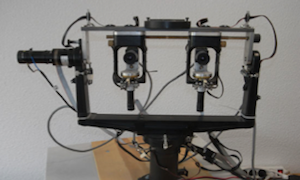
Humans have the ability to track objects by turning their head to and gazing at areas of interest. Integrating images from both eyes provides depth information that allows us to represent 3D objects. Such feats could prove useful in robotic systems with similar vision functionalities. POPEYE, shown in the image to the left, is able to independently move its head and two cameras used for stereo vision.

To perform 3D reconstruction of object features, the robot needs to know the spatial relationship between its two cameras. For this purpose, Sapienza et al. calibrate the robot vision system before the experiment by placing cards with known patterns in the environment and systematically moving the camera motors to learn how these motor changes impact the images captured. After calibration, and thanks to some math (homography-based method), the robot is able to measure how much its motors have moved and relate that to changes in the image features. Measuring motor changes is very fast, allowing for real-time 3D tracking.

Results show that the robot is able to keep track of a human face while performing 3D reconstruction. In the future, the authors hope to add zooming functionalities to their method.

Source: Michael Sapienza, Miles Hansard and Radu Horaud (2012) Real-time visuomotor update of an active binocular head, Autonomous Robots.


tags:


Sabine Hauert is President of Robohub and Associate Professor at the Bristol Robotics Laboratory


Subscribe to Robohub newsletter on substack


Related posts :

A multi-armed robot for assisting with agricultural tasks

  18 Mar 2026
How can a robot safely manipulate branches to reveal hidden flowers while remaining aware of interaction forces and minimizing damage?

Graphene-based sensor to improve robot touch

  16 Mar 2026
Multiscale-structured miniaturized 3D force sensors for improved robot touch.

Robot Talk Episode 148 – Ethical robot behaviour, with Alan Winfield

  13 Mar 2026
In the latest episode of the Robot Talk podcast, Claire chatted to Alan Winfield from the University of the West of England about developing new standards for ethics and transparency in robotics.

Coding for underwater robotics

  12 Mar 2026
Lincoln Laboratory intern Ivy Mahncke developed and tested algorithms to help human divers and robots navigate underwater.

Restoring surgeons’ sense of touch with robotic fingertips

  10 Mar 2026
Researchers are developing robotic “fingertips” that could give surgeons back their sense of touch during minimally invasive and robotic operations.

Robot Talk Episode 147 – Miniature living robots, with Maria Guix

  06 Mar 2026
In the latest episode of the Robot Talk podcast, Claire chatted to Maria Guix from the University of Barcelona about combining electronics and biology to create biohybrid robots with emergent properties.

Developing an optical tactile sensor for tracking head motion during radiotherapy: an interview with Bhoomika Gandhi

  05 Mar 2026
Bhoomika Gandhi discusses her work on an optical sensor for medical robotics applications.

Humanoid home robots are on the market – but do we really want them?

  03 Mar 2026
Last year, Norwegian-US tech company 1X announced “the world’s first consumer-ready humanoid robot designed to transform life at home”.


Robohub is supported by:


Subscribe to Robohub newsletter on substack


©2026.02 - Association for the Understanding of Artificial Intelligence