
Robohub.org
US Department of Transportation issues guidance for automated driving
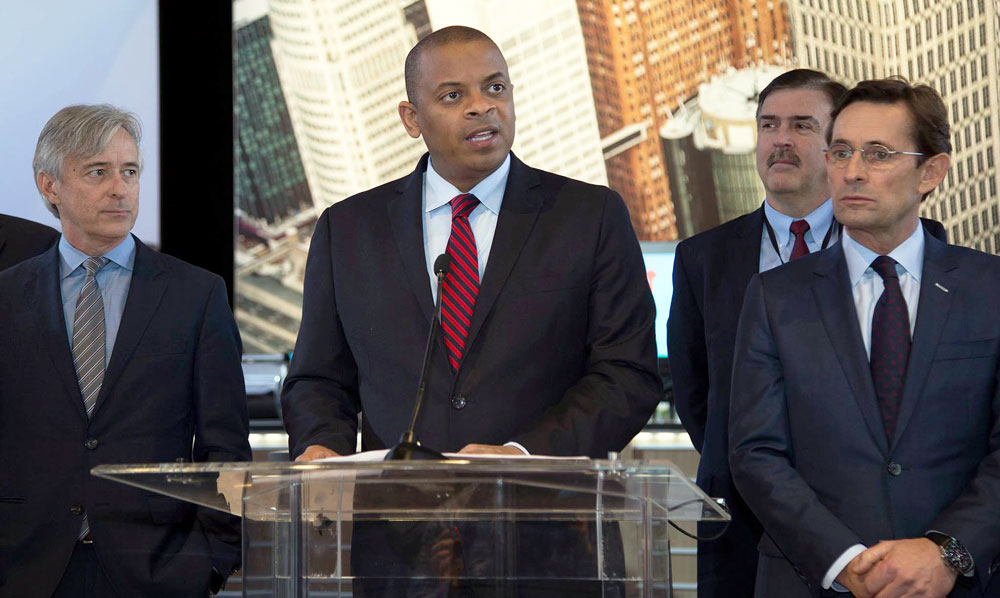
Source: US Department of Transportation.
With the recent announcement, the US Department of Transportation is enthusiastically embracing automated driving. It’s saying that self-driving vehicles are coming in some form (or many forms) and that the agency can play a role not only in supervising but also in assisting this transportation transformation. The DOT is recognizing the wide range of relevant technologies, applications, and business models and is striving to address them more quickly and flexibly through its wide range of prospective and retrospective regulatory tools. (To be pithy: It’s not your father’s Oldsmobile; it can’t be your father’s DOT.)
https://www.youtube.com/watch?v=YSYjxXfdBcs
As always, the devil will be in the details. Those details will become clearer when the agency releases its full guidance on Tuesday and then as that guidance is (1) revised after public comment (for which the DOT wisely provided), (2) augmented by a related report by the American Association of Motor Vehicle Administrators, and (3) actually applied. For example, the DOT has not yet indicated whether its model state policy will be permissive or restrictive, particularly with respect to actual demonstration projects and even commercial deployments.
I would also expect that this guidance will be the starting point for more thoughtful legislative discussions — not only at the state level but also, for the first time, at the federal level. It will be interesting to see which developers carry the DOT’s implicit requests for new authorities and resources to Congress. The model state policy does not bind states, and some may well decide not to follow it. The performance guidance likewise does not bind developers of automated driving systems, but I would expect few of these developers to deviate from it. This soft guidance could become even more influential if states incorporate it in legislation, if the DOT’s National Highway Traffic Safety Administration (NHTSA) considers it in the course of exemption or enforcement decisions, or if courts look to it to understand how a reasonable developer should act. In other words, DOT is establishing expectations.
You can read the Federal Automated Vehicles Policy – September 2016 here.
Accordingly, I’m especially pleased to see the DOT’s recommendation that these developers undertake — and share — a 15-point safety assessment. Given its limited resources and the speed of technological change, NHTSA cannot hope to come up with all the answers for automated driving in its many forms. But NHTSA can focus on asking the important questions. To that end, this safety assessment encourages developers to share what they are doing, why they think it is safe, and why they should be believed. This is what I have recommended on many occasions (including here, here, and here).
Finally, a note on “driver.” I’ve noted a lot of confusion about NHTSA’s earlier recognition that an automated driving system can be a “driver” for the purpose of the federal motor vehicle safety standards. That limited recognition did not change and could not change how states define drivers for the purpose of their laws or what legal obligations states place on these drivers. Similarly, DOT’s statements today about software do not represent some dramatic change. Because of its authority over motor vehicle design, NHTSA has always had authority over motor vehicle software, which is already ubiquitous on vehicles. (Indeed, in the aftermath of the Toyota’s sudden unintended acceleration debacle, the National Academies released a major report on this very topic.) NHTSA would not change state law by continuing to exercise this authority. For example, NHTSA might recommend (and may one day require) that automated driving software be designed to generally obey speed limits, but states would still set those speed limits.
For DOT’s actual guidance, check out transportation.gov/AV. For more thoughts on what governments can do, check out How Governments Can Promote Automated Driving at newlypossible.org.
If you liked this post, you may also want to read:
- Why Tesla’s purported liability ‘fix’ is technically and legally questionable
- Two New Year’s resolutions for developers of automated vehicles
- 50 different state regulations for robocars is not a bad idea
- Automated vehicle crashes
See all the latest robotics news on Robohub, or sign up for our weekly newsletter.
tags: automotive, robohub focus on autonomous driving

AUAI is supported by:









