Robohub.org
 

Gecko adhesives allow flying robot to perch on walls

by
15 May 2013


share this:
AirBurrXwithLegs

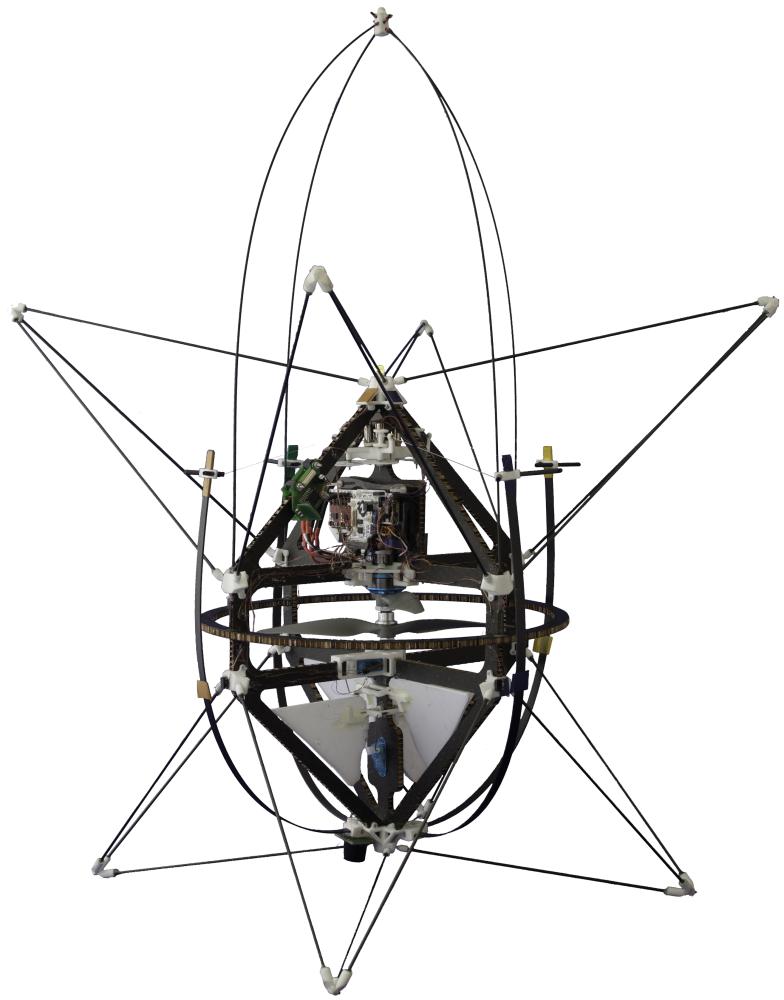
The Airburr, a light-weight flying robot from the Laboratory of Intelligent Systems (my PhD lab) at EPFL, was designed to fly in cluttered environments. Unlike most flying robot, which avoid contact at all cost, the Airburr interacts with its environment to navigate. Just like you might trail your hand along a wall to find your way in the dark, the robot can bounce of walls or follow them without crashing to the ground. In case of a crash, it also has a mechanism to pick itself back up and fly away. I’ve added past videos of the Airburr in action below.

The Airburr can now perch, thanks to a gecko-inspired adhesive pad that is mounted on a mechanism within the structure of the robot. This work was presented last week and ICRA (read the paper here). The gecko pad can be deployed on demand when perching is initiated. Perching allows the robot to power down and save energy, while still providing an aerial perspective that is useful for real-world missions such as search and rescue.

The work was done in collaboration with Mettin Sitti from Carnegie Mellon University, an expert in dry adhesive materials, and was inspired by the hairy feet of geckos. Rather than using claws or sticky substances to climb up walls, geckos use van der Waals forces between the tip of each hair and the surface to cling to. The artificial hairs used on Airburr have a diameter of 40um and a height of 100um with mushroom tips of 80um.

Airburr Crash Recovery

Uprighting Mechanism


tags: , , , , ,


Sabine Hauert is President of Robohub and Associate Professor at the Bristol Robotics Laboratory


Related posts :


Robot Talk Episode 139 – Advanced robot hearing, with Christine Evers

  09 Jan 2026
In the latest episode of the Robot Talk podcast, Claire chatted to Christine Evers from University of Southampton about helping robots understand the world around them through sound.

Meet the AI-powered robotic dog ready to help with emergency response

  07 Jan 2026
Built by Texas A&M engineering students, this four-legged robot could be a powerful ally in search-and-rescue missions.

MIT engineers design an aerial microrobot that can fly as fast as a bumblebee

  31 Dec 2025
With insect-like speed and agility, the tiny robot could someday aid in search-and-rescue missions.

Robohub highlights 2025

  29 Dec 2025
We take a look back at some of the interesting blog posts, interviews and podcasts that we've published over the course of the year.

The science of human touch – and why it’s so hard to replicate in robots

  24 Dec 2025
Trying to give robots a sense of touch forces us to confront just how astonishingly sophisticated human touch really is.

Bio-hybrid robots turn food waste into functional machines

  22 Dec 2025
EPFL scientists have integrated discarded crustacean shells into robotic devices, leveraging the strength and flexibility of natural materials for robotic applications.

Robot Talk Episode 138 – Robots in the environment, with Stefano Mintchev

  19 Dec 2025
In the latest episode of the Robot Talk podcast, Claire chatted to Stefano Mintchev from ETH Zürich about robots to explore and monitor the natural environment.

Artificial tendons give muscle-powered robots a boost

  18 Dec 2025
The new design from MIT engineers could pump up many biohybrid builds.


Robohub is supported by:


Would you like to learn how to tell impactful stories about your robot or AI system?


scicomm
training the next generation of science communicators in robotics & AI


©2025.05 - Association for the Understanding of Artificial Intelligence