Robohub.org
 

Seeing is touching


by
13 February 2013


share this:
13-0005-n

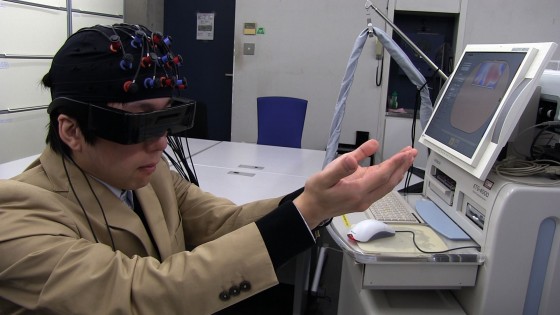
Professor Takashi Kawai’s lab at Waseda University’s School of Fundamental Science and Engineering is conducting research on a cross-modal perception technology employing multi-sensory integration in which participants perceive tactile sensation from visual stimulation. In a visual-evoked “minute tactile sensation” presentation system prototype, a very simple mechanism is used to enable the phenomenon of tactile sensation perception, despite the lack of any physical contact, simply by viewing a video image.

“One element of the system is the use of a see-through head-mounted display to present a stereoscopic image. Unlike when typically viewing an image on a display, it is important here for the image to be viewed in space. An extremely important aspect in constructing this system is that the participant is able to observe in a natural manner a part of his or her body such as the hands making contact with the image.”

First, a commercially available see-through head-mounted display is worn. An image of an object floating about 30cm in front of the eyes becomes visible. Presently this object is displayed as a ball of fire or ice to represent temperature sensation. The participant places his hands as if touching the viewed object so that the ball of fire or ice is observed resting on the hands. By adjusting the hands so that the object is touching the palms and then by gently shaking the head left and right so that a slow-speed motion is perceived, he can experience a subtle tactile sensation such as a slight breeze or cool or warm sensation.

“Feasible areas of application are entertainment or communication, or as a new form of media for producing visual content to induce tactile illusion. Or for more serious applications, there are various possibilities for consideration including rehabilitation as well as training and education where this type of system can be used effectively.”

With the prototype system, the research group has discovered that the participant’s perceived tactile sensation will change qualitatively, such as a sensation of warmth or cold, according to the content of the video image. The group will continue to conduct research on video content with associated tactile sensation and search for effective utilization of tactile sensation in fields such as education and social welfare.


tags: , ,


DigInfo TV is a Tokyo-based online video news platform dedicated to producing original coverage of cutting edge technology, research and products from Japan.

            AUAI is supported by:


Subscribe to Robohub newsletter on substack


Related posts :

Ultralightweight sonar plus AI lets tiny drones navigate like bats

  29 Apr 2026
Researchers develop ultrasound-based perception system inspired by bat echolocation.

Gradient-based planning for world models at longer horizons

  28 Apr 2026
What were the problems that motivated this project and what was the approach to address them?

Robot Talk Episode 153 – Origami-inspired robots, with Chenying Liu

  24 Apr 2026
In the latest episode of the Robot Talk podcast, Claire chatted to Chenying Liu from University of Oxford about how a robot's physical form can actively contribute to sensing, processing, decision-making, and movement.

Sony AI table tennis robot outplays elite human players

  22 Apr 2026
New robot and AI system has beaten professional and elite table tennis players.

AI system learns to keep warehouse robot traffic running smoothly

  20 Apr 2026
This new approach adapts to decide which robots should get the right of way at every moment, avoiding congestion and increasing throughput.

Robot Talk Episode 152 – Dexterous robot hands, with Rich Walker

  17 Apr 2026
In the latest episode of the Robot Talk podcast, Claire chatted to Rich Walker from Shadow Robot Company about their advanced robotic hands for research and industry.

What I’ve learned from 25 years of automated science, and what the future holds: an interview with Ross King

and   14 Apr 2026
Ross King created the first robot scientist back in 2009. He spoke to us about the nature of scientific discovery, the role AI has to play, and his recent work in DNA computing.

Robot Talk Episode 151 – Robots to study the ocean, with Simona Aracri

  10 Apr 2026
In the latest episode of the Robot Talk podcast, Claire chatted to Simona Aracri from National Research Council of Italy about innovative robot designs for oceanography and environmental monitoring.


AUAI is supported by:


Subscribe to Robohub newsletter on substack


©2026.02 - Association for the Understanding of Artificial Intelligence