
Robohub.org
 

Seegrid adds vision-guided lifting and stacking to product line

by
19 January 2014


share this:

Seegrid-walkie-stacker_400_237_80
Seegrid Corporation, a Pittsburgh-based start-up, has been providing driverless tugs for moving materials from point a to point b. Up until now they have just delivered the skids of material and then a human-operated forklift would lift the skids and place them on the racks

(or the reverse: a human-driven forklift would take from the racks and stack and place the materials so that they could be transported autonomously by a Seegrid tug to where the material was needed).

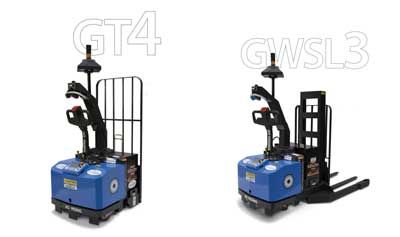
Now Seegrid is introducing an $80,000 driverless walkie stacker using an off-the-shelf* Class III forklift chassis equipped with Seegrid’s vision-guided autonomous navigation system so that the new device can provide the additional functions to transport: pick, stack and put away*. The tablet-driven walkie stacker GWSL3 is equipped with Seegrid’s vision-guided autonomous navigation system and will be launched at MODEX 2014 in Atlanta this coming March 17-20.

John Hayes, Seegrid VP of Sales and Marketing, said, “With the flexible GWS35 walkie stacker, we have expanded our traditional horizontal transportation line by adding a vehicle that allows for nearly all traditional AGV applications to be both simple and affordable.”

The new walkie stacker will work in conjunction with Seegrid’s new $75,000 vision-guided GT4 tugger. Both the walkie stacker and the tugger can also be leased instead of purchased.

__________________

* There have been rumors that Seegrid has chosen to focus on what it does best: provide vision, scanning and navigation systems and purchase off-the-shelf tugs and forklifts and outfit them with their special equipment and software. It is not known whether the new GWSL3 and GT4 are fully built by Seegrid or not.


tags:


Frank Tobe is the owner and publisher of The Robot Report, and is also a panel member for Robohub's Robotics by Invitation series.

            AUAI is supported by:


Subscribe to Robohub newsletter on substack


Related posts :

Developing active and flexible microrobots

  13 May 2026
This class of robots opens up possibilities for biomedical applications.

How to teach the same skill to different robots

  11 May 2026
A new framework to teach a skill to robots with different mechanical designs, allowing them to carry out the same task without rewriting code for each.

Robot Talk Episode 155 – Making aerial robots smarter, with Melissa Greeff

  08 May 2026
In the latest episode of the Robot Talk podcast, Claire chatted to Melissa Greeff from Queen's University about autonomous navigation and learning for drones.

New understanding of insect flight points way to stable flapping-wing robots

  07 May 2026
The way bugs and birds flap their wings may look effortless, but the dynamics that keep them aloft are dizzyingly complex and difficult to quantify.

Robotically assembled building blocks could make construction more efficient and sustainable

  05 May 2026
Research suggests constructing a simple building from interlocking subunits should be mechanically feasible and have a much smaller carbon footprint.

Robot Talk Episode 154 – Visual navigation in insects and robots, with Andrew Philippides

  01 May 2026
In the latest episode of the Robot Talk podcast, Claire chatted to Andrew Philippides from the University of Sussex about what we can learn from ants and bees to improve robot navigation.

Ultralightweight sonar plus AI lets tiny drones navigate like bats

  29 Apr 2026
Researchers develop ultrasound-based perception system inspired by bat echolocation.

Gradient-based planning for world models at longer horizons

  28 Apr 2026
What were the problems that motivated this project and what was the approach to address them?


AUAI is supported by:


Subscribe to Robohub newsletter on substack


©2026.02 - Association for the Understanding of Artificial Intelligence









