Robohub.org
ep.

164

podcast
 

M-Blocks with John Romanishin

MIT         

by
05 September 2014


share this:


M-Blocks

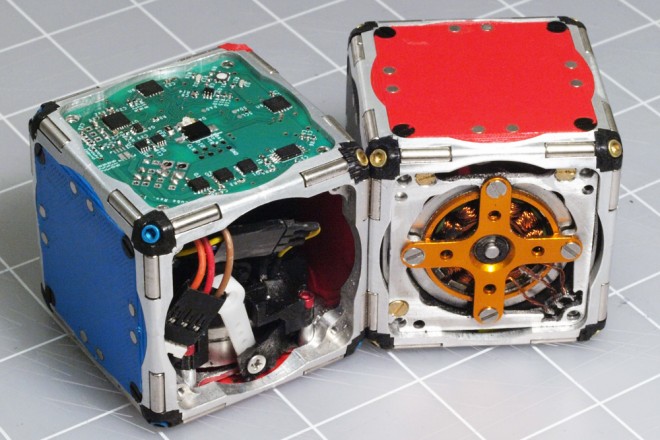
In this episode, Audrow Nash interviews John Romanishin from MIT, about his modular robotics project ‘M-Blocks’. M-Blocks are small cubes (5 cm on a side) that have no external actuators, yet they manage to move and even jump. They do this by rotating an internal mass at high speeds then stopping that mass suddenly, which transfers inertia to the cube causing it to move. The rotating mass can change which plane it’s spinning in, allowing the cube to move in any direction.  By combining this inertial actuator with permanent magnets, M-Blocks can move over similar robots (or more M-Blocks) and precisely line up. The future of this project is best put by John, who says, “We want hundreds of cubes, scattered randomly across the floor, to be able to identify each other, coalesce, and autonomously transform into a chair, or a ladder, or a desk, on demand.” 

JohnRomanishin

John Romanishin
John Romanishin is currently a graduate student studying mechanical engineering and researching self-reconfigurable modular robots at the Distributed Robotics Laboratory led by Daniela Rus at MIT.

Links:


tags: ,


Audrow Nash is a Software Engineer at Open Robotics and the host of the Sense Think Act Podcast

            AUAI is supported by:


Subscribe to Robohub newsletter on substack


Related posts :

AI agents create virtual playgrounds to help robots get crucial training data

  07 Aug 2026
“SceneSmith” system uses collaborative AI agents to create realistic 3D environments of places like kitchens, hotels, and living rooms, where robots can simulate everyday chores.

Robots in society, business and culture: July 2026

A round up of robotics stories in a new monthly series from IEEE RAS.

Simulated zebrafish and a vision-equipped robotic fish reveal how the body shapes brain circuits

Researchers look to the fish brain to create a robotic zebrafish that can autonomously swim upstream.

Researchers develop modular nanorobot

  31 Jul 2026
A team at the University of Basel has developed a versatile nanorobot with propulsion and payload modules.

Surviving the paper deluge: a one-year study in learning from demonstration

With the explosion of robotics research, staying current in fields like Learning from Demonstration is a monumental challenge.

Soft robotic heart offers new way to study disease and test life-saving devices

Researchers have developed a soft robotic model of the human heart that can mimic disease and provide a realistic environment for testing the next generation of cardiac devices.

A mini robot to simplify dental treatment

  24 Jul 2026
Researchers have developed a miniature dental robot that could one day automatically prepare teeth for crowns.

Pressure-free growing robots for soft medical robotics

A Q&A with the best paper award winner at RoboSoft.


AUAI is supported by:


Subscribe to Robohub newsletter on substack


©2026.05 - Association for the Understanding of Artificial Intelligence