
Robohub.org
 

Latest research report shows 10.4% CAGR for robotics to 2025

by
10 November 2014


share this:
bcg-ex1-chart_800_499_80

Boston Consulting Group (BSG) recently released a global robotics market study that projects industry growth of 10.4% CAGR (Compounded Annual Growth Rate).

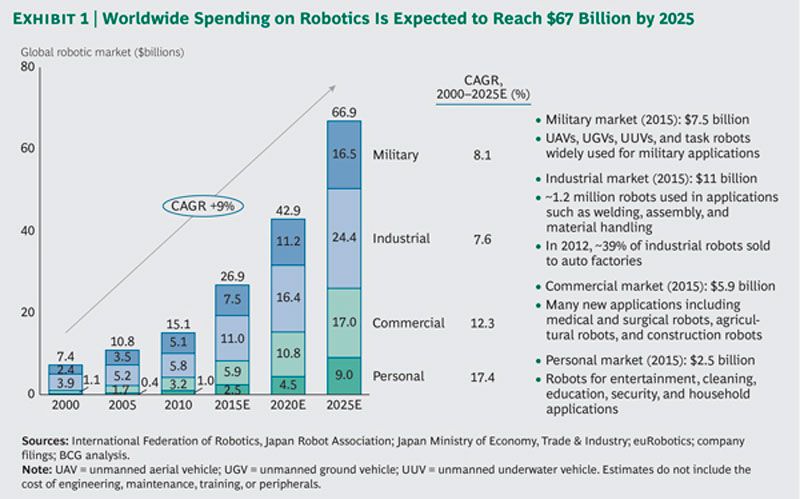
The BCG report, The Rise of Robotics, appeared on BCG Perspectives in late August. At the heart of the report is a very informative chart showing growth by each of the four robotic industry segments:

  • The personal segment—robots used for entertainment, cleaning, education, security, and household applications—is projected to grow the fastest, at a compound annual rate of 15.8 percent, ballooning from $1 billion in 2010 to $9.0 billion in 2025.
  • The commercial segment—robots used for medical and surgical purposes, agriculture, and construction, among other applications—is expected to grow at a compound growth rate of 11.8 percent from $3.2 billion to $17.0 billion, overtaking spending on military applications.
  • The industrial segment—robots used in applications such as welding, assembly, painting, and material handling—will continue to be the largest, growing at a compound growth rate of 10.1 percent from $5.8 billion to $24.4 billion.
  • The military segment—for unmanned aerial, ground, military exoskeletons, and underwater vehicles, among other applications—is projected to grow at a compound growth rate of 8.1 percent to 2025 and will be second largest, at $16.5 billion.

Driving this growth is a convergence of falling prices and performance improvements. The cost of high-quality robots and components is dropping rapidly, while CPUs are getting faster, sensors are getting smaller and less costly, and application programming is getting easier. As robots become cheaper, smaller, and more energy efficient, they gain flexibility and increase the range of potential applications.


tags:


Frank Tobe is the owner and publisher of The Robot Report, and is also a panel member for Robohub's Robotics by Invitation series.

            AUAI is supported by:


Subscribe to Robohub newsletter on substack


Related posts :

Sony AI table tennis robot outplays elite human players

  22 Apr 2026
New robot and AI system has beaten professional and elite table tennis players.

AI system learns to keep warehouse robot traffic running smoothly

  20 Apr 2026
This new approach adapts to decide which robots should get the right of way at every moment, avoiding congestion and increasing throughput.

Robot Talk Episode 152 – Dexterous robot hands, with Rich Walker

  17 Apr 2026
In the latest episode of the Robot Talk podcast, Claire chatted to Rich Walker from Shadow Robot Company about their advanced robotic hands for research and industry.

What I’ve learned from 25 years of automated science, and what the future holds: an interview with Ross King

and   14 Apr 2026
Ross King created the first robot scientist back in 2009. He spoke to us about the nature of scientific discovery, the role AI has to play, and his recent work in DNA computing.

Robot Talk Episode 151 – Robots to study the ocean, with Simona Aracri

  10 Apr 2026
In the latest episode of the Robot Talk podcast, Claire chatted to Simona Aracri from National Research Council of Italy about innovative robot designs for oceanography and environmental monitoring.

Generative AI improves a wireless vision system that sees through obstructions

  08 Apr 2026
With this new technique, a robot could more accurately detect hidden objects or understand an indoor scene using reflected Wi-Fi signals.

Resource-constrained image generation and visual understanding: an interview with Aniket Roy

  07 Apr 2026
Aniket tells us about his research exploring how modern generative models can be adapted to operate efficiently while maintaining strong performance.

Back to school: robots learn from factory workers

  02 Apr 2026
A Czech startup is making factory automation easier by letting workers teach robots new tasks through simple demonstrations instead of complex coding.


AUAI is supported by:


Subscribe to Robohub newsletter on substack


©2026.02 - Association for the Understanding of Artificial Intelligence









