
Robohub.org
 

Making an iCub robot “clever”

by
23 October 2012


share this:

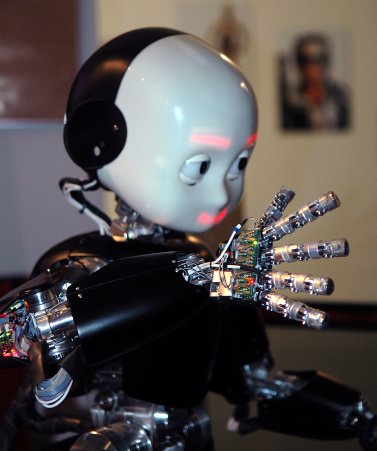
As part of the IM-CLeVeR project, the IDSIA robotics laboratory recently released a video-overview of their work on the technologies, architectures and algorithms required to give an iCub robot more human-like abilities. This includes the ability to reason about and manipulate its local environment, and in the process, to acquire new skills that can be applied to future problems.


The iCub robot is an open-source humanoid platform developed by the Italian Institute of Technology and used by over 20 robotics laboratories worldwide in research areas such as human-robot interaction, computer reasoning, motion planning and “socially aware robotics”.


Some of these we’ve covered on Robohub before: From iCub to artist and iCub drums and crawls using bio-inspired control.


The IM-CLeVeR project was launched in 2009 and uses the iCub as a platform to support the goal of:

Developing a new methodology for designing robots that can cumulatively learn new  skills through autonomous development based on intrinsic motivations, and reuse such skills for accomplishing multiple, complex, and externally-assigned tasks.

In the following 13 minute video, researchers from the IDSIA laboratory, an IM-CLeVeR project-partner, describe motivations, challenges and successes in fields such as computer vision, motion planning, “reflex” behaviors and reinforcement learning.


For more information on the project, consult the laboratory’s other videos and technical releases, or visit the IM-CLeVeR homepage.


A list of iCub related projects can be found here.


tags: , , ,


Mike Hamer


Subscribe to Robohub newsletter on substack


Related posts :

Graphene-based sensor to improve robot touch

  16 Mar 2026
Multiscale-structured miniaturized 3D force sensors for improved robot touch.

Robot Talk Episode 148 – Ethical robot behaviour, with Alan Winfield

  13 Mar 2026
In the latest episode of the Robot Talk podcast, Claire chatted to Alan Winfield from the University of the West of England about developing new standards for ethics and transparency in robotics.

Coding for underwater robotics

  12 Mar 2026
Lincoln Laboratory intern Ivy Mahncke developed and tested algorithms to help human divers and robots navigate underwater.

Restoring surgeons’ sense of touch with robotic fingertips

  10 Mar 2026
Researchers are developing robotic “fingertips” that could give surgeons back their sense of touch during minimally invasive and robotic operations.

Robot Talk Episode 147 – Miniature living robots, with Maria Guix

  06 Mar 2026
In the latest episode of the Robot Talk podcast, Claire chatted to Maria Guix from the University of Barcelona about combining electronics and biology to create biohybrid robots with emergent properties.

Developing an optical tactile sensor for tracking head motion during radiotherapy: an interview with Bhoomika Gandhi

  05 Mar 2026
Bhoomika Gandhi discusses her work on an optical sensor for medical robotics applications.

Humanoid home robots are on the market – but do we really want them?

  03 Mar 2026
Last year, Norwegian-US tech company 1X announced “the world’s first consumer-ready humanoid robot designed to transform life at home”.

Robot Talk Episode 146 – Embodied AI on the ISS, with Jamie Palmer

  27 Feb 2026
In the latest episode of the Robot Talk podcast, Claire chatted to Jamie Palmer from Icarus Robotics about building a robotic labour force to perform routine and risky tasks in orbit.


Robohub is supported by:


Subscribe to Robohub newsletter on substack


©2026.02 - Association for the Understanding of Artificial Intelligence









