Robohub.org
 

Fifty planes in the air running ROS & Gazebo

by
23 September 2015


share this:

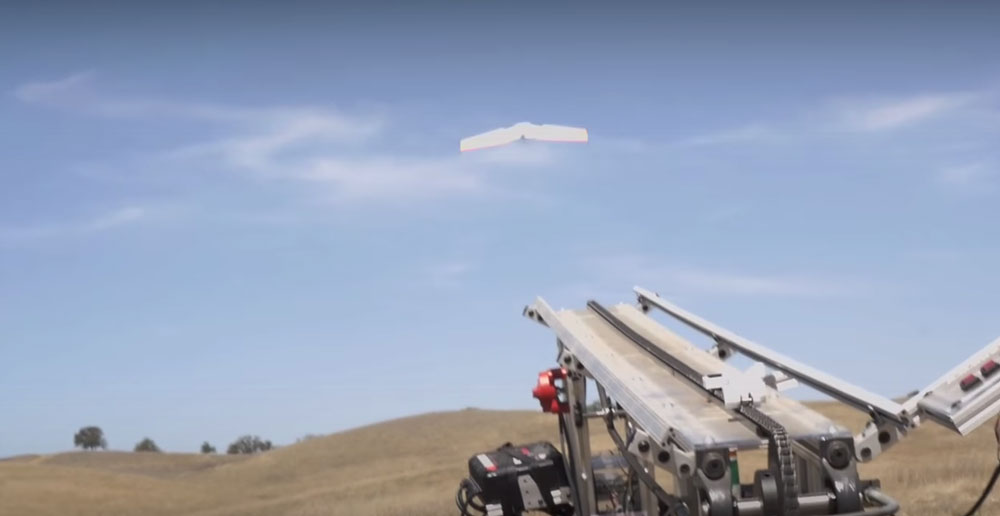
ARSENL50The Advanced Robotic Systems Engineering Lab at the Naval Postgraduate School in Monterey, CA recently flew fifty small autonomous planes together using ROS.

Each plane – a styrofoam wing with a 56” wingspan – was equipped with a Pixhawk autopilot running a modified version of the open-source Ardupilot firmware and an ODroid u3 “payload” computer running ROS Indigo. The payload used autopilot_bridge (similar to mavros) to bridge between serial communications with the autopilot and ROS messages and services. A network node bridged ROS communications with a lightweight UDP-based protocol that allowed aircraft to share their pose and status with one another and to receive commands from the ground.

Also residing on the payload was a set of controller nodes that could “drive” the plane by sending updated target latitude-longitude-altitude commands to the autopilot. Controllers were individually activated by a state machine, based on commands from the ground. The controller used during the fifty-plane flight was a follower controller. A single ground operator commanded two sets of 25 planes each to configure themselves into leader-follower formations; planes would determine a leader based on highest altitude (which was deconflicted at the start of the flight). The leader would then proceed along a predefined racetrack, and all followers, listening to the broadcast position of the leader, would track its path while remaining at their designated altitudes.

https://youtu.be/-zKDdAw609Y

A detailed writeup of the flight test is posted at DIY Drones and more information on the research project can be found at the ARSENL website.


tags: , , ,


Open Source Robotics Foundation supports the development, distribution, and adoption of open source software for use in robotics research, education, and product development.

            AUAI is supported by:


Subscribe to Robohub newsletter on substack


Related posts :

How to teach the same skill to different robots

  11 May 2026
A new framework to teach a skill to robots with different mechanical designs, allowing them to carry out the same task without rewriting code for each.

Robot Talk Episode 155 – Making aerial robots smarter, with Melissa Greeff

  08 May 2026
In the latest episode of the Robot Talk podcast, Claire chatted to Melissa Greeff from Queen's University about autonomous navigation and learning for drones.

New understanding of insect flight points way to stable flapping-wing robots

  07 May 2026
The way bugs and birds flap their wings may look effortless, but the dynamics that keep them aloft are dizzyingly complex and difficult to quantify.

Robotically assembled building blocks could make construction more efficient and sustainable

  05 May 2026
Research suggests constructing a simple building from interlocking subunits should be mechanically feasible and have a much smaller carbon footprint.

Robot Talk Episode 154 – Visual navigation in insects and robots, with Andrew Philippides

  01 May 2026
In the latest episode of the Robot Talk podcast, Claire chatted to Andrew Philippides from the University of Sussex about what we can learn from ants and bees to improve robot navigation.

Ultralightweight sonar plus AI lets tiny drones navigate like bats

  29 Apr 2026
Researchers develop ultrasound-based perception system inspired by bat echolocation.

Gradient-based planning for world models at longer horizons

  28 Apr 2026
What were the problems that motivated this project and what was the approach to address them?

Robot Talk Episode 153 – Origami-inspired robots, with Chenying Liu

  24 Apr 2026
In the latest episode of the Robot Talk podcast, Claire chatted to Chenying Liu from University of Oxford about how a robot's physical form can actively contribute to sensing, processing, decision-making, and movement.


AUAI is supported by:


Subscribe to Robohub newsletter on substack


©2026.02 - Association for the Understanding of Artificial Intelligence