
Robohub.org
Governments greasing wheels in robotics
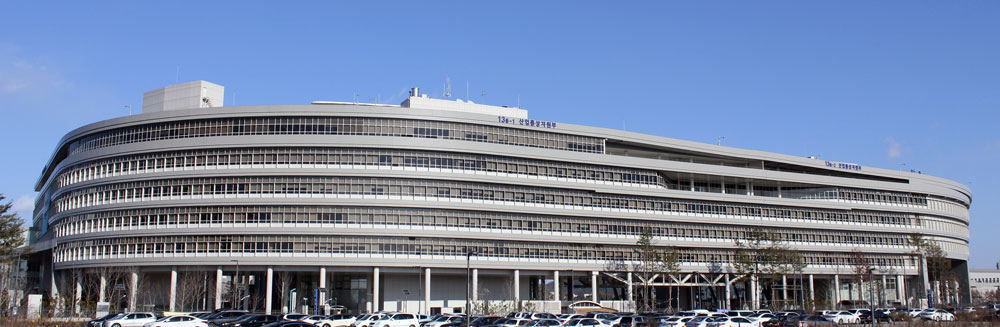
Ministry of Trade, Industry and Energy (South Korea). Source: Minseong Kim via Wikimedia Commons
The South Korean government funded Samsung $14.8M to develop and manufacture industrial robots; the US FDA just gave approval to Corindus Vascular Robotics for a new medical device; and the US FAA set up a task force and put them on a tight deadline to figure out how to register drone owners.
 SAMSUNG
The South Korean government’s Ministry of Trade, Industry and Energy said they would invest $14.8 million for Samsung to develop product specs for factory robots that can carry out complex tasks normally reserved for “nimble human fingers.” The government wants Samsung to help develop an in-country high-precision robot industry instead of the current situation of importing them from Japan and Europe and farming out manufacturing to off-shore cheap labor countries. Additionally the government wants Samsung to build precision components: speed reducers, servos, controllers and sensor encoders. The new robots will be put to work making consumer electronics products, and the components (in addition to being incorporated into the robots) will be available for sale to other South Korean robot manufacturers to help minimize the importation of foreign-made robots.
“Once affordable robots reach the market and are more widely used, it can lead to the creation of ‘smart factories’ and bring about far-reaching innovations to the manufacturing sector,” the ministry said in a statement.
 CORINDUS VASCULAR ROBOTICS
The US Food and Drug Administration (FDA) has given Corindus Vascular Robotics clearance for their robotic-assisted CorPath angioplasty system. The CorPath device and system has a control console from which the cardiologist controls the movements of guidewires, stent catheters and balloons used in the procedure — a procedure (PCI) that begins in an artery in the wrist but has been guided by a doctor heavily clad in radiation protection gear as he or she guides a catheter into the patient’s heart using a fluoroscopy device that gives off radiographic exposure. The new FDA-approved CorPath method enables the cardiologist, sitting at a console removed from the radiation, to drive the catheter to the correct location using joysticks and touchscreen controls.
“The CorPath System’s ability to protect cath lab personnel during these cases is more important than ever with the increasing prevalence of radial and complex PCI in today’s cath lab,” said David Handler, President and CEO, Corindus.
 FAA TASK FORCE TO DEVELOP REGISTRATION RECOMMENDATIONS BY NOVEMBER 20
The U.S. Federal Aviation Administration (FAA) set up a task force to develop recommendations for a registration process for unmanned aircraft systems (UAS) of all types. The task force must deliver their recommendations by November 20, 2015.
“Registering unmanned aircraft will help build a culture of accountability and responsibility, especially with new users who have no experience operating in the U.S. aviation system,” Transportation Secretary Anthony Foxx said. “It will help protect public safety in the air and on the ground.”
“Because safe operations are essential for all users of the national airspace, AUVSI is also looking forward to continuing its work with the FAA and other supporters of the ‘Know Before You Fly’ campaign to educate newcomers to UAS technology about where they should and shouldn’t fly.”
See also: What we know about the FAA’s new drone registration requirement, and what we don’t
tags: drones, FAA, Samsung, South Korea, USDA

AUAI is supported by:









