Robohub.org
 

The Year of CoCoRo Video #49/52: Base stations

by
08 December 2015


share this:
underwater_robot_cocoro_swarm

During the past year we have shown many swarm algorithms in various experiments. The spotlight was always on the Lily and the Jeff robots. However, there is now another star in the team and this trailer is dedicated to this special agent: the base station!

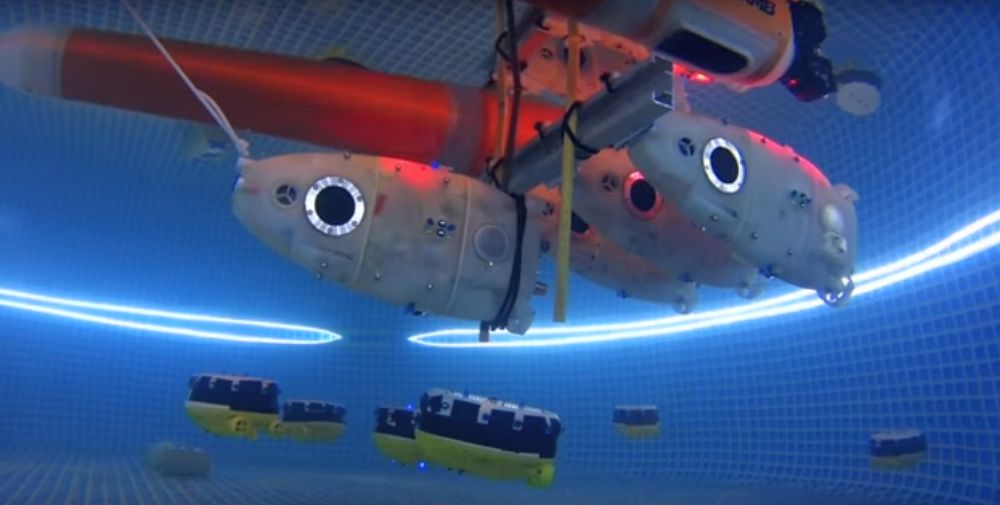
The base station was finished towards the end of the project, thus, we had to develop (i.e. hack) many surrogates and placeholders for it over the course of the project. We got so experienced with it that we could quickly hack a surrogate base station from almost anything that was lying around in the lab: styrofoam, cans, boxes … whatever was around and handy. This video shows some of those creations.

A few months before the final review we had the real thing ready: a typical Italian machine (like Italian cars) made by our partners from SSSA (Pontedera). It was fast as hell, highly manoeuvrable, and elegant. The base station has a docking device and can actively manoeuvre, dock and undock robots and carry three attached spare robots with it. With this central masterpiece, we were ready for our final review.

The EU-funded Collective Cognitive Robotics (CoCoRo) project has built a swarm of 41 autonomous underwater vehicles (AVs) that show collective cognition. Throughout 2015 – The Year of CoCoRo – we’ll be uploading a new weekly video detailing the latest stage in its development.


tags: , , , , , , ,


Thomas Schmickl is an Associate Professor at Karl-Franzens University, Graz, Austria, and a lecturer at the University for Applied Sciences in St. Pölten, Austria.


Related posts :


MIT engineers design an aerial microrobot that can fly as fast as a bumblebee

  31 Dec 2025
With insect-like speed and agility, the tiny robot could someday aid in search-and-rescue missions.

Robohub highlights 2025

  29 Dec 2025
We take a look back at some of the interesting blog posts, interviews and podcasts that we've published over the course of the year.

The science of human touch – and why it’s so hard to replicate in robots

  24 Dec 2025
Trying to give robots a sense of touch forces us to confront just how astonishingly sophisticated human touch really is.

Bio-hybrid robots turn food waste into functional machines

  22 Dec 2025
EPFL scientists have integrated discarded crustacean shells into robotic devices, leveraging the strength and flexibility of natural materials for robotic applications.

Robot Talk Episode 138 – Robots in the environment, with Stefano Mintchev

  19 Dec 2025
In the latest episode of the Robot Talk podcast, Claire chatted to Stefano Mintchev from ETH Zürich about robots to explore and monitor the natural environment.

Artificial tendons give muscle-powered robots a boost

  18 Dec 2025
The new design from MIT engineers could pump up many biohybrid builds.

Robot Talk Episode 137 – Getting two-legged robots moving, with Oluwami Dosunmu-Ogunbi

  12 Dec 2025
In the latest episode of the Robot Talk podcast, Claire chatted to Oluwami Dosunmu-Ogunbi from Ohio Northern University about bipedal robots that can walk and even climb stairs.


Robohub is supported by:


Would you like to learn how to tell impactful stories about your robot or AI system?


scicomm
training the next generation of science communicators in robotics & AI


©2025.05 - Association for the Understanding of Artificial Intelligence