Robohub.org
podcast
 

The Wambots Team with Thomas Bräunl


by
30 November 2012


share this:

In today’s episode, we speak with Thomas Bräunl from the University of Western Australia about the MAGIC 2010 Challenge, the Wambot team and work done at the Robotics & Automation Lab.


Thomas Bräunl
Thomas Bräunl is Professor at the University of Western Australia and leader of the Robotics & Automation Lab. He tells us about the first MAGIC Challenge (Multi Autonomous Ground-Robotics International Challenge) that took place in 2010 in Adelaide, South Australia. MAGIC is a 1.6 million dollar prize competition for autonomous mobile robots funded by the primary research organizations for Tank and Defense research in the USA and Australia-TARDEC and DSTO. The goal of the competition is to create multi-robot teams that can execute an intelligence, surveillance and reconnaissance mission in a dynamic urban environment. Tasks include mapping a 500 m x 500 m area in under 3.5 hours and identifying targets of interest. Bräunl tells us what it takes to make a robot for your first participation in a robotics competition, lessons learned from their 4th place and other work done in the lab on underwater robotics and the “not so Grand Challenge”.


Calum Meiklejohn
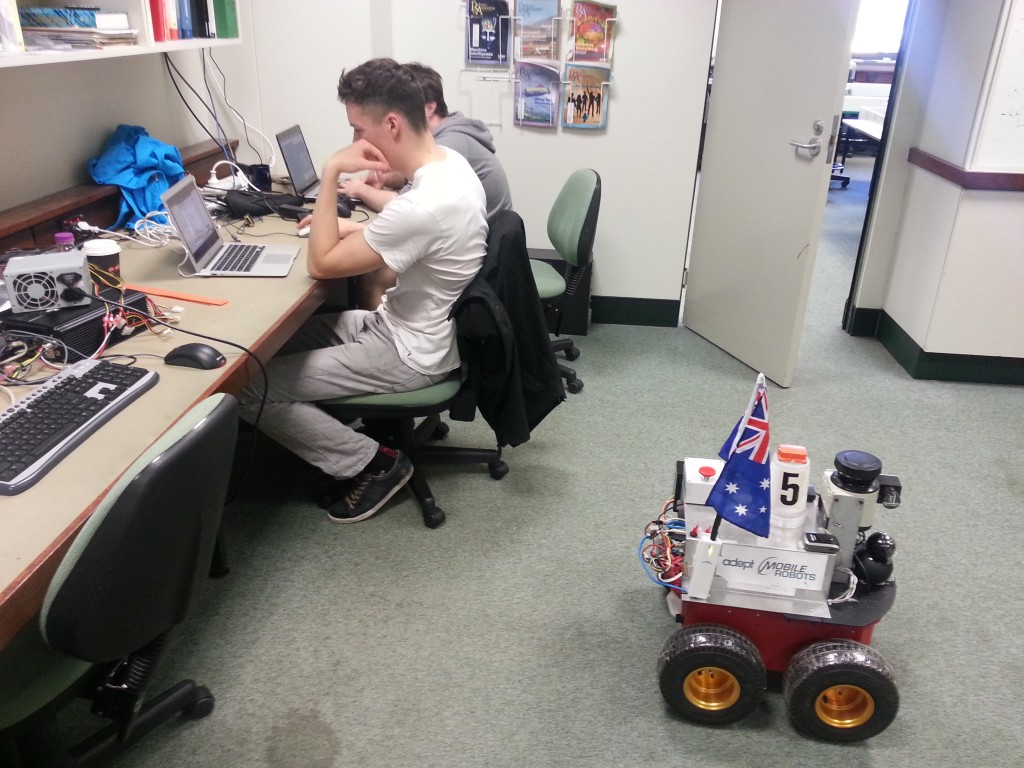
Calum is a mechatronics student working towards his final year project. He tells us about his work on the new UWA Wambot robot including an upgrade in software that now uses ROS (Robot Operating System) to coordinate sensors for SLAM (Simultaneous localization and Mapping). Their final aim is to have a swarm of these cooperate to build maps of an environment.

Links:


tags: ,


Podcast team The ROBOTS Podcast brings you the latest news and views in robotics through its bi-weekly interviews with leaders in the field.

            AUAI is supported by:


Subscribe to Robohub newsletter on substack


Related posts :

How to teach the same skill to different robots

  11 May 2026
A new framework to teach a skill to robots with different mechanical designs, allowing them to carry out the same task without rewriting code for each.

Robot Talk Episode 155 – Making aerial robots smarter, with Melissa Greeff

  08 May 2026
In the latest episode of the Robot Talk podcast, Claire chatted to Melissa Greeff from Queen's University about autonomous navigation and learning for drones.

New understanding of insect flight points way to stable flapping-wing robots

  07 May 2026
The way bugs and birds flap their wings may look effortless, but the dynamics that keep them aloft are dizzyingly complex and difficult to quantify.

Robotically assembled building blocks could make construction more efficient and sustainable

  05 May 2026
Research suggests constructing a simple building from interlocking subunits should be mechanically feasible and have a much smaller carbon footprint.

Robot Talk Episode 154 – Visual navigation in insects and robots, with Andrew Philippides

  01 May 2026
In the latest episode of the Robot Talk podcast, Claire chatted to Andrew Philippides from the University of Sussex about what we can learn from ants and bees to improve robot navigation.

Ultralightweight sonar plus AI lets tiny drones navigate like bats

  29 Apr 2026
Researchers develop ultrasound-based perception system inspired by bat echolocation.

Gradient-based planning for world models at longer horizons

  28 Apr 2026
What were the problems that motivated this project and what was the approach to address them?

Robot Talk Episode 153 – Origami-inspired robots, with Chenying Liu

  24 Apr 2026
In the latest episode of the Robot Talk podcast, Claire chatted to Chenying Liu from University of Oxford about how a robot's physical form can actively contribute to sensing, processing, decision-making, and movement.


AUAI is supported by:


Subscribe to Robohub newsletter on substack


©2026.02 - Association for the Understanding of Artificial Intelligence