
Robohub.org
What artificial intelligence will look like in 2030

Artificial intelligence (AI) has already transformed our lives — from the autonomous cars on the roads to the robotic vacuums and smart thermostats in our homes. Over the next 15 years, AI technologies will continue to make inroads in nearly every area of our lives, from education to entertainment, health care to security.
The question is, are we ready? Do we have the answers to the legal and ethical quandaries that will certainly arise from the increasing integration of AI into our daily lives? Are we even asking the right questions?
Now, a panel of academics and industry thinkers has looked ahead to 2030 to forecast how advances in AI might affect life in a typical North American city and spark discussion about how to ensure the safe, fair, and beneficial development of these rapidly developing technologies.
“Artificial Intelligence and Life in 2030” is the first product of the One Hundred Year Study on Artificial Intelligence (AI100), an ongoing project hosted by Stanford University to inform debate and provide guidance on the ethical development of smart software, sensors, and machines. Every five years for the next 100 years, the AI100 project will release a report that evaluates the status of AI technologies and their potential impact on the world.
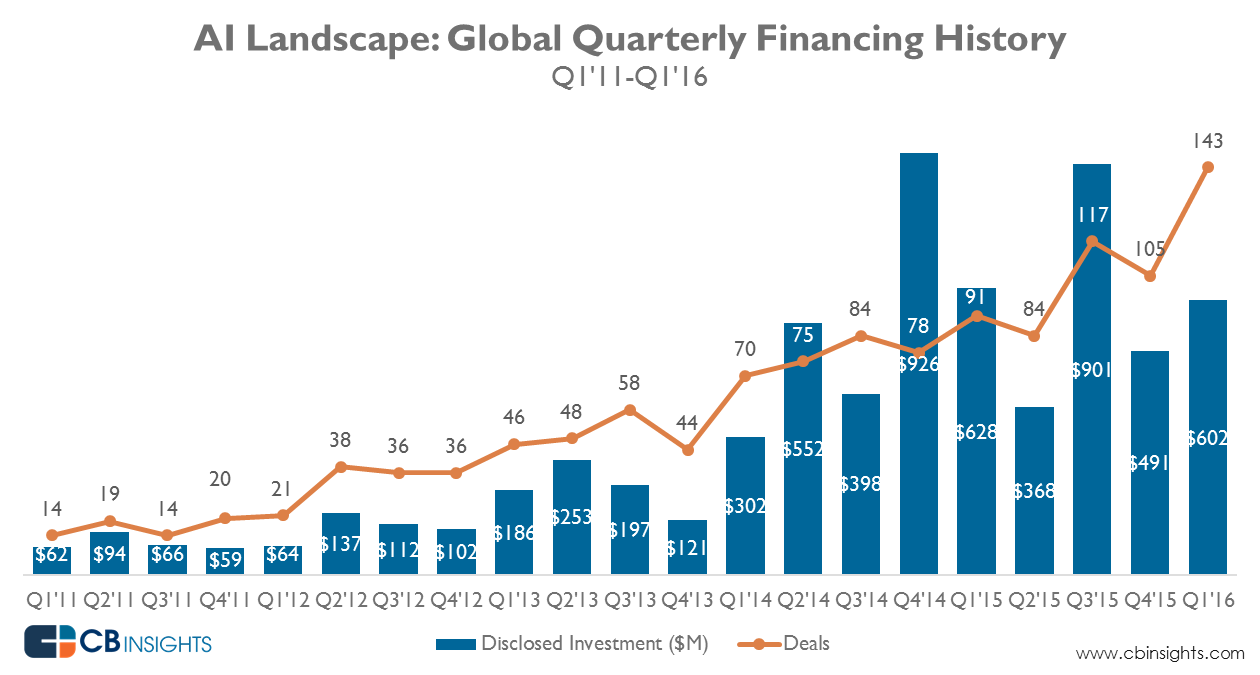
Credit: CB Insights
Barbara Grosz, Higgins Professor of Natural Sciences at the Harvard John A. Paulson School of Engineering and Applied Sciences, chairs the AI100 Standing Committee.
“Now is the time to consider the design, ethical, and policy challenges that AI technologies raise,” said Grosz. “If we tackle these issues now and take them seriously, we will have systems that are better designed in the future and more appropriate policies to guide their use.”
“We believe specialized AI applications will become both increasingly common and more useful by 2030, improving our economy and quality of life,” said Peter Stone, a computer scientist at the University of Texas, Austin, and chair of the report. “But this technology will also create profound challenges, affecting jobs and incomes and other issues that we should begin addressing now to ensure that the benefits of AI are broadly shared.”
The report investigates eight areas of human activity in which AI technologies are already affecting urban life and will be even more pervasive by 2030: transportation, home/service robots, health care, education, entertainment, low-resource communities, public safety and security, employment, and the workplace.
Some of the biggest challenges in the next 15 years will be creating safe and reliable hardware for autonomous cars and health care robots; gaining public trust for AI systems, especially in low-resource communities; and overcoming fears that the technology will marginalize humans in the workplace.
Issues of liability and accountability also arise with questions such as: Who is responsible when a self-driven car crashes or an intelligent medical device fails? How can we prevent AI applications from being used for racial discrimination or financial cheating?
The report doesn’t offer solutions but rather is intended to start a conversation between scientists, ethicists, policymakers, industry leaders, and the general public.
Grosz said she hopes the AI 100 report “initiates a century-long conversation about ways AI-enhanced technologies might be shaped to improve life and societies.
This article is published in collaboration with Harvard Gazette and World Economic Forum.
If you liked this article, you may also want to read:
- Taking measure of artificial intelligence and the Turing Test
- Artificial intelligence expedites breast cancer risk prediction
- How cooperative behaviour could make artificial intelligence more human
- Artificial intelligence could transform healthcare, but we need to accept it first
- Why football, not chess, is the true final frontier for robotic artificial intelligence
See all the latest robotics news on Robohub, or sign up for our weekly newsletter.
tags: AI, Artificial Intelligence, c-Politics-Law-Society, robotics, World Economic Forum


AUAI is supported by:









