Robohub.org
 

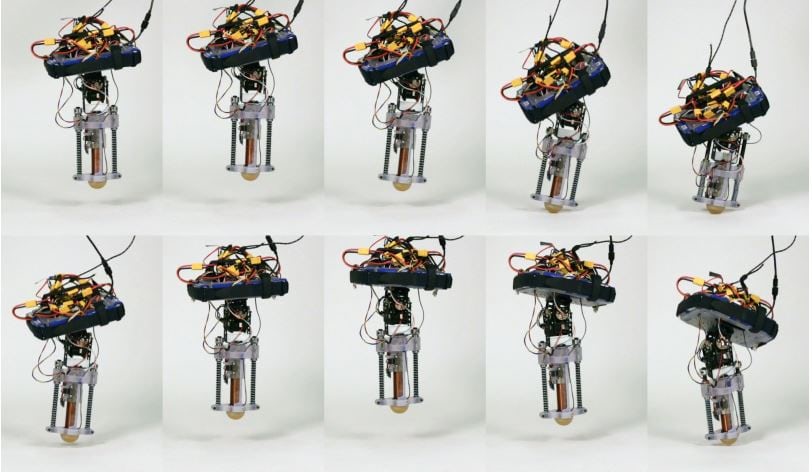
Disney’s one-legged untethered hopping robot

by
12 October 2016


share this:
The Disney hopping robot in action (Credit: Disney Research)

The Disney hopping robot in action (Credit: Disney Research)

Disney Research presents their design and control for an untethered, energetically autonomous single-legged hopping robot. While this isn’t the first hopping robot to be built, it is the first not to rely on a tether or external power source for its hopping.

From their website:

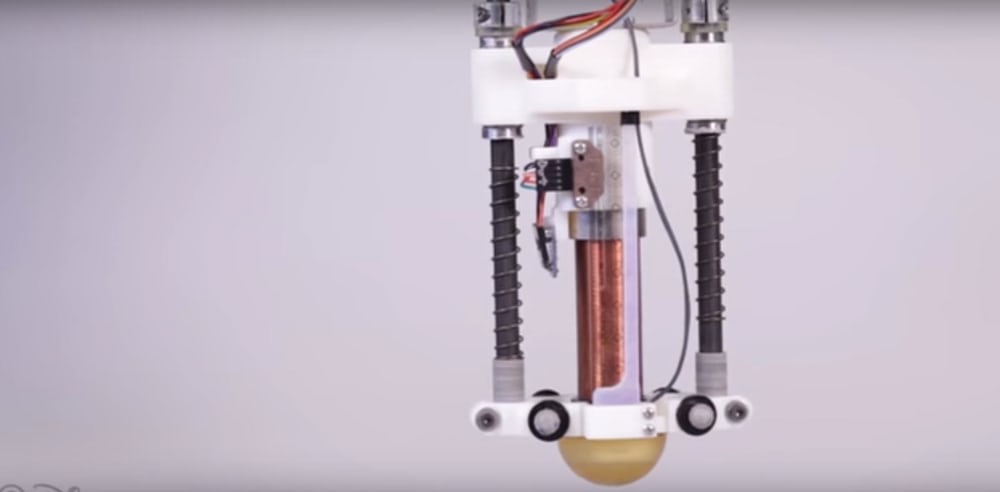
“The thrust-producing mechanism of the robot’s leg is an actuated prismatic joint, called a linear elastic actuator in parallel (LEAP). The LEAP mechanism comprises of a voice-coil actuator in parallel with two compression springs, which gives our robot passive compliance. An actuated gimbal hip joint is realized by two standard servomotors.”
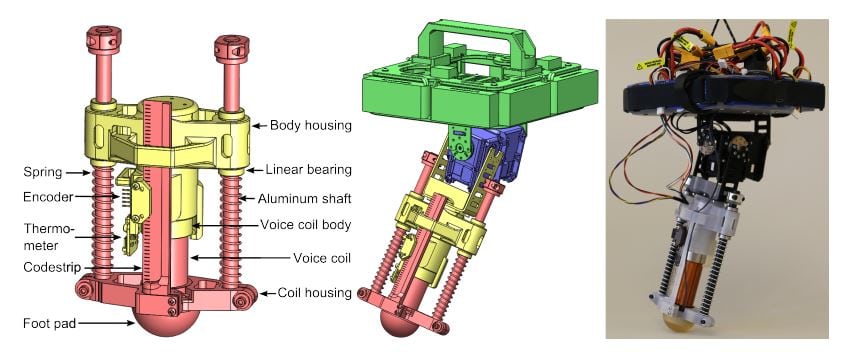
Diagram of the Disney hopping robot (Credit: Disney Research)

Diagram of the Disney hopping robot (Credit: Disney Research)

The researchers adapted a Raibert’s hopping controller to control the robot and found it could maintain balance in place for up to 7 seconds, or 19 hops, while continuously hopping.

Here are a few more pictures of the hopping robot:
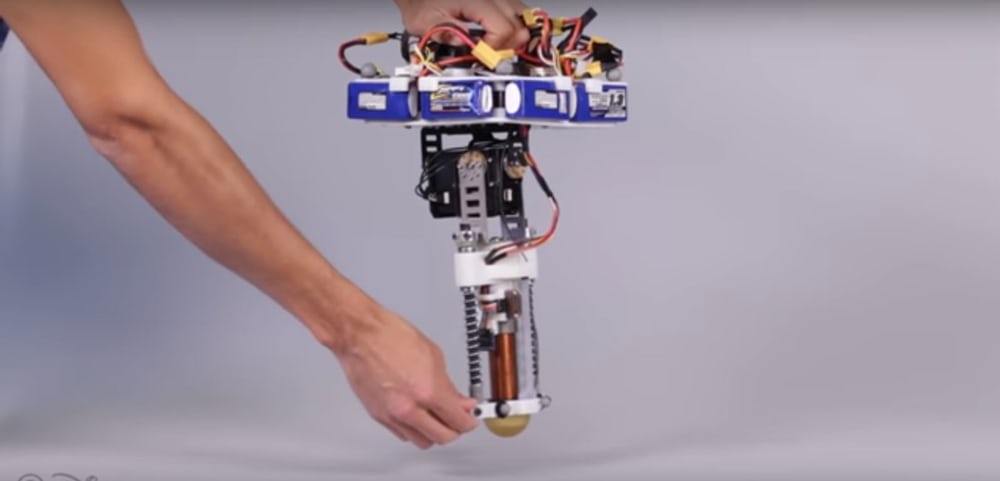
The Disney hopping robot is the first built since 2007 (Credit: Disney Research)
The Disney hopping robot is the first built since 2007 (Credit: Disney Research)

Robot's leg (Credit: Disney Research)

Robot’s leg (Credit: Disney Research)
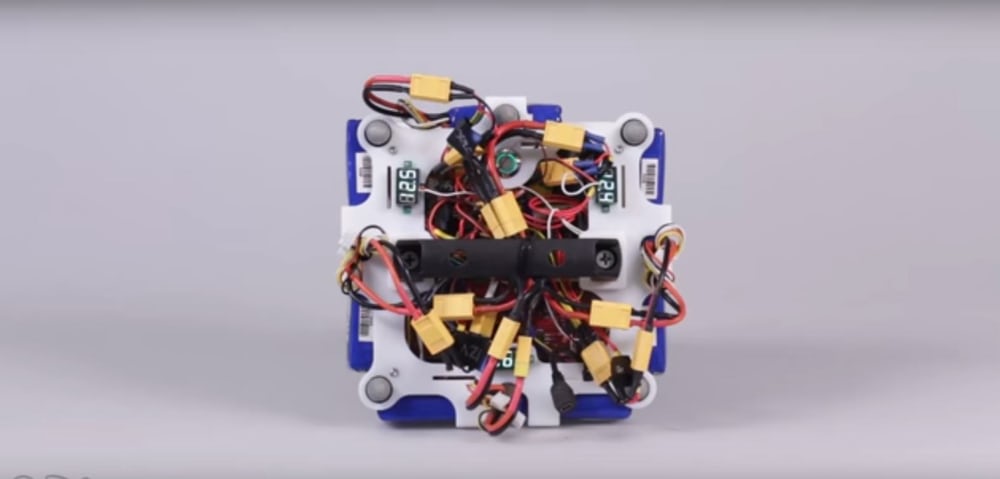
Robot's control unit (Credit: Disney Research)

Robot’s control unit (Credit: Disney Research)

Download the paper here or visit the Disney Research website.


If you liked this article, you may also want to read:

See all the latest robotics news on Robohub, or sign up for our weekly newsletter.


tags:


Robohub Editors


Subscribe to Robohub newsletter on substack


Related posts :

Robot Talk Episode 149 – Robot safety and security, with Krystal Mattich

  20 Mar 2026
In the latest episode of the Robot Talk podcast, Claire chatted to Krystal Mattich from Brain Corp about trustworthy autonomous robots in public spaces.

A multi-armed robot for assisting with agricultural tasks

  18 Mar 2026
How can a robot safely manipulate branches to reveal hidden flowers while remaining aware of interaction forces and minimizing damage?

Graphene-based sensor to improve robot touch

  16 Mar 2026
Multiscale-structured miniaturized 3D force sensors for improved robot touch.

Robot Talk Episode 148 – Ethical robot behaviour, with Alan Winfield

  13 Mar 2026
In the latest episode of the Robot Talk podcast, Claire chatted to Alan Winfield from the University of the West of England about developing new standards for ethics and transparency in robotics.

Coding for underwater robotics

  12 Mar 2026
Lincoln Laboratory intern Ivy Mahncke developed and tested algorithms to help human divers and robots navigate underwater.

Restoring surgeons’ sense of touch with robotic fingertips

  10 Mar 2026
Researchers are developing robotic “fingertips” that could give surgeons back their sense of touch during minimally invasive and robotic operations.

Robot Talk Episode 147 – Miniature living robots, with Maria Guix

  06 Mar 2026
In the latest episode of the Robot Talk podcast, Claire chatted to Maria Guix from the University of Barcelona about combining electronics and biology to create biohybrid robots with emergent properties.

Developing an optical tactile sensor for tracking head motion during radiotherapy: an interview with Bhoomika Gandhi

  05 Mar 2026
Bhoomika Gandhi discusses her work on an optical sensor for medical robotics applications.


Robohub is supported by:


Subscribe to Robohub newsletter on substack


©2026.02 - Association for the Understanding of Artificial Intelligence